
Stowmarket in Suffolk, England, United Kingdom — Northwestern Europe (the British Isles)
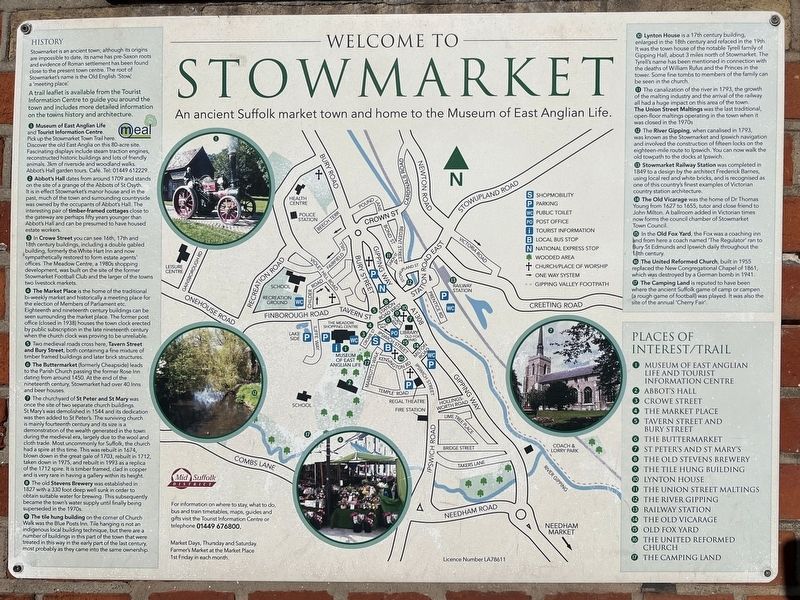
Welcome to Stowmarket
An ancient Suffolk market town and home to the Museum of East Anglian Life
Photographed by Ray Gurganus, April 24, 2026
1. Stowmarket Marker
History
Stowmarket is an ancient town; although its origins are impossible to date, its name has pre-Saxon roots and evidence of Roman settlement has been found close to the present town centre. The root of Stowmarket's name is the Old English 'Stow', a 'meeting place'.
A trail leaflet is available from the Tourist Information Centre to guide you around the town and includes more detailed information on the towns history and architecture.
1. Museum of East Anglian Life and Tourist Information Centre. Pick up the Stowmarket Town Trail here. Discover the old East Anglia on this 80-acre site. Fascinating displays include steam traction engines, reconstructed historic buildings and lots of friendly animals of riverside and woodland walks. Abbots Hall garden tours.
2. Abbot's Hall dates from around 1709 and stands on the site of a grange of the Abbots of St Osyth. It is in effect Stowmarket's manor house and in the past, much of the town and surrounding countryside was owned by the occupants of Abbots Hall. The interesting pair of timber-framed cottages close to the gateway are perhaps fifty years younger than Abbot's
this page online
3. In Crowe Street you can see 16th, 17th and 18th century buildings, including a double gabled building, formerly the White Hart Inn and now sympathetically restored to form estate agents offices. The Meadow Centre, a 1980s shopping development, was built on the site of the former Stowmarket Football Club and the larger of the towns two livestock markets.
4. The Market Place is the home of the traditional bi-weekly market and historically a meeting place for the election of Members of Parliament etc. Eighteenth and nineteenth century buildings can be seen surrounding the market place. The former post office (closed in 1938) houses the town clock erected by public subscription in the late nineteenth century when the church clock was proving to be unreliable.
5. Two medieval roads cross here, Tavern Street and Bury Street, both containing a fine mixture of timber framed buildings and later brick structures.
6. The Buttermarket (formerly Cheapside) leads to the Parish Church passing the former Rose Inn dating from around 1450. At the end of the nineteenth century, Stowmarket

Photographed by JThomas, Geograph Britain and Ireland (via Wikimedia Commons under CC 2.0), September 17, 2015
2. Welcome to Stowmarket Marker - wide view
The marker is visible here just below the window with an arched pediment to the left of the Stowmarket station sign.
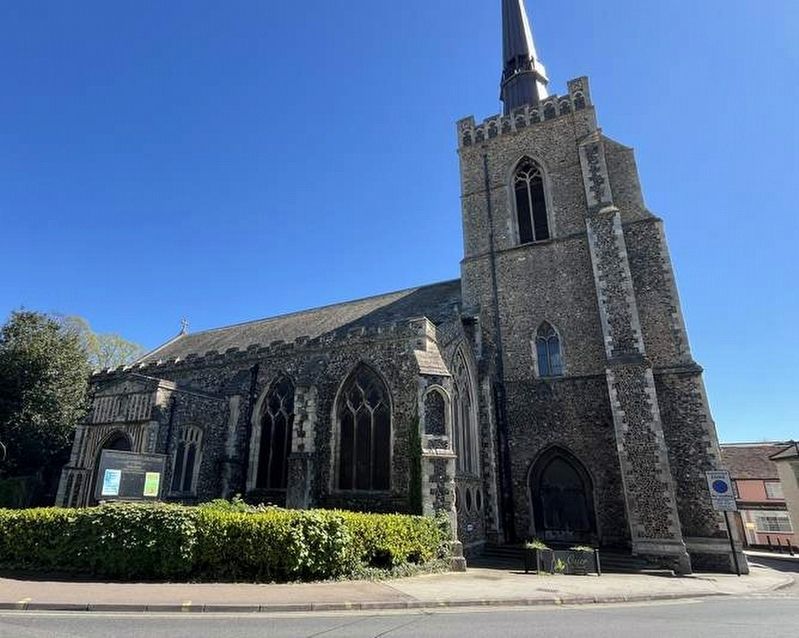
7. The churchyard of St Peter and St Mary was once the site of two separate church buildings. St Mary's was demolished in 1544 and is dedication was then added to St Peters. The surviving church is mainly fourteenth century and its size is a demonstration of the wealth generated in the town during the medieval era, largely due to the wool and cloth trade. Most uncommonly for Suffolk, the church had a spire at this time. This was rebuilt in 1674, blown down in the great gale of 1703, rebuilt in 1712, taken down in 1975, and rebuilt in 1993 as a replica of the 1712 spire. It is timber framed, clad in copper and is very rare in having a gallery within its height.
8. The old Stevens Brewery was established in 1827 with a 330 foot deep well sunk in order to obtain suitable water for brewing. This subsequently became the town's water supply until finally being superseded in the 1970s.
9. The tile hung building on the comer of Church Walk was the Blue Posts Inn. Tile hanging is not an indigenous local building technique, but there are a number of buildings in this part of the town that were treated
Photographed by Ray Gurganus, April 24, 2026
3. Church of St Peter and St Mary
10. Lynton House in a 17th century building enlarged in the 18th century and refaced in the 19th. It was the town house of the notable Tyrell family of Gipping Hall, about 3 miles north of Stowmarket. The Tyrell's name has been mentioned in connection with the deaths of William Rufus and the Princes in the tower. Some fine tombs to members of the family can be seen in the church.
11. The canalization of the river in 1793, the growth of the malting industry and the arrival of the railway all had a huge impact on this area of the town. The Union Street Maltings was the last traditional open-floor maltings operating in the town when it was closed in the 1970s.
12. The River Gipping, when canalised in 1793 was known as the Stowmarket and Ipswich navigation involved the construction of fifteen locks on the eighteen-mile route to Ipswich. You can now walk the old towpath to the docks at Ipswich.
13. Stowmarket Railway Station was completed in 1849 to a design by the architect Frederick Barnes, using local red and white bricks, and is recognised as one of this country's finest examples of Victorian country station architecture.
14. The Old Vicarage was the home of Dr Thomas Young from 1627 to 1655, tutor and close friend to John Milton. A ballroom added in Victorian time now forms the council chamber of Stowmarket Town Council.
15. In the Old Fox Yard, the Fox was a coaching inn from here a coach named 'The Regulator' ran to Bury St Edmunds and Ipswich daily throughout the 18th century.
16. The United Reformed Church, built in 1955, replaced the New Congregational Chapel of 1861, which was destroyed by a German bomb in 1941.
17. The Camping Land is reputed to have been where the ancient Suffolk game of camp or campen (a rough game of football) was played. It was also the site of the annual 'Cherry Fair'.
Topics. This historical marker is listed in these topic lists: Industry & Commerce • Settlements & Settlers.
Location. 52° 11.385′ N, 0° 59.994′ E. Marker is in Stowmarket, England, in Suffolk. It is on Station Road East. The marker is attached to the front of the railway station. Touch for map. Marker is at or near this postal address: 81 Station Rd E, Stowmarket, England IP14 1EL, United Kingdom. Touch for directions.

Regionally, this marker is in England’s East Anglia. Globally, it is on the Atlantic Ocean, in the North Atlantic Region, in Europe, in Atlantic Europe, on one of the British Isles, in the Western World, and in the Anglosphere. Historically, it finds itself in what was once the Roman Empire.
Other nearby markers. At least 7 other markers are within 19 kilometers of this marker, measured as the crow flies: In Grateful Memory (approx. 17 kilometers away); Dr. Kurt Erich Glauber (approx. 17.9 kilometers away); Mary Whitmore, MBE (approx. 18 kilometers away); Ipswich (approx. 18.3 kilometers away); Gipeswic (approx. 18.4 kilometers away); Ipswich Almshouses (approx. 18.5 kilometers away); Ipswich Blackfriars (approx. 18.5 kilometers away).
Credits. This page was last revised on July 10, 2026. It was originally submitted on July 10, 2026, by Ray Gurganus of Washington, District of Columbia. This page has been viewed 9 times since then. Photos: 1. submitted on July 10, 2026, by Ray Gurganus of Washington, District of Columbia. 2. submitted on July 10, 2026. 3. submitted on July 10, 2026, by Ray Gurganus of Washington, District of Columbia. • Andrew Ruppenstein was the editor who published this page.
