Downtown in Boise in Ada County, Idaho — The American West (Mountains)
Assay Office
Photographed by Douglass Halvorsen, July 4, 2026
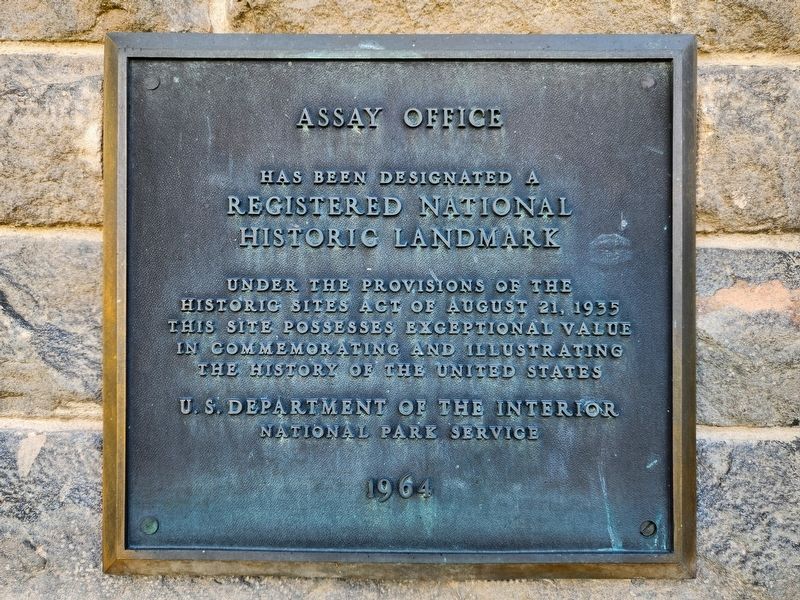
1. Assay Office Marker
Registered National Historic Landmark
Under the Provisions of the
Historic Sites Act of August 21, 1935
This Site Possesses Exceptional Value
In Commemorating and Illustrating
the History of the United States
U.S. Department of the Interior
National Park Service
1964
Erected 1964 by U.S. Department of the Interior, National Park Service.
Topics and series. This historical marker is listed in this topic list: Industry & Commerce. In addition, it is included in the National Historic Landmarks series list. A significant historical date for this entry is August 21, 1935.
Location. 43° 36.76′ N, 116° 11.803′ W. Marker is in Boise, Idaho, in Ada County. It is in Downtown. It is on West Main Street. Touch for map. Marker is at or near this postal address: 210 W Main Street, Boise ID 83702, United States of America. Touch for directions.

Regionally, this marker is on the Snake River Plain. It is also in the American Mountain West. Globally, it is in North America, the Western Hemisphere, the Western World, and the Anglosphere.
Other nearby markers. At least 8 other markers are within walking
this page online
More about this marker. The marker is located just to the left of the main entrance.
Also see . . .
1. Assay Office. An excellent background of the history of this building.
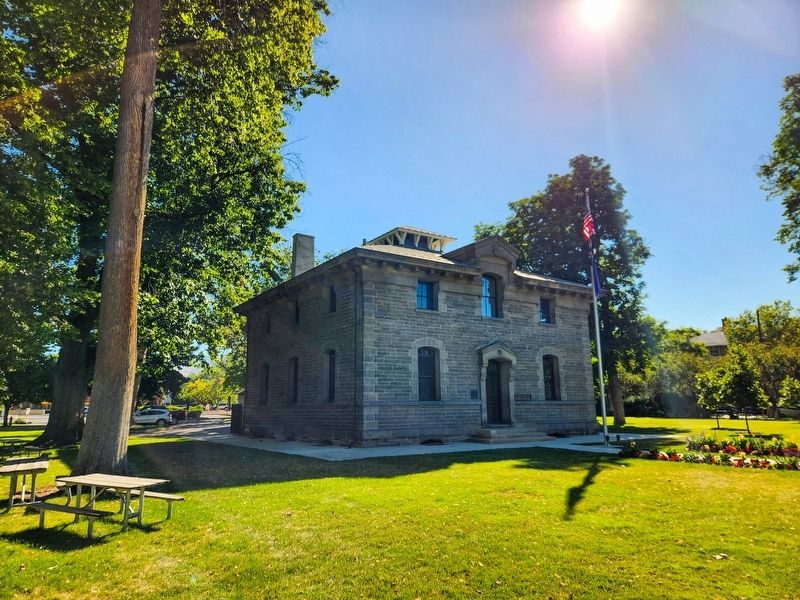
The Federal Assay Office, built in Boise, Idaho in 1871 was one of only seven offices in the country. The architect, Alfred B. Mullet was commissioned by the U.S. Congress to design the building. The style has been called “Italian Villa,” “French Chateau,” and/or “Provincial.”(Submitted on July 10, 2026, by Douglass Halvorsen of Klamath Falls, Oregon.)
Mullet constructed the office on a large parcel of land donated by a Boisean,Alexander Rossi, for the project. An assay office is the location miners would bring their gold to in order to have it separated from the invaluable rock. It would also be “assayed” for value, and stamped with a hallmark.Photographed by Douglass Halvorsen, July 4, 20262. Assay Office Marker
Naturally, the building contained heavy equipment for such purposes. The floor plan while in operation consisted of main operations downstairs, living quarters for the Chief Assayer and his family on the top floor, and rooms for the help, guards, and geothermal in the basement. The outside of the building demonstrates the main function of the building: security. Because over one and a half million dollars were deposited a year, the windows were barred, and the walls were built of local sandstone two feet thick! After the gold rush died down in the Idaho territory, the office was closed in 1933. The government then donated it to the Forest Service, which used the building as offices, and the grounds as a city park.
Evidence of this park still remains, as the small building located directly behind the offices still resembles the public restrooms it once held. During this time the Forrest Service also proposed arenovation which would have added wings to the building, diminishing the historical value. The building is now inhabited by SHPO, the State Historic Preservation Office after being turned over in 1972. The old Assay Office is significant to Idaho history because its exterior is so well preserved. It is also indicative of the impact mining had on the life of Idahoans in the late nineteenth and early twentieth centuries. This has lead to the building being recognized as a national landmark! Idaho has 10 national landmarks, only 3 of which are buildings.Photographed by Douglass Halvorsen, July 4, 20263. Assay Office Marker
Additionally, modern inhabitants say that the history has been commemorated in another way as well, in the form of miner ghost. A cleaning lady reported seeing the miner clad in a plaid shirt and boots late at night several years ago, and SHPO workers who stay late often hear the mysterious sound of mining boots in the building.

2. Idaho NHL Assay Office. National Register of Historic Places Inventory-Nomination Form, 1980, Statement of Significance:
Erected by the United States Government in 1870-71,(Submitted on July 10, 2026, by Douglass Halvorsen of Klamath Falls, Oregon.)the Boise Assay Office was the most important example of public architecture in Idaho until the 20th century. The building is a symbol of the importance of mining in the political, social, economic and legal development of Idaho and the Far West, and also bears testimony to Federal encouragement of mining in that territory.Photographed by Douglass Halvorsen, July 4, 20264. Assay Office Marker
The discovery of gold on the Clearwater River by Captain Elias Davidson Pierce in 1860, brought a rush of miners to northern Idaho in 1861. This strike was followed by the opening of new placer mines, on the Salmon River in 1862, and then in the Boise Basin in 1863. Considerable rushes followed both of these discoveries. With a population of some 20,656 miners, Idaho was established as a territory on March 4, 1863.
These Idaho placer mines were at first exceedingly rich. Between 1861 and 1866, Idaho's gold output totaled somewhere between $42,000,000 and $52,000,000, or about 19% of the United States total production during this period. This yield placed Idaho third, after California and Nevada, in gold production during the 1861-66 period.
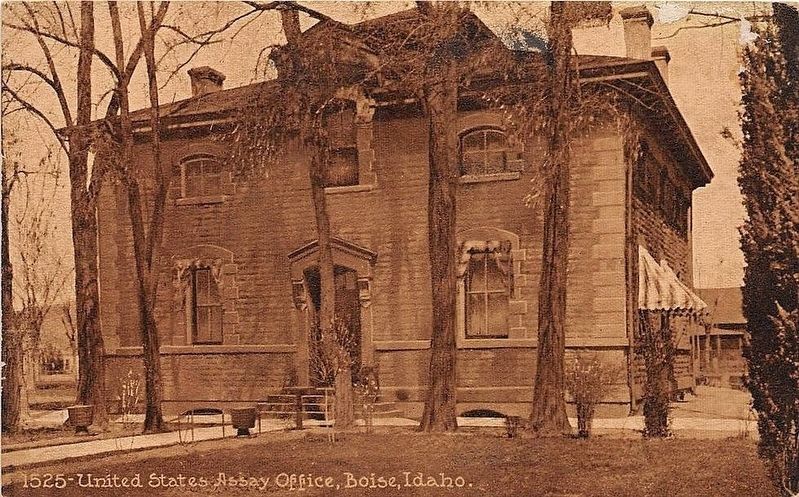
The Idaho miners, however, were isolated by great distances andmountains from the rest of the country, and they therefore found it difficult to dispose of their products except at heavy cost. As a result, as early as 1864 there was a strong demand for a Federal mint or assay office in Idaho. By an Act approved February 19, 1869, Congress responded and appropriated $75,000 to erect a U.S. Assay Office in Boise.Photographed by Wikimedia Commons5. Assay Office, 1910
Plans and specifications for the building were drawn up under the direction of Alfred B. Mullet, Supervising Architect of the Treasury Department and construction began in July 1870. The new Assay Office was substantially completed by June 1871, but a delay in the receipt of the machinery prevented the first assay from being made until March 2, 1872.
By this date, the rich surface placers had been largely worked out and Idaho gold production underwent a considerable slump until 1883, when reports of gold led to a rush to the Coeur d'Alene region of northern Idaho. Gold production doubled in 1884. The transcontinental railroads, together with considerable amounts of Eastern and San Francisco capital, reached Idaho in 1887. Deep mine shafts were sunk to reach the quartz veins, stamp mills and smelters were erected, and new mines, producing silver and lead, were opened.
By 1895 deposits in the U.S. Assay Office at Boise reached more than one million dollars for the year, and for the next 11 years these averaged one and one-half million dollars annually. By 1917 the Idaho mines had yielded a total of $400,000,000 in minerals: one-quarter in gold, one-quarter in silver, and one-half in lead.
The Assay Office continued its operations until June 30, 1933, when it was turned over to the U.S. Forest Service as headquarters for the Boise National Forest. In 1970 the Forest Service vacated the building which is currently maintained by the Idaho Historical Society as a musuem.

Credits. This page was last revised on July 10, 2026. It was originally submitted on July 10, 2026, by Douglass Halvorsen of Klamath Falls, Oregon. This page has been viewed 21 times since then. Photos: 1, 2, 3, 4, 5. submitted on July 10, 2026, by Douglass Halvorsen of Klamath Falls, Oregon. • Andrew Ruppenstein was the editor who published this page.
