Naval Station Norfolk , Virginia — The American South (Mid-Atlantic)
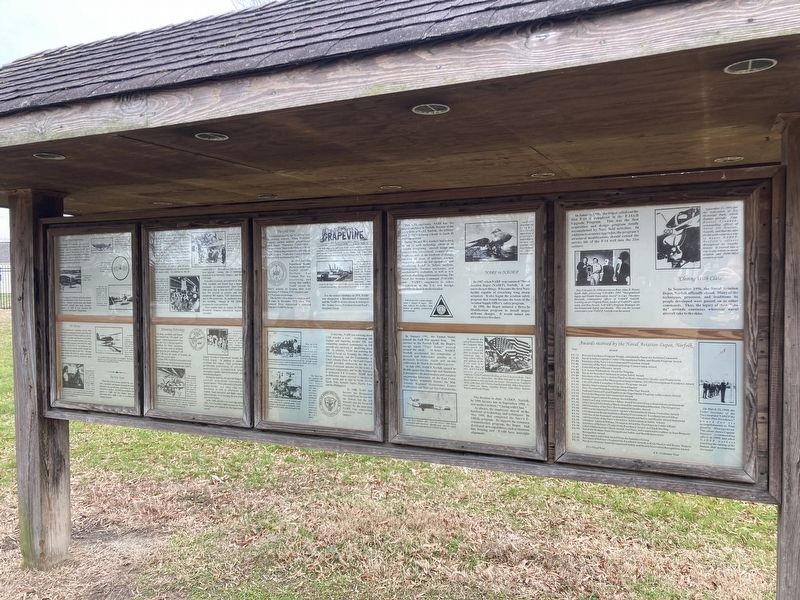
History of Naval Air Depot, Norfolk
February 10, 2024
1. History of Naval Air Station and Naval Air Depot, Norfolk Marker
From These Beginnings
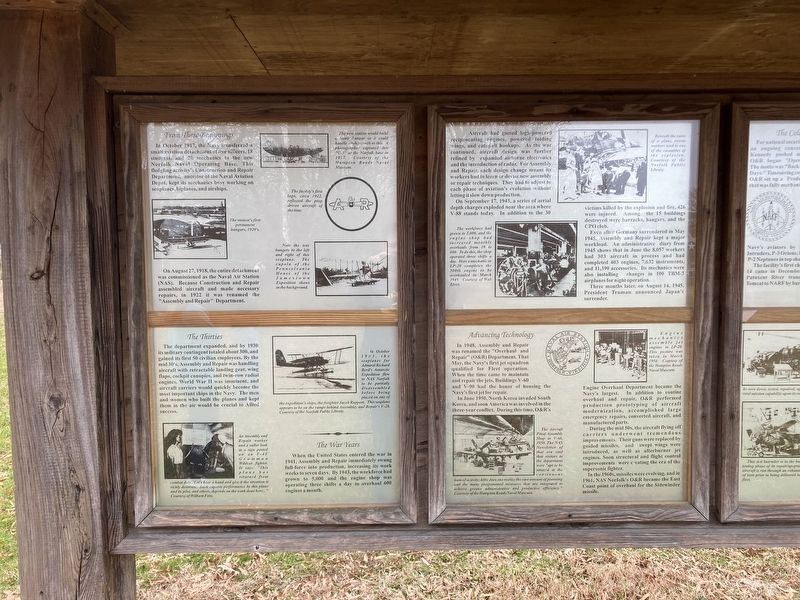
In October 1917, the Navy transferred a small aviation detachment of five officers, 18 students, and 20 mechanics to the new Norfolk Naval Operating Base. This fledgling activity's Construction and Repair Department, ancestor of the Naval Aviation Depot, kept its mechanics busy working on seaplanes, biplanes, and airships.
Photo Caption: The station's first permanent hangars, 1920's.
On August 27, 1918, the entire detachment was commissioned as the Naval Air Station (NAS). Because Construction and Repair assembled aircraft and made necessary repairs, in 1922 it was renamed the "Assembly and Repair" Department.
Graphic Captions:
The new station would build a blimp hangar so it could handle airships such as this. A photographer captures this "C-3" at the Norfolk base in 1917. Courtesy of the Hampton Roads Naval Museum.
The facility's first logo, circa 1922, reflected the prop driven aircraft of the time.
Note the tent hangars to the left and right of this seaplane. The cupola of the Pennsylvania House of the Jamestown Exposition shows in the background.
The Thirties
The department
this page online
Photo Caption: In October 1933, the seaplanes for Admiral Richard Byrd's Antarctic Expedition flew to NAS Norfolk to be partially disassembled before being placed on one of the expedition's ships, the freighter Jacob Ruppert. This seaplane appears to be on the ramps behind Assembley and Repair's V-28. Courtesy of the Norfolk Public Libraty.
The War Years
When the United States entered the war in 1941, Assembly and Repair immediately swung full-force into production, increasing its work weeks to seven days. By 1943, the workforce had grown to 5,000 and the engine shop was operating three shifts a day to overhaul 600 engines a month.
Photo Caption: An Assembly and Repair worker and a sailor look at a sign posted on an F-4F Grumman Wildcat fighter. It says: "This plane has returned from combat duty...Let's bear a hand and give it the attention it richly deserves. Such capable performance by this plane and its pilot, and others, depends on the work done here..." Courtesy of William Foss.
Aircraft
2024
2. History of Naval Air Depot, Norfolk Marker
Leftmost Panel
On September 17, 1943, a series of aerial depth charges exploded near the area where V-88 stands today. In addition to the 30 victims killed by the explosion and fire, 426 were injured. Among the 15 buildings destroyed were barracks, hangars, and the CPO club.
Even after Germany surrendered in May 1945, Assembly and Repair kept a major workload. An administrative diary from 1945 shows that in June the 8,057 workers had 303 aircraft in process and had completed 403 engines, 7,362 instruments, and 11,390 accessories. Its mechanics were also installing changes in 100 TBM-3 airplanes for night operation.
Three months later, on August 14, 1945, President Truman announced Japan's surrender.
Photo Captions:
Beneath the ruins of a plane, rescue workers tend to one of the casualties of the explosion. Courtesy of the Norfolk Public Library.
The workforce had grown to 5,000, and the engine shop had increased monthly overhauls from 19 to 600. To do this, the shop operated three shifts a day. Here a mechanic in LP-20 completes the 500th engine to be overhauled in March 1945. Courtesy of Walt Elver.
Advancing Technology
In
2024
3. History of Naval Air Depot, Norfolk Marker
Center Panel
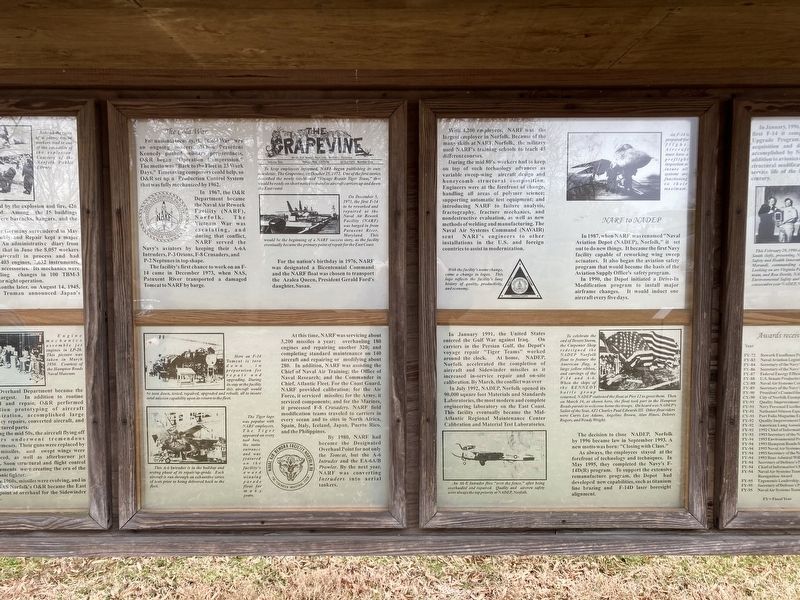
In June 1950, North Korea invaded South Korea, and soon America was involved in the three-year conflict. During this time, O&R's Engine Overhaul Department became the Navy's largest. In addition to routine overhaul and repair, O&R performed production prototyping of aircraft modernization, accomplished large emergency repairs, converted aircraft, and manufactured parts.
During the mid 50s, the aircraft flying off carriers underwent tremendous improvements. Their guns were replaced by guided missiles, and swept wings were introduced, as well as afterburner jet engines. Soon structural and flight control improvements were creating the era of the supersonic fighter.
In the 1960s, missiles were evolving, and in 1961, NAS Norfolk's O&R became the East Coast point of overhaul for the Sidewinder missile.
Photo Captions:
The Aircraft Final Assembly Shop in V-60, 1950. The NAS Newsletter of that era said that visitors to the department were "apt to be amazed at the continuous hum of activity; little does one realize the vast amount of planning and the many programmed measures that are integrated to achieve greater administrative and productive efficiency." Courtesy of the Hampton Roads Naval Museum.
Engine mechanics assemble jet engines in LP-20. This picture was taken in March 1950. Courtesy of the Hampton Roads Naval Museum.
The Cold War
For
2024
4. History of Naval Air Depot, Norfolk Marker
Rightmost Panel
In 1967, the O&R Department became the Naval Air Rework Facility (NARF), Norfolk. The Vietnam War was escalating, and during that conflict, NARF served the Navy's aviators by keeping their A-6A Intruders, P-3 Orions, F-8 Crusaders, and P-2 Neptunes in top shape.
The facility's first chance to work on an F-14 came in December 1973, when NAS, Patuxent River transported a damaged Tomcat to NARF by barge.
For the nation's birthday in 1976, NARF was designated a Bicentennial Command and the NARF float was chosen to transport the Azalea Queen, President Gerald Ford's daughter, Susan.
Graphic Captions:
To keep employees informed, NARF began publishing its own newsletter, The Grapevine, on October 25, 1972. One of the first stories described the newly established "Voyage Repair Tiger Team," that would be ready on short notice to travel to aircraft carriers up and down the East Coast.
On December 5, 1973, the first F-14 to be reworked and repaired at the Naval Air Rework Facility (NARF) was barged in from Patuxent River, Maryland. This would be the beginning of a NARF success story, as the facility eventually became the primary point of repair for the East Coast.
At this time, NARF was servicing about 3,200 missiles a year; overhauling 180 engines and repairing another 320; and completing standard maintenance on 140 aircraft and repairing or modifying about 280. In addition, NARF was assisting the Chief of Naval Air Training; the Office of Naval Research; and the Commander in Chief, Atlantic Fleet. For the Coast Guard, NARF provided calibration; for the Air Force, it serviced missiles; for the Army, it serviced components; and for the Marines, it processed F-8 Crusaders. NARF field modification teams traveled to carriers in every ocean and to sites in North Africa, Spain, Italy, Iceland, Japan, Puerto Rico, and the Philippines.
By 1980, NARF had become the Designated Overhaul Point for not only the Tomcat, but the A-6 Intruder and the EA-6A/B Prowler. By the next year, NARF was converting Intruders into aerial tankers.
Graphic Captions:
Here an F-14 Tomcat is torn down and preparation for repair and upgrading. During its stay at the facility this aircraft would be torn down, tested, repaired, upgraded and rebuilt, all to insure total mission capability upon its return to the fleet.
This A-6 Intruder is in the buildup and testing phase of its repair/up-grade. Each aircraft is run through an exhaustive series of tests prior to being delivered back to the fleet.
The Tier logo was popular with NARF employees. The Tiger appeared on every tool box, the main entrance and was featured on the facility's award winning parade float for many years.
With 4,200 employee, NARF was the largest employer in Norfolk. Because of the many skills at NARF, Norfolk, the military used NARF's training schools to teach 45 different courses.
During the mid 80's, workers had to keep on top of such technology advances as variable sweep-wing aircraft design and honeycomb structural composition. Engineers were at the forefront of change, handling all areas of polymer science; supporting automatic test equipment; and introducing NARF to failure analysis, fractography, fracture mechanics, and nondestructive evaluation, as well as new methods of welding and manufacturing. The Naval Air Systems Command (NAVAIR) sent NARF's engineers to other installations in the U.S. and foreign countries to assist in modernization.
Photo Caption: An F-14 is prepared for flight. Aircraft must have a preflight inspection to insure all systems are functioning to their maximum.
NARF to NADEP
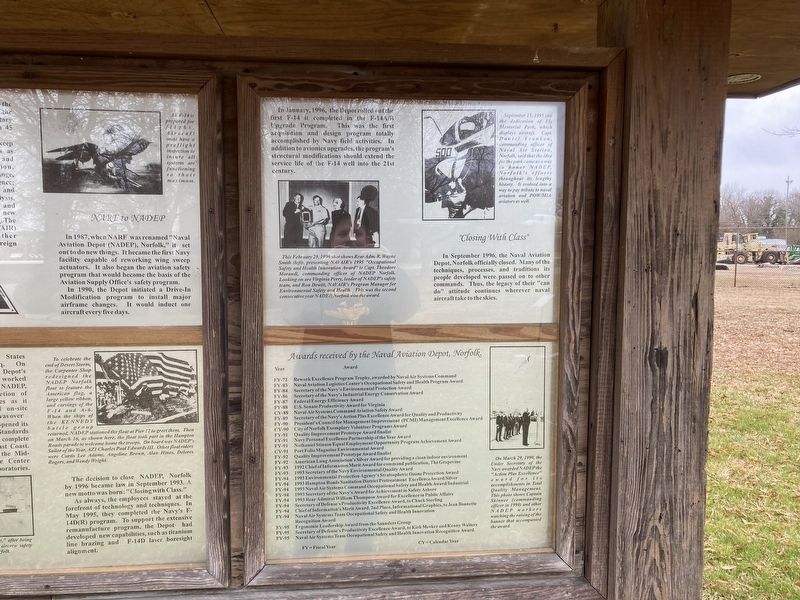
In 1987, when NARF was renamed "Naval Aviation Depot (NADEP), Norfolk," it set out to do new things. It became the first Navy facility capable of reworking wing sweep actuators. It also began the aviation safety program that would become the basis of the Aviation Supply Office's safety program.
In 1990, the Depot initiated a Drive-In Modification program to install major airframe changes. It would induct one aircraft every five days.
Graphic Caption: With the facility's name change, came a change in logos. This logo reflects the facility's long history of quality, productivity, and economy.
In January 1991, the United States entered the Gulf War against Iraq. On carriers in the Persian Gulf, the Depot's voyage repair "Tiger Teams" worked around the clock. At home, NADEP, Norfolk accelerated the completion of aircraft and Sidewinder missiles as it increased in-service repair and on-site calibration. By March, the conflict was over
In July 1992, NADEP, Norfolk opened its 90,000 square foot Materials and Standards Laboratories, the most modern and complete engineering laboratory on the East Coast. This facility eventually became the Mid-Atlantic Regional Maintenance Center Calibration and Material Test Laboratories.
Photo Captions:
To celebrate the end of Desert Storm, the Carpenter Shop redesigned the NADEP Norfolk float to feature the American flag, a large yellow ribbon, and carvings of the F-14 and A-6. When the ships of the KENNEDY battle group returned, NADEP stationed the float at Pier 12 to greet them. Then on March 16, as shown here, the float took part in the Hampton Roads parade to welcome home the troops. On board was NADEP's Sailor of the Year, AZ1 Charles Paul Edwards III. Other float riders were Curtis Lee Adams, Angeline Brown, Alan Hines, Delores Rogers, and Wendy Wright.
An A-6E Intruder flies "over the fence," after being overhauled and repaired. Quality and aircrew safety were always the top priority at NADEP, Norfolk.
The decision to close NADEP, Norfolk by 1996 became law in September 1993. A new motto was born: "Closing with Class."
As always, the employees stayed at the forefront of technology and techniques. In May 1995, they completed the Navy's F-14D(R) program. To support the extensive remanufacture program, the Depot had developed new capabilities, such as titanium line brazing and F-14D laser boresight alignment.
In January, 1996, the Depot rolled out the first F-14 it completed in the F-14A/B Upgrade Program. This was the first acquisition and design program totally accomplished by Navy field activities. In addition to avionics upgrades, the program's structural modifications should extend the service life of the F-14 well into the 21st century.
Photo Captions:
This february 29, 1996 shot shows Rear Adm. R. Wayne Smith (left), presenting NAVAIR's 1995 "Occupational Safety and Health Innovation Award" to Capt. Theodore Morandi, commanding officer of NADEP Norfolk. Looking on are Virginia Perry, leader of NADEP's safety team, and Ron Dewitt, NAVAIR's Program Manager for Environmental Safety and Health. This was the second consecutive year NADEP, Norfolk won the award.
September 15, 1995 saw the dedication of Ely Memorial Park, which displays aircraft. Capt. Daniel Franken, commanding officer of Naval Air Station, Norfolk, said the idea for the park came as a way to honor NADEP, Norfolk's efforts throughout its lengthy history. It evolved into a way to pay tribute to naval aviation and POW/MIA aviators as well.
"Closing With Class"
In September 1996, the Naval Aviation Depot, Norfolk officially closed. Many of the techniques, processes, and traditions its people developed were passed on to other commands. Thus, the legacy of their "can do" attitude continues wherever naval aircraft take to the skies.
Awards Received by the Naval Aviation Depot, Norfolk
FY-72 Rework Excellence Program Trophy, awarded by Naval Air Systems Command
FY-83 Naval Aviation Logistics Center's Occupational Safety and Health Program Award
FY-86 Secretary of the Navy's Industrial Energy Conservation Award
FY-87 Federal Energy Efficiency Award
FY-88 U.S. Senate Productivity Award for Virginia
CY-88 Naval Air Systems Command Aviation Safety Award
FY-89 Secretary of the Navy's action Plus Excellence Award for Quality and Productivity
FY-90 President's Council for Management Improvement (PCMI) Management Excellence Award
CY-90 City of Norfolk Exemplary Volunteer Programs Award
FY-91 Quality Improvement Prototype Award finalist
FY-91 Navy Personal Excellence Partnership of the Year Award
FY-91 Nathaniel Stinson Equal Employment Opportunity Program Achievement Award
CY-91 Port Folio Magazine Environmental Award
FY-92 Quality Improvement Prototype Award finalist
FY-92 American Lunch Association's Silver Award for providing a clean indoor environment
FY-93 1992 Chief of Information Merit Award for command publication, The Grapevine
FY-93 1993 Secretary of the Navy Environmental Quality Award
FY-94 1993 Environmental Protection Agency's Stratospheric Ozone Protection award
FY-94 1993 Hampton Roads Sanitation District Pretreatment Excellence Award/Silver
FY-94 1993 Naval Air Systems Command Occupational Safety and Health Award/Industrial
FY-94 1993 Secretary of the Navy's Award for Achievement in Safety Ashore
FY-94 1993 Rear Admiral William Thompson Award for Excellence in Public Affairs
FY-94 Secretary of Defense's Productivity Excellence Award, to Chuck Sterling
FY-94 Chief of Information's Merit Award, 2nd Place, Informational Graphics, to Jean Bonnette
FY-94 Naval Air Systems Team Occupational Safety and Health Innovation Award
FY-95 Ergonomic Leadership Award from the Saunders Group
FY-95 Secretary of Defense's Productivity Excellence Award, to Kirk Meeker and Kenny Walters
FY-95 Naval Air Systems Team Occupational Safety and Health Innovation Recognition Award
FY=Fiscal Year
CY=Calendar Year
Photo Caption: On March 29, 1990, the Under Secretary of the Navy awarded NADEP the "Action Plus Excellence" award for its accomplishments in Total Quality Management. This photo shows Captain Skinner (commanding officer in 1990) and other NADEP workers watching the raising of the banner that accompanied the award.
Topics. This historical marker is listed in these topic lists: Air & Space • War, Vietnam • War, World I • War, World II. A significant historical month for this entry is October 1917.
Location. 36° 56.685′ N, 76° 16.418′ W. Marker is in Norfolk, Virginia. It is in Naval Station Norfolk. It is on Bellinger Boulevard 0.1 miles east of B Street, on the left when traveling west. Marker is at Ely Memorial Park on board Naval Station Norfolk. A DoD identification card is required to access the installation. Touch for map. Marker is in this post office area: Norfolk VA 23511, United States of America. Touch for directions.

Regionally, this marker is in Virginia’s Hampton Roads, specifically in Coastal Virginia, and in the Hampton Roads Metropolitan Area. It is also in the American South, specifically in the Upper South, in the Tidewater, and on the Eastern Seaboard. Globally, it is in the North Atlantic Region, North America, the Western Hemisphere, the Western World, and the Anglosphere. Historically, it finds itself in what was once the territory of the Mississippian Culture, one of the original Thirteen Colonies, one of the Confederate States of America, and the Antebellum South.
Other nearby markers. At least 8 other markers are within walking distance of this marker: Grumman F-14 Tomcat (a few steps from this marker); Grumman A-6E Intruder (a few steps from this marker); Bell HH-1K (UH-1) Huey (within shouting distance of this marker); Naval Air Station Norfolk (within shouting distance of this marker); Sikorsky SH-3H Sea King (within shouting distance of this marker); Kaman SH-2F Seasprite (within shouting distance of this marker); Grumman E-2C Hawkeye (within shouting distance of this marker); Boeing Vertol CH-46A Sea Knight (within shouting distance of this marker). Touch for a list and map of all markers in Norfolk.
Credits. This page was last revised on July 13, 2026. It was originally submitted on July 11, 2026. This page has been viewed 21 times since then. Photos: 1, 2, 3, 4. submitted on July 11, 2026. • Bernard Fisher was the editor who published this page.
