
North City in Dublin, County Dublin, Ireland — (Éire) North Atlantic Ocean (the British Isles)
Nelson and the Spire
⎯⎯⎯
Nelson agus an Túr Solais
| — | The Dubline / Dublin Discovery Trail | — |
Photographed by Ian Lefkowitz, May 18, 2026
1. Nelson and the Spire side of marker

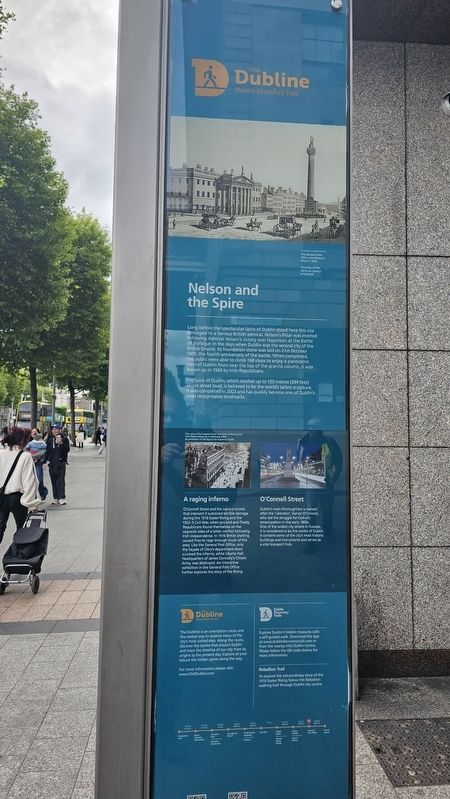
Nelson and the Spire
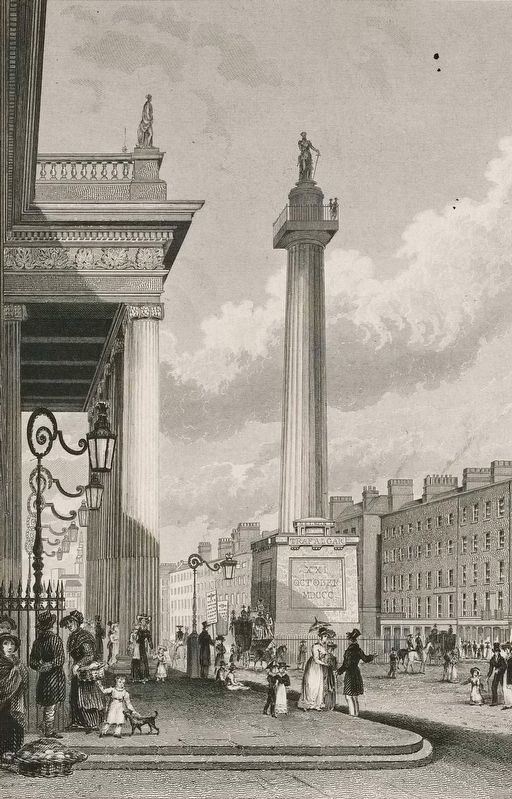
Long before the spectacular Spire of Dublin stood here this site belonged to a famous British admiral. Nelson’s Pillar was erected following Admiral Nelson’s victory over Napoleon at the Battle of Trafalgar in the days when Dublin was the second city of the British Empire. Its foundation stone was laid on 21st October 1809, the fourth anniversary of the battle. When completed, the public were able to climb 168 steps to enjoy a panoramic view of Dublin from near the top of the granite column. It was blown up in 1966 by Irish Republicans.
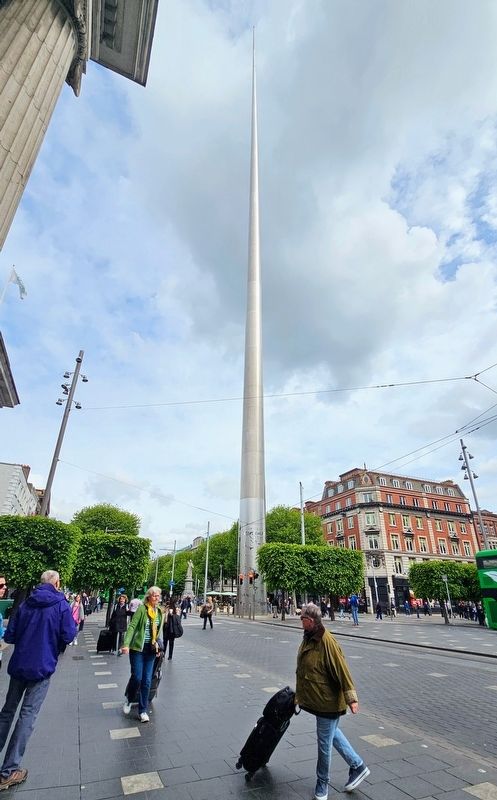
The Spire of Dublin, which reaches up to 120 metres (394 feet) above street level, is believed to be the world’s tallest sculpture. It was completed in 2003 and has quickly become one of Dublin’s most recognisable landmarks.
A Raging Inferno
O’Connell Street and the various streets that intersect it sustained terrible damage during the 1916 Easter Rising and the 1922–3 Civil War, when pro and anti-Treaty Republicans found themselves on the opposite sides of a bitter conflict following Irish independence. In 1916 British shelling caused fires to rage through much of the area. Like the General Post Office, only the façade of Clery’s department store survived the inferno, while Liberty Hall, headquarters of James Connolly’s Citizen Army, was destroyed. An interactive exhibition in the General Post Office further explores the story of the Rising.
O’Connell Street
Dublin’s main thoroughfare is named after the ‘Liberator’, Daniel O’Connell, who led the struggle for Catholic emancipation in the early 1800s. One of the widest city streets in Europe, it is considered to be the centre of Dublin. It contains some of the city’s most historic buildings and monuments and serves as a vital transport hub.
(Captions)
The General Post Office and Nelson’s Pillar in 1820. Courtesy of the National Library of Ireland.
The ruins of the Imperial Hotel and Clery’s following the 1916 Easter Rising, by TJ Westropp MRIA. By permission of the Royal Irish Academy. © RIA.
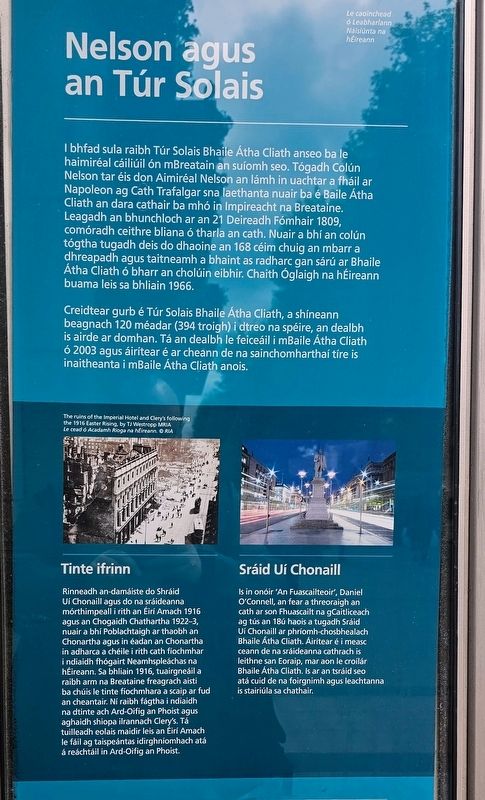
Nelson agus an Túr Solais
I bhfad sula raibh Túr Solais Bhaile Átha Cliath anseo ba le haimiréal cáiliúil ón mBreatain an suíomh seo. Tógadh Colún Nelson tar éis don Aimiréal Nelson an lámh in uachtar a fháil ar Napoleon ag Cath Trafalgar sna laethanta nuair ba é Baile Átha Cliath an dara cathair ba mhó in Impireacht na Breataine. Leagadh an bhunchloch ar an 21 Deireadh Fómhair 1809, comóradh ceithre bliana ó tharla an cath. Nuair a bhí an colún tógtha tugadh deis do dhaoine an 168 céim chuig an mbarr a dhreapadh agus taitneamh a bhaint as radharc gan sárú ar Bhaile Átha Cliath ó bharr an cholúin eibhir. Chaith Óglaigh na hÉireann buama leis sa bhliain 1966.
Creidtear gurb é Túr Solais Bhaile Átha Cliath, a shíneann beagnach 120 méadar (394 troigh) i dtreo na spéire, an dealbh is airde ar domhan. Tá an dealbh le feiceáil i mBaile Átha Cliath ó 2003 agus áirítear é ar cheann de na sainchomharthaí tíre is inaitheanta i mBaile Átha Cliath anois.
Tinte Ifrinn
Rinneadh an-damáiste do Shráid Uí Chonaill agus do na sráideanna mórthimpeall i rith an Éirí Amach 1916 agus an Chogaidh Chathartha 1922–3, nuair a bhí Poblachtaigh ar thaobh an Chonartha agus in éadan an Chonartha in adharca a chéile i rith cath fiochmhar i ndiaidh fhógairt Neamhspleáchas na hÉireann. Sa bhliain 1916, tuairgnéail a raibh arm na Breataine freagrach aisti ba chúis le tinte fiochmhara a scaip ar fud an cheantair. Ní raibh fágtha i ndiaidh na dtinte ach Ard-Oifig an Phoist agus aghaidh shiopa ilrannach Clery’s. Tá tuilleadh eolais maidir leis an Éirí Amach le fáil ag taispeántas idirghníomhach atá á reáchtáil in Ard-Oifig an Phoist.
Sráid Uí Chonaill
Is in onóir ‘An Fuascailteoir’, Daniel O’Connell, an fear a threoraigh an cath ar son Fhuascailt na gCaitliceach ag tús an 18ú haois a tugadh Sráid Uí Chonaill ar phríomh-chosbhealach Bhaile Átha Cliath. Áirítear é i measc ceann de na sráideanna cathrach is leithne san Eoraip, mar aon le croílár Bhaile Átha Cliath. Is ar an tsráid seo atá cuid de na foirgnimh agus leachtanna is stairiúla sa chathair.
Topics.
this page online
Location. 53° 20.941′ N, 6° 15.617′ W. Marker is in Dublin, County Dublin. It is in North City. It is at the intersection of O'Connell Street Upper and Prince's Street North, on the left when traveling north on O'Connell Street Upper. Touch for map. Marker is at or near this postal address: 39 O'Connell Street Upper, Dublin, County Dublin D01 PY90, Ireland. Touch for directions.

Regionally, it is on the Atlantic Ocean, in the North Atlantic Region, in Europe, on the Island of Ireland, on the Celtic Fringe, in the European Union, in Atlantic Europe, on one of the British Isles, in the Western World, and in the Anglosphere. Historically, it finds itself in what was once a British colony.
Other nearby markers. At least 8 other markers are within walking distance of this marker: A different marker also named Nelson and the Spire / Nelson agus an Túr Solais (here, next to this marker in Leinster); Jim Larkin (within shouting distance of this marker in Leinster); Sir John Gray, Kn[igh]t. MD. JP. (within
Photographed by Ian Lefkowitz, May 18, 2026
2. Nelson agus an Túr Solais side of marker

Photographed by Ian Lefkowitz, May 18, 2026
3. Nelson and the Spire / Nelson agus an Túr Solais Marker
This Dubline stop is located near Penney's on O'Connell Street.
Photographed by Ian Lefkowitz, May 18, 2026
4. The Dublin Spire
Fisher, H. Son and Co; George Petrie; R. Winkles, Public domain, via Wikimedia Commons
5. Nelson's Pillar, 1829
Credits. This page was last revised on July 12, 2026. It was originally submitted on July 12, 2026, by Ian Lefkowitz of New York, New York. This page has been viewed 6 times since then. Photos: 1, 2, 3, 4, 5. submitted on July 12, 2026, by Ian Lefkowitz of New York, New York. • Andrew Ruppenstein was the editor who published this page.
