Hohenschwangau in Schwangau in Ostallgäu, Bavaria, Germany — Central Europe
Schloss Neuschwanstein
Photographed by James Hulse, February 24, 2024
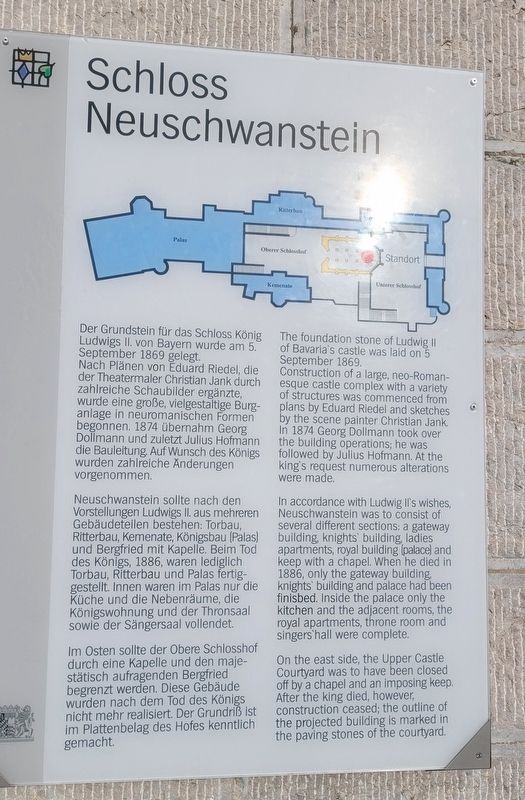
1. Schloss Neuschwanstein Marker

Der Grundstein für das Schloss König Ludwigs II. von Bayern wurde am 5. September 1869 gelegt. Nach Plänen von Eduard Riedel, die der Theatermaler Christian Jank durch zahlreiche Schaubilder ergänzte, wurde eine große, vielgestaltige Burganlage in neuromanischen Formen begonnen. 1874 übernahm Georg Dollmann und zuletzt Julius Hofmann die Bauleitung. Auf Wunsch des Königs wurden zahlreiche Änderungen vorgenommen.
Neuschwanstein sollte nach den Vorstellungen Ludwigs II. aus mehreren Gebäudeteilen bestehen: Torbau, Ritterbau, Kemenate, Königsbau (Palas) und Bergfried mit Kapelle. Beim Tod des Königs, 1886, waren lediglich Torbau, Ritterbau und Palas fertiggestellt. Innen waren im Palas nur die Küche und die Nebenräume, die Königswohnung und der Thronsaal sowie der Sängersaal vollendet.
Im Osten sollte der Obere Schlosshof durch eine Kapelle und den majestätisch aufragenden Bergfried begrenzt werden. Diese Gebäude wurden nach dem Tod des Königs nicht mehr realisiert. Der Grundriß ist im Plattenbelag des Hofes kenntlich gemacht.
[Auf Englisch:]
In accordance with Ludwig II's wishes, Neuschwanstein was to consist of several different sections: a gateway building, knights' building, ladies apartments, royal building (palace) and keep with a chapel. When he died in 1886, only the gateway building, knights' building and palace had been finished. Inside the palace only the kitchen
this page online
On the east side, the Upper Castle Courtyard was to have been closed off by a chapel and an imposing keep. After the king died, however, construction ceased; the outline of the projected building is marked in the paving stones of the courtyard.
Topics. This historical marker is listed in this topic list: Forts and Castles. A significant historical date for this entry is September 5, 1869.
Location. 47° 33.484′ N, 10° 44.998′ E. Marker is in Schwangau, Bayern (Bavaria), in Ostallgäu. It is in Hohenschwangau. It can be reached from Neuschwansteinstraße just east of Alpseestraße, on the left when traveling south. Touch for map. Marker is at or near this postal address: Neuschwansteinstraße 20, Schwangau BY 87645, Germany. Touch for directions.

Regionally, this marker is in German Swabia, in the Allgäu, and on the Romantic Road. Globally, it is in Europe, the European Union, Atlantic Europe, Central Europe, the Schengen Area, Western Europe, and the Western World. Historically, it finds itself in what was once the Roman Empire, the Holy Roman Empire,
Photographed by James Hulse, February 24, 2024
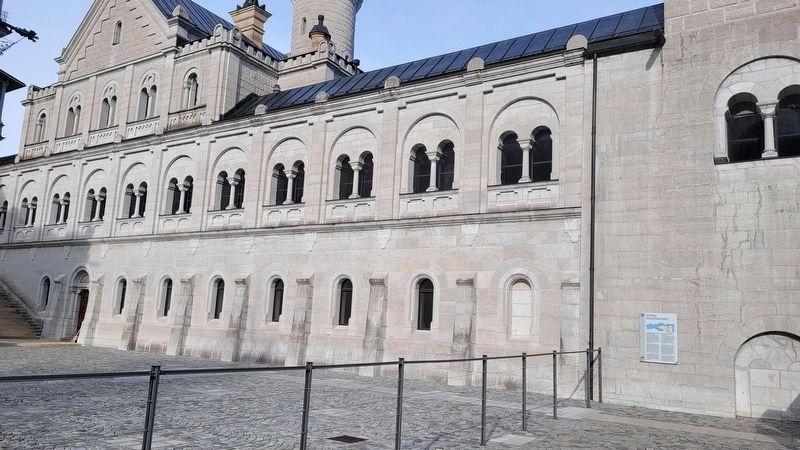
2. The Schloss Neuschwanstein Marker is located at the far right of the upper courtyard
Other nearby markers. At least 8 other markers are within 5 kilometers of this marker, measured as the crow flies: Marienbrücke (approx. 0.3 kilometers away); Schloss Hohenschwangau / Hohenschwangau Castle (approx. 0.9 kilometers away); Schloss Neuschwanstein / Neuschwanstein Castle (approx. 0.9 kilometers away); Imperial-Royal Austrian Soldiers Memorial (approx. 3.7 kilometers away); Franziskanerkloster Alter Friedhof St. Sebastian (approx. 3.7 kilometers away); Füssen im Königswinkel • Stadtmauer / Füssen in the King's Corner • City Wall (approx. 3.7 kilometers away); Schrannenplatz mit Kornhaus / The Schrannenplatz with Corn House (approx. 3.9 kilometers away); Hier wohnten die Geigenmacher / The Violin Makers Lived Here (approx. 3.9 kilometers away). Touch for a list and map of all markers in Schwangau.
More about this marker. The marker is located inside the upper courtyard of Schloss Neuschwanstein and there is a small entrance fee to visit the inside sections of the castle.
Also see . . . Neuschwanstein Castle. Wikipedia (Submitted on April 8, 2024, by James Hulse of Medina, Texas.)
Photographed by James Hulse, February 24, 2024
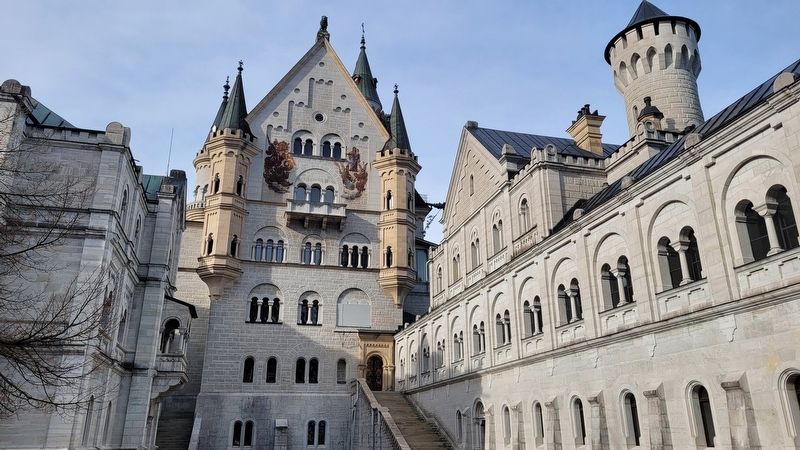
3. The view of the upper courtyard of Schloss Neuschwanstein
The knight's building is located on the right side and the front of the palace is located in the middle of the courtyard.
Photographed by James Hulse, February 24, 2024
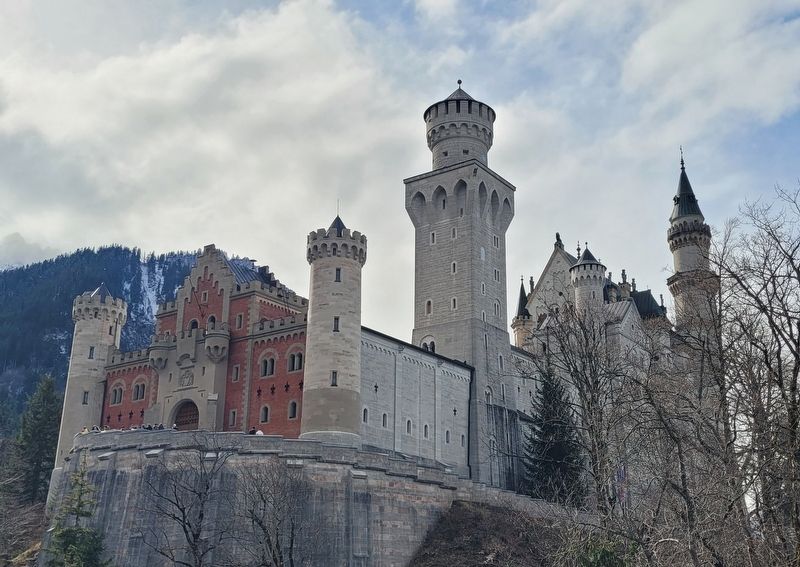
4. Gatehouse of Schloss Neuschwanstein
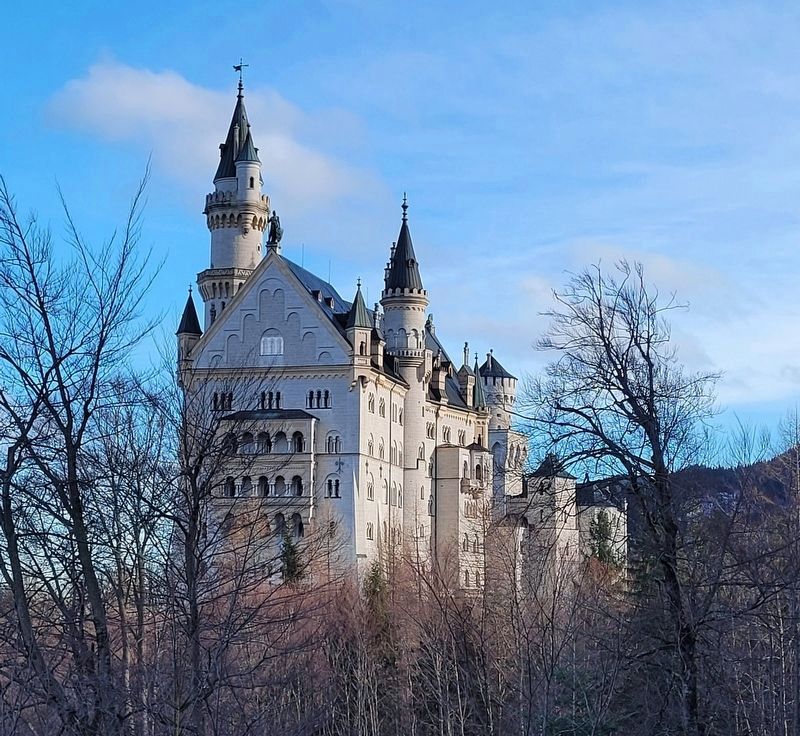
Photographed by James Hulse, February 24, 2024
5. The Palace side of Schloss Neuschwanstein
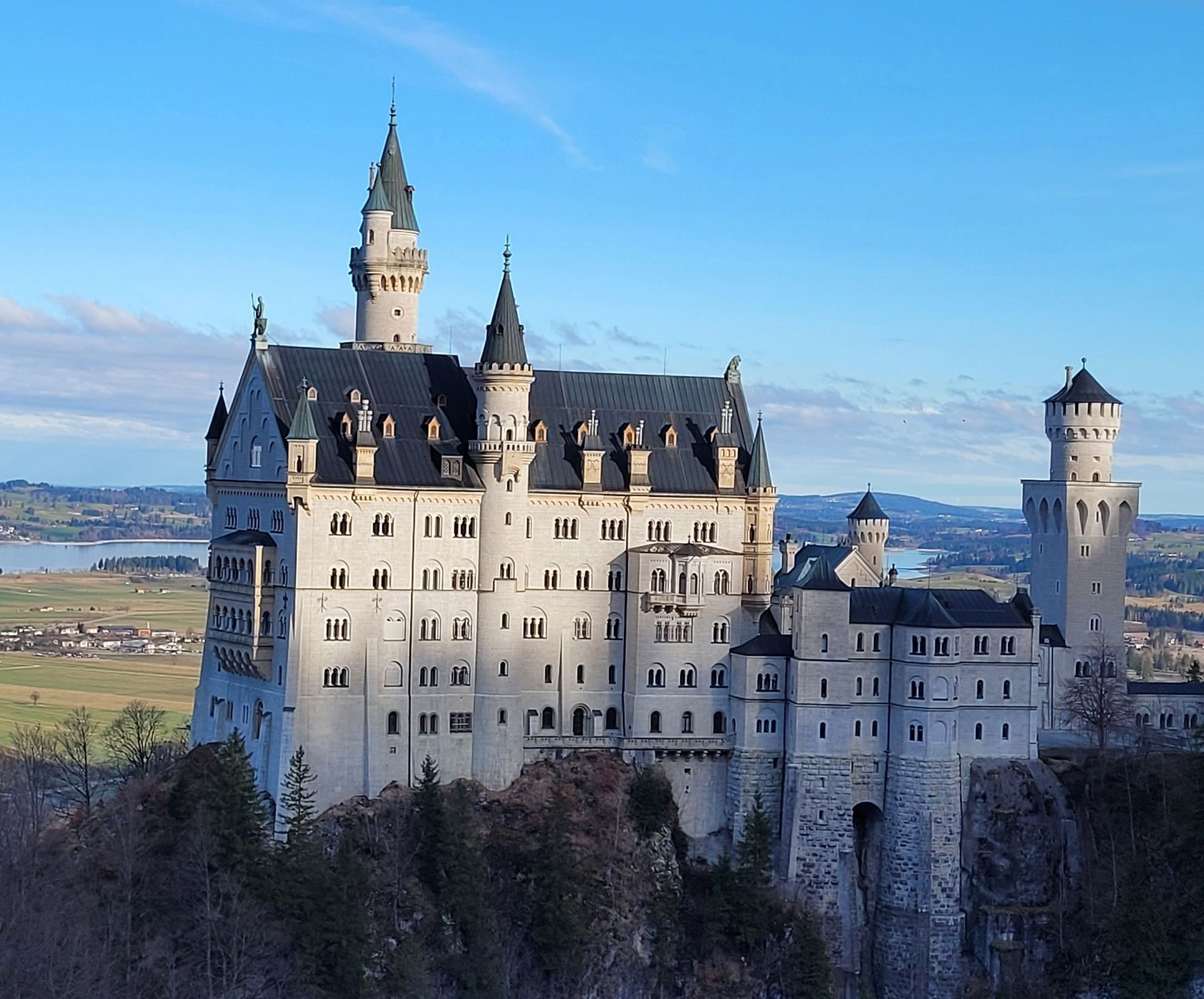
Photographed by James Hulse, February 24, 2024
6. Schloss Neuschwanstein
Credits. This page was last revised on July 14, 2026. It was originally submitted on April 8, 2024, by James Hulse of Medina, Texas. This page has been viewed 345 times since then and 94 times this year. Last updated on July 13, 2026, by Carl Gordon Moore Jr. of North East, Maryland. Photos: 1, 2, 3, 4, 5, 6. submitted on April 8, 2024, by James Hulse of Medina, Texas. • Devry Becker Jones was the editor who published this page.
