Heiloo, North Holland, Netherlands — Northwestern Europe
Onze lieve Vrouwe ter Nood
⎯⎯⎯
Our Lady in Need
Photographed by Andrew Ruppenstein, May 31, 2026
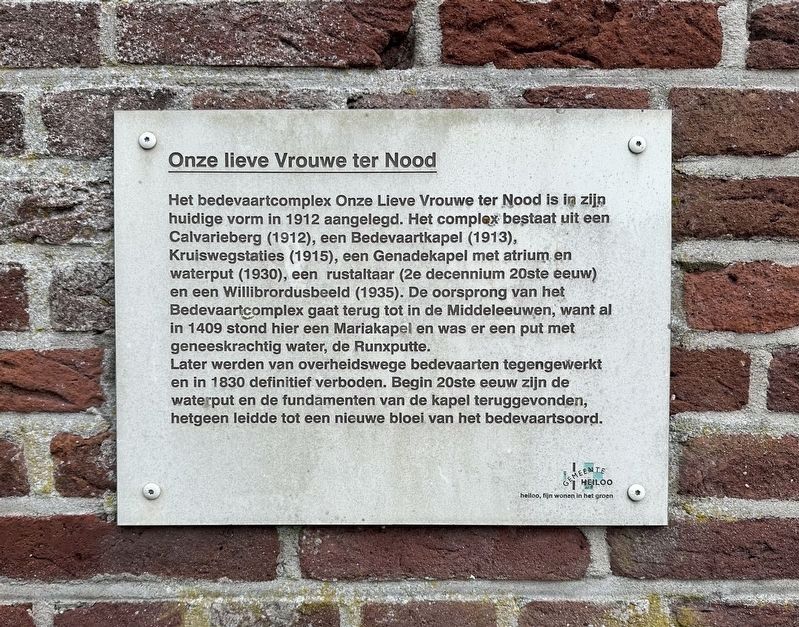
1. Onze lieve Vrouwe ter Nood / Our Lady in Need Marker

Het bedevaartcomplex Onze Lieve Vrouwe ter Nood is in zijn huidige vorm in 1912 aangelegd. Het complex bestaat uit een Calvarieberg (1912), een Bedevaartkapel (1913), Kruiswegstaties (1915), een Genadekapel met atrium en waterput (1930), een rustaltaar (2e decennium 20ste eeuw) en een Willibrordusbeeld (1935). De oorsprong van het Bedevaartcomplex gaat terug tot in de Middeleeuwen, want al in 1409 stond hier een Mariakapel en was er een put met geneeskrachtig water, de Runxputte.
Later werden van overheidswege bedevaarten tegengewerkt en in 1830 definitief verboden. Begin 20ste eeuw zijn de waterput en de fundamenten van de kapel teruggevonden, hetgeen leidde tot een nieuwe bloei van het bedevaartsoord.
“Our Lady in Need” (Onze Lieve Vrouwe ter Nood)
The Our Lady in Need pilgrimage complex was laid out in its current form in 1912. The complex comprises a Calvary (1912), a pilgrimage chapel (1913), Stations of the Cross (1915), a Shrine Chapel with an atrium and well (1930), a rest altar (1910s), and a statue of Saint Willibrord (1935). The origins
this page online
Later, the authorities discouraged pilgrimages, eventually banning them outright in 1830. In the early 20th century, the well and the chapel's foundations were rediscovered, leading to a revival of the pilgrimage site.
Erected by Gemeente Heiloo.
Topics. This historical marker is listed in this topic list: Religion & Religious Structures. A significant historical year for this entry is 1912.
Location. 52° 35.041′ N, 4° 41.204′ E. Marker is in Heiloo, Noord-Holland (North Holland). It is at the intersection of Runxputteweg and Kapellaan, on the right when traveling north on Runxputteweg. Touch for map. Marker is at or near this postal address: Kapellaan 148, Heiloo, Noord-Holland 1851 PE, Netherlands. Touch for directions.

Regionally, it is in Europe, the European Union, Atlantic Europe, the Benelux Low Countries, the Schengen Area, Western Europe, and the Western World. Historically, it finds itself in what was once the Holy Roman
Photographed by Andrew Ruppenstein, May 31, 2026
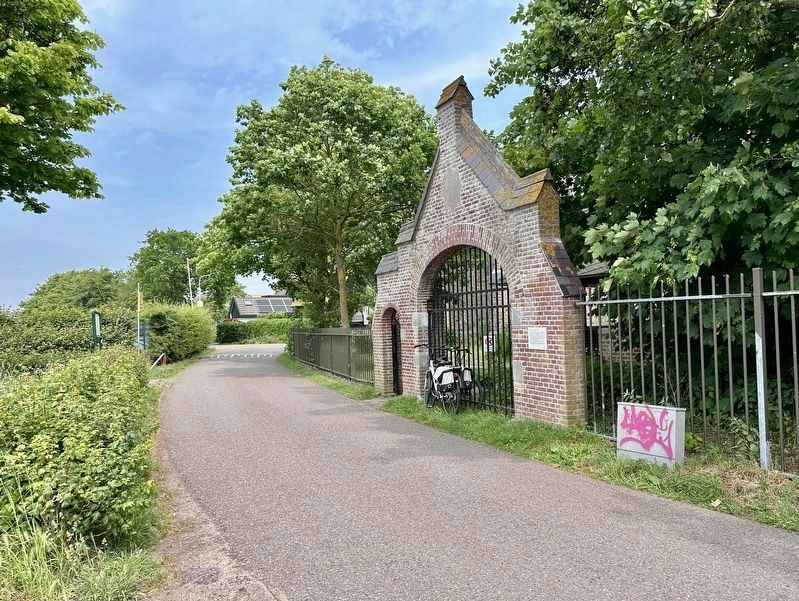
2. Onze lieve Vrouwe ter Nood / Our Lady in Need Marker - wide view
Looking north on Runxputteweg
Other nearby markers. At least 8 other markers are within 5 kilometers of this marker, measured as the crow flies: Genadekapel / Chapel of Grace (within shouting distance of this marker); Runxputte / The “Runx” Well (within shouting distance of this marker); Heilige Willibrordus / St. Willibrord (about 90 meters away, measured in a direct line); Jan Brasser (approx. 0.8 kilometers away); Het Schuilveld / The Sheltering Field (approx. 0.8 kilometers away); Hervormde Kerk Limmen / Reformed Church of Limmen (approx. 2.2 kilometers away); Fusillade Monument Castricum / Castricum Execution Memorial (approx. 2.8 kilometers away); Woonhuis en Stolpboerderij / House and Farmhouse (approx. 4 kilometers away). Touch for a list and map of all markers in Heiloo.
Also see . . .
1. Onze-Lieve-Vrouwe ter Nood (Heiloo) (Wikipedia, in Dutch). Overview (in translation):
Onze-Lieve-Vrouw ter Nood is a pilgrimage site in the hamlet of Kapel (also known as Capel and Oesdom) in the south of the Dutch municipality of Heiloo. Located on a hill within the grounds is the Runxputte, a well whose water is considered to have healing properties.
Photographed by Andrew Ruppenstein, May 31, 2026
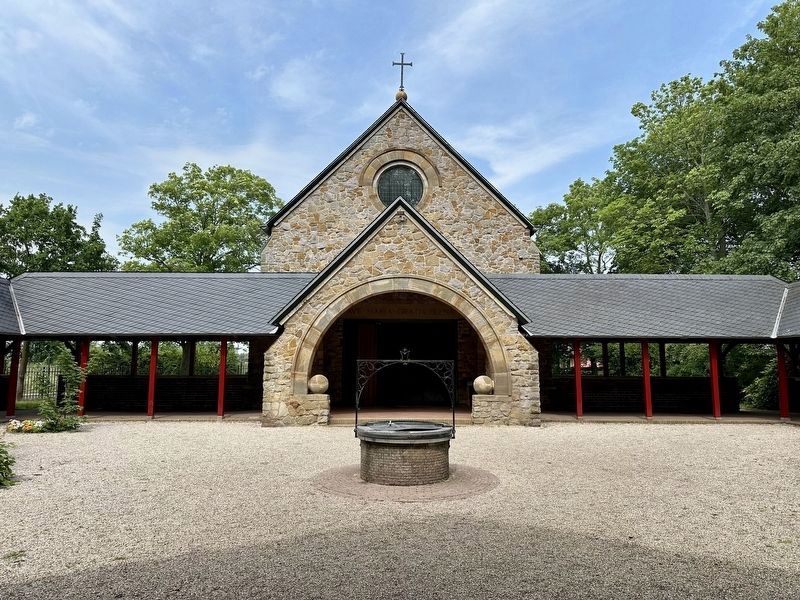
3. Genadekapel / Chapel of Grace and well (mentioned on the marker)
The marker, not quite visible here, is just to the right of the chapel entrance.
2. Over het Heiligdom OLV ter Nood (O.L.V. ter Nood, in Dutch). Overview (in translation):
Our Lady of Succour (Onze Lieve Vrouw ter Nood) in Heiloo, North Holland, is the largest Marian pilgrimage site in the Netherlands. The history of the shrine dates back to the late 14th century. In the forecourt of the Chapel of Grace, there is a well containing water believed to have healing properties. During the Reformation, the chapel was destroyed and the well filled in with rubble from the building. In 1713, during an outbreak of cattle plague, water surged up forcefully from beneath the debris. History records that animals that drank this water survived the plague.(Submitted on July 14, 2026.)
Photographed by Andrew Ruppenstein, May 31, 2026
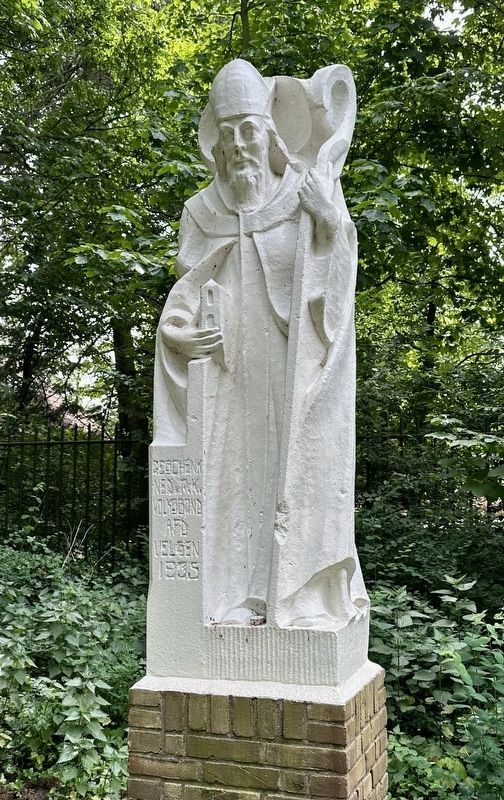
4. Heilige Willibrordus / St. Willibrord Statue (mentioned on marker)
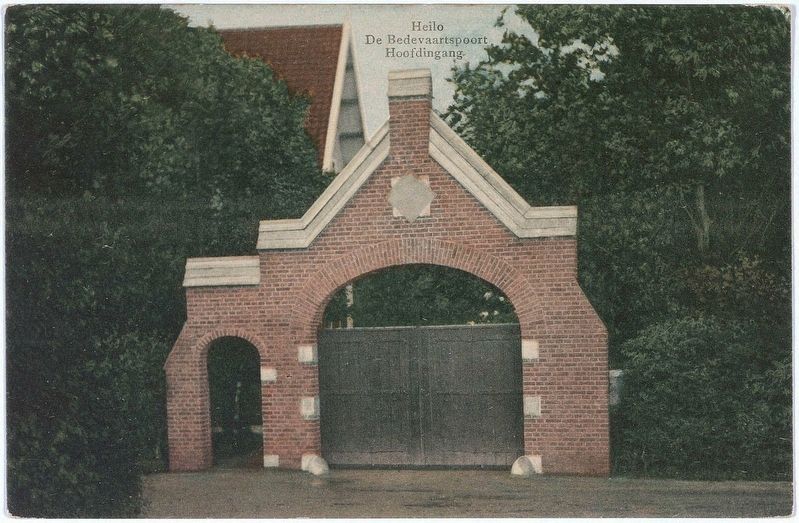
D. Broers, courtesy Noord-Hollands Archief (Inventaris 21698), 1930
5. Onze lieve Vrouwe ter Nood - entrance gate (marker site)
Credits. This page was last revised on July 14, 2026. It was originally submitted on July 14, 2026, by Andrew Ruppenstein of Lamorinda, California. This page has been viewed 24 times since then. Photos: 1, 2. submitted on July 14, 2026, by Andrew Ruppenstein of Lamorinda, California. 3. submitted on July 13, 2026, by Andrew Ruppenstein of Lamorinda, California. 4. submitted on June 7, 2026, by Andrew Ruppenstein of Lamorinda, California. 5. submitted on July 14, 2026.
