Walter Welford
Former Governor of North Dakota 1935-1936

In honor of Walter Welford, the twentieth governor of North Dakota (1935-1936) and resident of the town of Pembina, Governor George A. Sinner planted this tree on September 30, 1992. A tree was planted in the hometown of every North Dakota governor as part of the centennial tree project.
Erected by State Historical Society of North Dakota.
Topics and series. This historical marker is listed in this topic list: Government & Politics. In addition, it is included in the Historic Trees series list. A significant historical date for this entry is September 30, 1992.
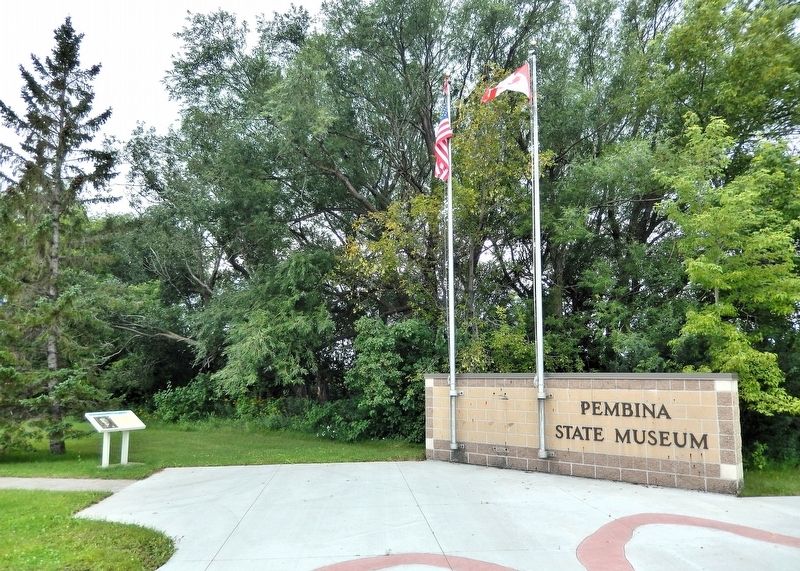
Location. 48° 58.381′ N, 97° 15.271′ W. Marker is in Pembina, North Dakota, in Pembina County. It is on State Highway 59 just north of West Rolette Street, on the left when traveling north. The marker is beside the walkway on the south side of the Pembina State Museum parking lot. Touch for map. Marker is at or near this postal address: 805 North Dakota Highway 59, Pembina ND 58271, United States of America. Touch for directions.

Regionally, this marker is in the Red River Valley and in the Turtle Mountains. It is also in the American Lewis & Clark Corridor, on the prairies,
this page online
Other nearby markers. At least 8 other markers are within 21 kilometers of this marker, measured as the crow flies: Votes For Women (a few steps from this marker); Pembina State Park (approx. 0.8 miles away); Dumoulin Church (approx. 1.2 miles away); Pembina - Emerson Area (approx. 2.4 miles away in Canada); Emerson Court House and Town Hall (approx. 4.7 kilometers away in Canada); Fort Dufferin (approx. 7.4 kilometers away in Canada); First Railway in Western Canada / Le Premier Chemin de Fer de L'Ouest du Canada (approx. 20.2 kilometers away in Canada); The Fish (approx. 20.2 kilometers away in Canada). Touch for a list and map of all markers in Pembina.
Another marker is no longer nearby. The March West / La Marche Vers L'ouest (was approx. 7.4 kilometers away in Canada but has been permanently removed).
Also see . . .
1. Walter Welford (Wikipedia).
Excerpt: Walter Welford (May 21,(Submitted on July 21, 2026, by Cosmos Mariner of Cape Canaveral, Florida.)1868 – June 28, 1952) was inaugurated as the 20th governor of North Dakota on February 2, 1935, after Thomas H. Moodie was removed after it was determined he was ineligible to hold the office. Welford lost the 1936 election to former governor William Langer, and served until the end of his term in January 1937.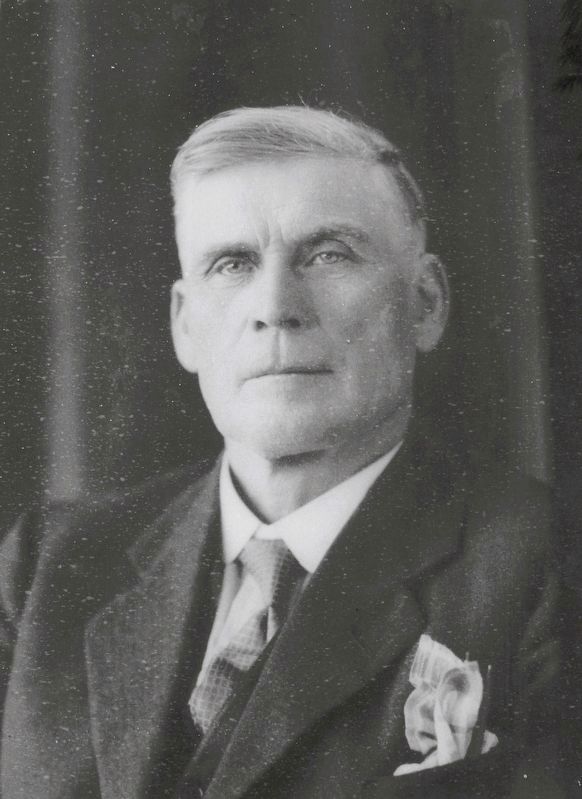 2. Marker detail: Walter Welford
Born in the North Yorkshire village of Bellerby on 21 May 1868, Welford moved with his family to Pembina, North Dakota, in 1879. A farmer, he also served as Vice President of the Merchants Bank of Pembina County. Welford was a staunch supporter of the Nonpartisan League (NPL), a farmers' political group. During Welford's administration the state was caught in the grip of the Great Depression. The 1936 crop yield was disastrously low because of drought. Welford met with President Franklin Roosevelt and obtained federal aid for drought-stricken farmers. In 1936, Welford decided to run for office again. He beat former Governor William Langer for the Republican gubernatorial nomination, but Langer refused to drop out and entered the general election as an independent. Welford lost the three-way governor's election to Langer.
2. Centennial Trees Program (Prairie Public Newsroom).

(By Jack Dura) Excerpt: The state’s Centennial Commission set an ambitious goal in 1987 to plant 100 million trees by the year 2000 — 1 million trees for every year of statehood, to honor pioneers who planted trees on the open prairie. The Centennial Trees Program was to be a “‘living legacy’ that will serve as a lasting reminder for future generations to enjoy.”(Submitted on July 21, 2026, by Cosmos Mariner of Cape Canaveral, Florida.)The North Dakota Forest Service, State Game and Fish Department, city forestry departments and soil conservation districts made plans — from planting new trees in small town parks to developing large acreages, called “centennial forests,” containing thousands of trees.
The most high-profile planting was that of President George H.W. Bush during a visit to Bismarck to honor North Dakota’s centennial. He planted an elm outside the Capitol, but gypsy moth larvae and winter weather led to the tree’s demise in 1990.
Governor George Sinner planted trees in the hometowns of former North Dakota governors. Near the end of his term in 1992, he raced around the state by plane in one day to plant trees in McClusky, Larimore, Park River and Pembina.
Credits. This page was last revised on July 21, 2026. It was originally submitted on July 18, 2026, by Cosmos Mariner of Cape Canaveral, Florida. This page has been viewed 14 times since then. Photos: 1, 2, 3, 4. submitted on July 21, 2026, by Cosmos Mariner of Cape Canaveral, Florida.
