Chatham in Chatham-Kent, Ontario — Central Canada (North America)
Carnegie Library
A Historic Downtown Committee Project

Photographed by Sean P. Flynn, July 17, 2026
1. Carnegie Library Marker
Sponsored by Ontario Heritage Foundation & Proctor A. Dick and Family
Researched by Chatham Collegiate Institute students C. Bouwmeester, D. Caron, R. Phan
Topics. This historical marker is listed in these topic lists: Architecture • Arts, Letters, Music • Charity & Public Work. A significant historical year for this entry is 1903.
Location. 42° 24.191′ N, 82° 11.141′ W. Marker is in Chatham, Ontario, in Chatham-Kent. It is on Queen Street south of Cross Street, on the right when traveling south. Touch for map. Marker is at or near this postal address: 120 Queen Street, Chatham ON N7M 2G6, Canada. Touch for directions.

Regionally, this marker is in the Southwest Ontario Area and in Southwestern Ontario. It is also in Central Canada. Globally, it is in North America, on the Great Lakes, in the Western Hemisphere, in the Western World, and in the Anglosphere. Historically, it finds itself in what was once a British colony, the Viceroyalty of New France, the Haudenosaunee (Iroquois) Confederacy, and Rupert’s Land.
Other nearby markers. At least 8 other markers are within walking distance of this marker: Casualties of the Skirmish / Les Pertes Survenues Lors de l'Escarmouche (approx. 0.4 kilometers away); a different marker also named Skirmish at the Forks (approx. 0.4 kilometers away); The Forks (approx. 0.4 kilometers
this page online
Other markers no longer nearby. Skirmish at the Forks (was approx. 0.4 kilometers away but has been confirmed missing); British Encampment: Forks of the Thames / Campement Britanique: Les Fourches De La Rivière Thames (was approx. 0.4 kilometers away but has been confirmed missing).
Also see . . . Carnegie's Canadian Libraries. From the Canada's Historic Places website.
Excerpt: "The funding of new libraries in Canadian towns and cities corresponded with a number of related societal issues. At the end of the 19th century, a dramatic expansion of Canadian society was occurring, and increasingly more people were demanding free public library services. City and town officials soon discovered, however, that while the rooms they rented to house lending libraries were now inadequate, there was still not enough money to build proper library(Submitted on July 21, 2026, by Sean P. Flynn of Oak Park, Illinois.)buildings to accommodate public demand. Consequently, there was great enthusiasm when Carnegie announced his funding program."Photographed by Sean P. Flynn, July 17, 20262. Chatham Public LibraryThe marker is to the right of the door.
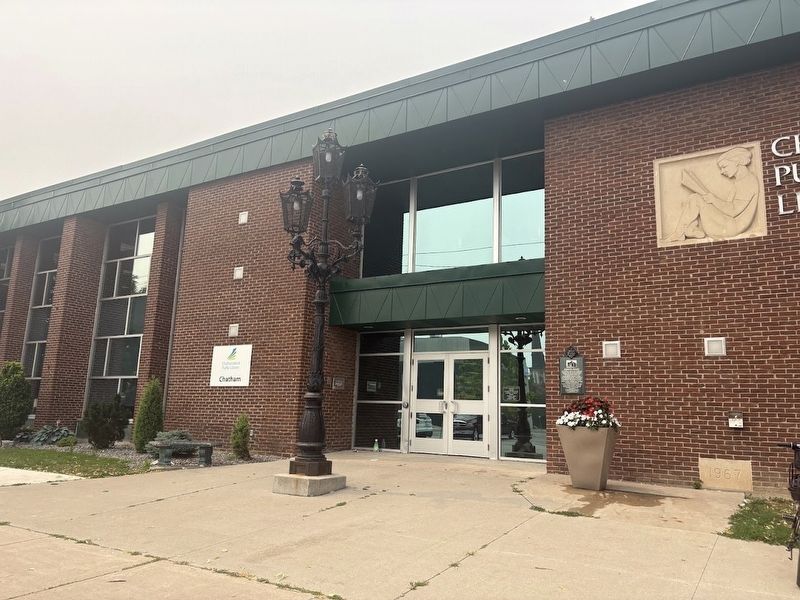

Photographed by Sean P. Flynn, July 17, 2026
3. Carnegie Library cornerstone
The stone is displayed near the corner of the building. St. Joseph Catholic Church is in the background.
Credits. This page was last revised on July 21, 2026. It was originally submitted on July 21, 2026, by Sean P. Flynn of Oak Park, Illinois. This page has been viewed 11 times since then. Photos: 1, 2, 3. submitted on July 21, 2026, by Sean P. Flynn of Oak Park, Illinois.
