Northwestern Precinct in Saint Paul in Ramsey County, Minnesota — The American Midwest (Upper Plains)
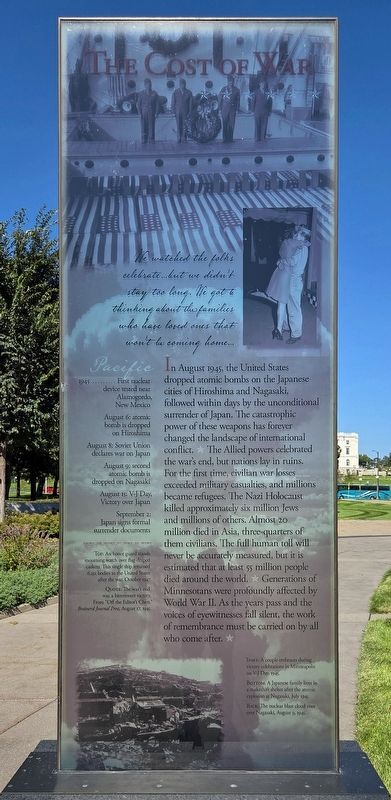
The Cost of War
Photographed by McGhiever, September 28, 2025
1. The Cost of War Marker
We watched the folks celebrate…but we didn't stay too long. We got to thinking about the families who have loved ones that won't be coming home…
In August 1945, the United States dropped atomic bombs on the Japanese cities of Hiroshima and Nagasaki, followed within days by the unconditional surrender of Japan. The catastrophic poewr of these weapons has forever changed the landscape of international conflict. ★ The Allied powers celebrated the war's end, but nations lay in ruins. For the first time, civilian war losses exceeded military casualties, and millions became refugees. The Nazi Holocaust killed approximately six million Jews and millions of others. Almost 20 million died in Asia, three-quarters of them civilians. The full human toll will never be accurately measured, but it is estimated that at least 55 millions people died around the world. ★ Generations of Minnesotans were profoundly affected by World War II. As the years pass and the voices of eyewitnesses fall silent, the work of remembrance must be carried on by all who come after. ★
Pacific
1945:
· First nuclear device tested near Alamogordo, New Mexico
· August 6: atomic bomb is dropped on Hiroshima
· August 8: Soviet Union declares war on Japan
· August 9: second atomic bomb is dropped on Nagasaki
· August 15: V-J Day, Victory over Japan
· September 2: Japan signs formal surrender documents
Top: An honor guard stands mourning watch over flag-draped caskets. This single ship returned 6,251 bodies to the United States after the war, October 1947.
Quote: The war's end was a bittersweet victory. From "Off the Editor's Chest," Brainerd Journal Press, August 17, 1945.
Inset: A couple embraces during victory celebrations in Minneapolis on V-J Day, 1945.
Bottom: A Japanese family lives in a makeshift shelter after the atomic explosion at Nagasaki, July 1945.
Back: The nuclear blast cloud rises over Nagasaki, August 9, 1945.
Erected 2007
this page online
Topics. This historical marker is listed in this topic list: War, World II. A significant historical month for this entry is August 1945.
Location. 44° 57.13′ N, 93° 6.142′ W. Marker is in Saint Paul, Minnesota, in Ramsey County. It is in Northwestern Precinct. It can be reached from W. 12th Street. The marker is at the northwest end of Minnesota World War II Memorial on the Capitol Mall. Touch for map. Marker is in this post office area: Saint Paul MN 55155, United States of America. Touch for directions.

Regionally, this marker is in the Twin Cities Metropolitan Area. It is also in the American Midwest, in the Corn Belt, and in the Great River Road Region. Globally, it is in North America, the Western Hemisphere, the Western World, and the Anglosphere. Historically, it finds itself in what was once Rupert’s Land, the territory of the Mississippian Culture, and the Louisiana Purchase.
Other nearby markers. At least 8 other markers are within walking distance of this marker: Governor, Warrior, Peacemaker (here, next to this marker); Service & Sacrifice (a few steps from this marker); Above & Beyond (a
Photographed by McGhiever, September 28, 2025
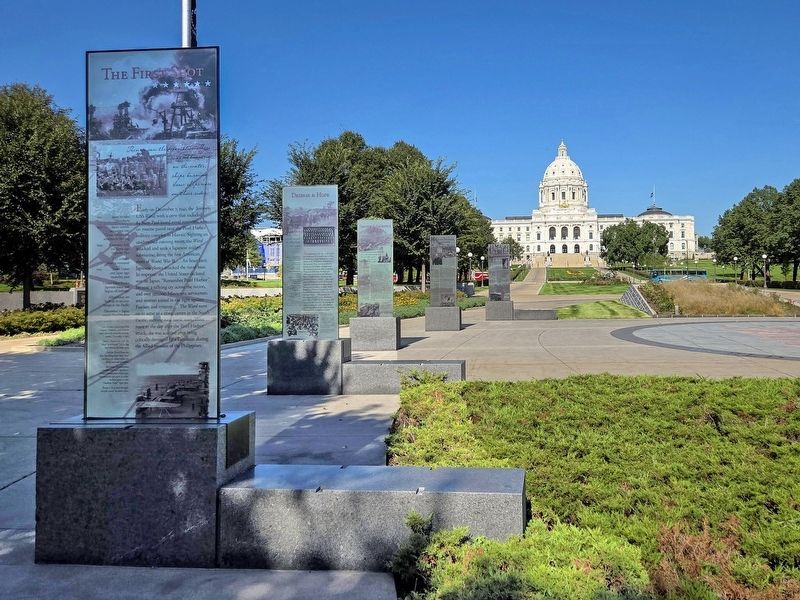
2. The Cost of War Marker (rear) on the west side of the Minnesota World War II Memorial
Credits. This page was last revised on July 23, 2026. It was originally submitted on July 23, 2026, by McGhiever of Minneapolis, Minnesota. This page has been viewed 11 times since then. Photos: 1, 2. submitted on July 23, 2026, by McGhiever of Minneapolis, Minnesota.
