William Penn Annex East in Philadelphia in Philadelphia County, Pennsylvania — The American Northeast (Mid-Atlantic)
The Executive Branch
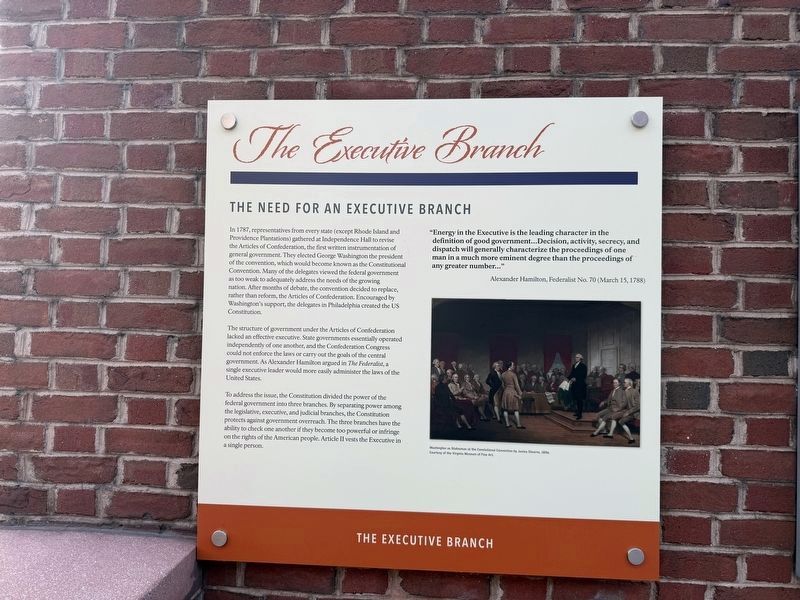
The Need for an Executive Branch
In 1787, representatives from every state (except Rhode Island and Providence Plantations) gathered at Independence Hall to revise the Articles of Confederation, the first written instrumentation of the general government. They elected George Washington the president of the Convention. Many of the delegates viewed the federal government as too weak to adequately address the needs of the growing nation. After months of debate, the convention decided to replace, rather than reform, the Articles of Confederation. Encouraged by Washington's support, the delegates in Philadelphia created the US Constitution.
The structure of government under the Articles of Confederation lacked an effective executive. State governments essential operated independently of one another, and the Confederation Congress could not enforce the laws or carry out the goals of the central government. As Alexander Hamilton argued in The Federalist, a single executive leader would more easily administer the laws of the United States.
To address the issue, the Constitution divided the power of the federal government
this page online
"Energy in the Executive is the leading character in the definition of good government…Decision, activity, secrecy, and dispatch will generally characterize the proceedings of one man in a much more eminent degree than the proceedings of any great number…"
Alexander Hamilton, Federalist No. 70 (March 15, 1788)
Erected 2026 by National Park Service, U.S. Department of the Interior.
Topics and series. This historical marker is listed in this topic list: Government & Politics. In addition, it is included in the Former U.S. Presidents: #01 George Washington series list. A significant historical year for this entry is 1787.
Location. 39° 57.032′ N, 75° 9.001′ W. Marker is in Philadelphia, Pennsylvania, in Philadelphia County. It is in William Penn Annex East. It is at the intersection of South 6th
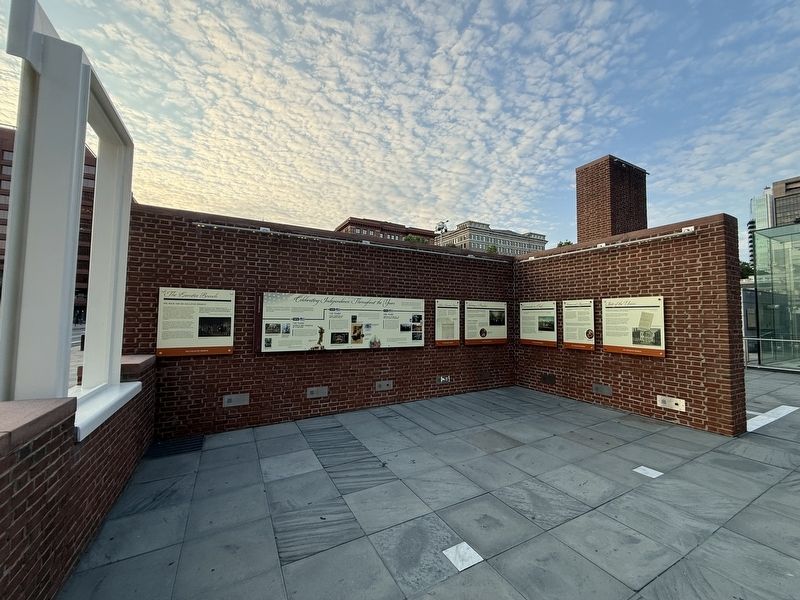
Photographed by Devry Becker Jones (CC0), July 25, 2026
2. Markers on Display at Independence National Historical Park

Regionally, this marker is in Southeast Pennsylvania. It is also in the American Northeast and in the Mid-Atlantic. Globally, it is in North America, the Western Hemisphere, the Western World, and the Anglosphere. Historically, it finds itself in what was once the Haudenosaunee (Iroquois) Confederacy, New Netherland, and one of the original Thirteen Colonies.
Other nearby markers. At least 6 other markers are within walking distance of this marker: Celebrating Independence Throughout the Years (here, next to this marker); What is Executive Power? (here, next to this marker); Abigail Adams (here, next to this marker); Selecting a President (here, next to this marker); Commander in Chief (here, next to this marker); Treaties and Appointments (here, next to this marker). Touch for a list and map of all markers in Philadelphia.
Other markers no longer nearby. Promoting the Abolition of Slavery (was here, next to this marker but has been replaced with another marker now near it); Death Carts (was here, next to this marker but has been replaced with another marker now near it); Refuge in the country (was here, next to this marker but has been replaced with another marker now near it); a different marker also named The Executive Branch (was here, next to this marker but has been permanently removed); A Day of Reciprocity (was here, next to this marker but has been replaced with another marker now near it); The opener of the Way (was here, next to this marker but has been replaced with another marker now near it); "Burn this treaty to Hell!" (was here, next to this marker but has been replaced with another marker now near it); "I am free now" (was here, next to this marker but has been permanently removed); "We shall come to a civil war" (was here, next to this marker but has been permanently removed); "An Act respecting fugitives from Justice" (was here, next to this marker but has been replaced with another marker now near it).
Related marker. Click here for another marker that is related to this marker. This marker has replaced the linked marker.
Additional commentary.
1. About the official name of the State of Rhode Island
In November 2020, the State of Rhode Island dropped and Providence Plantations by a state constitutional amendment passed by referendum.
— Submitted July 26, 2026, by Devry Becker Jones of Washington, District of Columbia.
2. The marker as propaganda
This marker serves as ideological propaganda by presenting the Constitution's creation of a strong executive as a universally necessary and uncontested solution for national success, entirely leaving out the Anti-Federalist warning about potential tyranny. By framing the shift from the Articles of Confederation solely around "efficiency" and "protection," it uses cherry-picked quotes from Alexander Hamilton to argue concentrated executive power as the only definition of "good government." By doing so, it rewrites the historic, fiercely contested political debate into an inevitable, heroic narrative of American constitutional design. That noted, it does mention the three branches as intending to balance each other out.
— Submitted July 26, 2026, by Devry Becker Jones of Washington, District of Columbia.
Credits. This page was last revised on July 26, 2026. It was originally submitted on July 26, 2026, by Devry Becker Jones of Washington, District of Columbia. This page has been viewed 13 times since then. Photos: 1, 2. submitted on July 26, 2026, by Devry Becker Jones of Washington, District of Columbia.
