William Penn Annex East in Philadelphia in Philadelphia County, Pennsylvania — The American Northeast (Mid-Atlantic)
Selecting a President
| — | The Executive Branch | — |
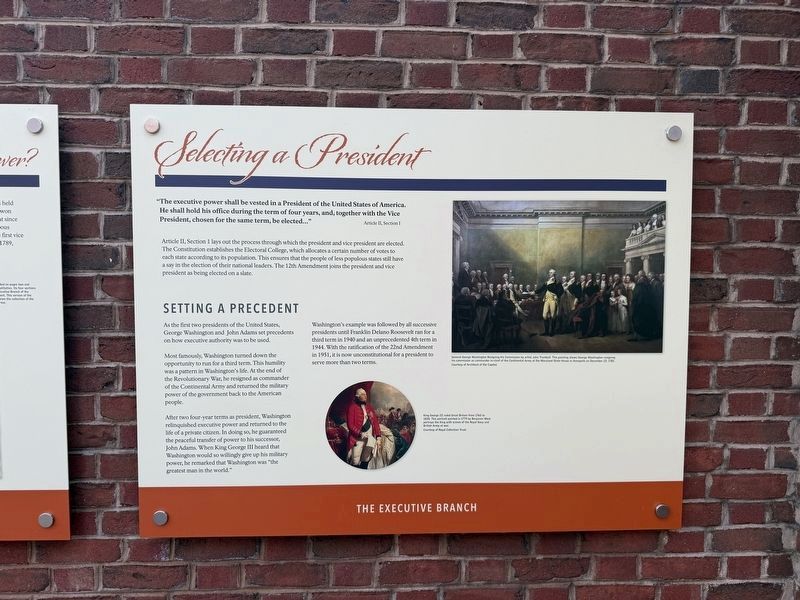
"The executive power shall be vested in a President of the United States of America. He shall hold his office during the term of four years, and, together with the Vice President, chosen for the same term, be elected…" Article II, Section I
Article II, Section 1 lays out the process through which the president and vice president are elected. The Constitution establishes the Electoral College, which allocates a certain number of votes to each state according to its population. This ensures that the poeple of less populous states still have a say in the election of their national leaders. The 12th Amendment joins the president and vice president as being elected on slate.
Setting a Precedent
As the first two presidents of the United States, George Washington and John Adams set precedents on how executive authority was to be used.
Most famously, Washington turned down the opportunity to run for a third term. This humility was a pattern in Washington's life. At the end of the Revolutionary War, he resigned as commander of the Continental Army and returned the military power of the government back to the American
this page online
After two four-year terms as president, Washington relinquished executive power and returned to the life of a private citizen. In doing so, he guaranteed the peaceful transfer of power to his successor, John Adams. When King George III heard that Washington would so willingly give up his military power, he remarked that Washington "was the greatest man in the world."
Washington's example was followed by all successive presidents until Franklin Delano Roosevelt ran for a third term in 1940 and an unprecedented 4th term in 1944. With the ratification of the 22nd Amendment in 1951, it is now unconstitutional for a president to serve more than two terms.
[Captions:]
General George Washington Resigning His Commission by artist John Trumball. This painting shows George Washington resigning his commission as commander-in-chief of the Continental Army at the Maryland State House in Annapolis on December 23, 1783.
Courtesy of Architect of the Capitol.
King George III ruled Great Britain from 1760 to 1820. This portrait painted in 1779 by Benjamin West portrays the King with scenes of the Royal Navy and British Army at war.
Courtesy of Royal Collection Trust.
Erected 2026
Photographed by Devry Becker Jones (CC0), July 25, 2026
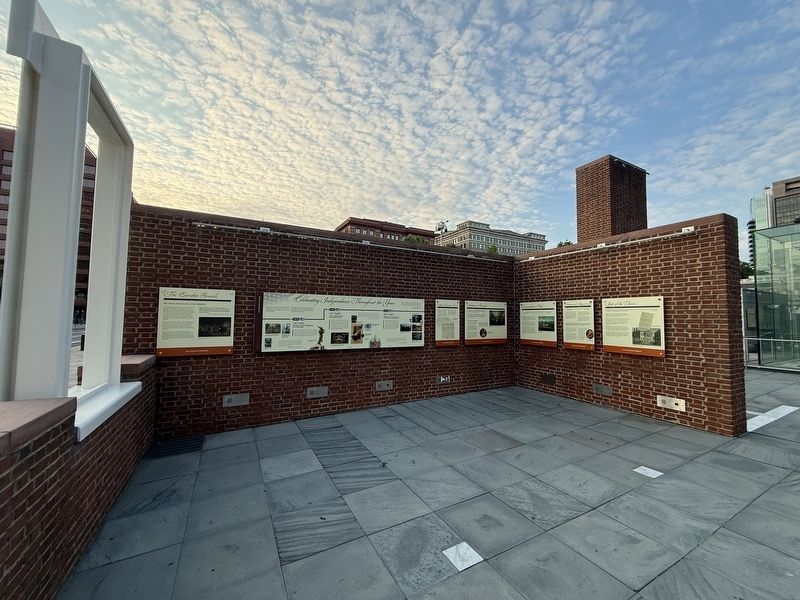
2. Markers on Display at Independence National Historical Park
Topics and series. This historical marker is listed in these topic lists: Government & Politics • War, US Revolutionary. In addition, it is included in the Former U.S. Presidents: #01 George Washington, the Former U.S. Presidents: #02 John Adams, and the Former U.S. Presidents: #32 Franklin D. Roosevelt series lists. A significant historical date for this entry is December 23, 1783.
Location. 39° 57.03′ N, 75° 9.001′ W. Marker is in Philadelphia, Pennsylvania, in Philadelphia County. It is in William Penn Annex East. It is at the intersection of South 6th Street (County Road 2005) and Market Street (County Road 2004), on the left when traveling south on South 6th Street. Touch for map. Marker is at or near this postal address: 598 Market St, Philadelphia PA 19106, United States of America. Touch for directions.

Regionally, this marker is in Southeast Pennsylvania. It is also in the American Northeast and in the Mid-Atlantic. Globally, it is in North America, the Western Hemisphere, the Western World, and the Anglosphere. Historically, it finds itself in what was once the Haudenosaunee (Iroquois) Confederacy, New Netherland, and one of the original Thirteen Colonies.
Other nearby markers. At least 5 other markers are within walking distance of this marker: Commander in Chief (here, next to this marker); What is Executive Power? (here, next to this marker); William Howe (here, next to this marker); Treaties and Appointments (here, next to this marker); The Executive Mansion (here, next to this marker). Touch for a list and map of all markers in Philadelphia.
Other markers no longer nearby. "Burn this treaty to Hell!" (was here, next to this marker but has been replaced with another marker now near it); "We shall come to a civil war" (was here, next to this marker but has been permanently removed); "An Act respecting fugitives from Justice" (was here, next to this marker but has been replaced with another marker now near it); Suppressing the Opposition (was here, next to this marker but has been replaced with another marker now near it); "I am free now" (was here, next to this marker but has been permanently removed); The Keeper of the House (was here, next to this marker but has been replaced with another marker now near it); "I will fear no Evil" (was here, next to this marker but has been replaced with another marker now near it); The opener of the Way (was here, next to this marker but has been replaced with another marker now near it); The House & the People Who Worked & Lived In It (was here, next to this marker but has been permanently removed); A Day of Reciprocity (was here, next to this marker but has been replaced with another marker now near it); The Executive Branch (was here, next to this marker but has been permanently removed).
Credits. This page was last revised on July 26, 2026. It was originally submitted on July 26, 2026, by Devry Becker Jones of Washington, District of Columbia. This page has been viewed 14 times since then. Photos: 1, 2. submitted on July 26, 2026, by Devry Becker Jones of Washington, District of Columbia.
