Near Charleston in Charleston County, South Carolina — The American South (South Atlantic)
Controlling the Harbor
Photographed by Craig Swain, May 3, 2010
1. Controlling the Harbor Marker
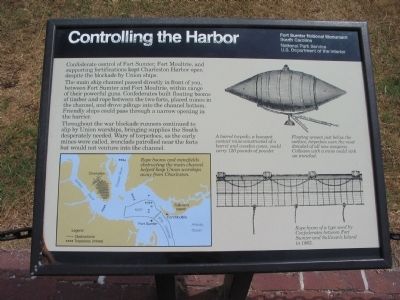
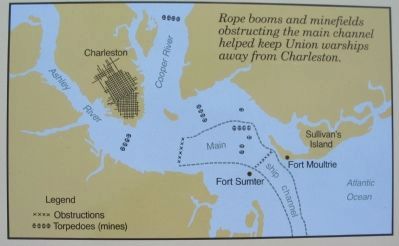
The main ship channel passed directly in front of you, between Fort Sumter and Fort Moultrie, within range of their powerful guns. Confederates built floating booms of timber and rope between the two forts, placed mines in the channel, and drove pilings into the channel bottom. Friendly ships could pass through a narrow opening in the barrier.
Throughout the war blockade runners continued to slip by Union warships, bringing supplies the South desperately needed. Wary of torpedoes, as the early mines were called, ironclads patrolled near the forts but would not venture into the channel.
Erected by Fort Sumter National Monument, South Carolina - National Park Service - U.S. Department of the Interior.
Topics. This historical marker is listed in this topic list: War, US Civil. A significant historical month for this entry is February 1865.
Location. 32° 45.138′ N, 79° 52.441′ W. Marker is near Charleston, South Carolina, in Charleston County. It can be reached from the Fort Sumter Ferry
this page online

Regionally, this marker is in Historic Charleston and in the Lowcountry. It is also in the American South, specifically in the Deep South, and on the Eastern Seaboard. Globally, it is in the North Atlantic Region, North America, the Western Hemisphere, the Western World, and the Anglosphere. Historically, it finds itself in what was once the territory of the Mississippian Culture, one of the original Thirteen Colonies, one of the Confederate States of America, and the Antebellum South.
Other nearby markers. At least 8 other markers are within walking distance of this marker: H.L. Hunley (here, next to this marker); Blockade Runners (a few steps from this marker); 6.4-Inch (100-Pounder) Parrott (a few steps from this marker); The Columbiad (within shouting distance of this marker); Ironclads Attack (within shouting distance of this marker); Rearming the Fort (within
Photographed by Bill Coughlin, August 4, 2013
2. Controlling the Harbor Marker
More about this marker. On the lower left is a map of the harbor showing the locations of the obstacles at the entrance. Rope booms and minefields obstructing the main channel helped keep Union warships away from Charleston.
In the upper right is a line drawing of a torpedo. A barrel torpedo, a buoyant contact mine constructed of a barrel and wooden cones, could carry 120 pounds of powder. Floating unseen just below the surface, torpedoes were the most dreaded of all new weapons. Collision with a mine could sink an ironclad.
At the lower right is a line drawing of a Rope boom of a type used by Confederates between Fort Sumter and Sullivan's Island in 1863.
Photographed by Craig Swain, May 3, 2010
3. Harbor Map
Photographed by Craig Swain
4. Markers overlooking the Main Channel
Photographed by Craig Swain, May 3, 2010
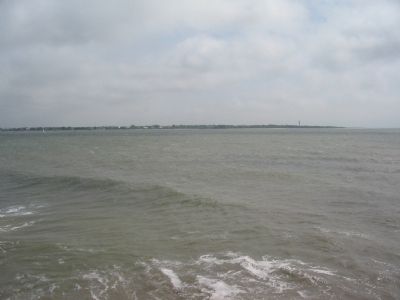
5. Sullivan's Island From Fort Sumter
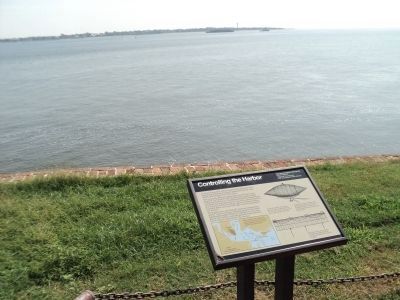
Looking northeast from Fort Sumter. Fort Moultrie stands on the western end of Sullivan's Island. During the Civil War, Confederates placed barriers of many sorts to deny use of the channel to Federal warships.
Credits. This page was last revised on January 4, 2026. It was originally submitted on May 14, 2010, by Craig Swain of Leesburg, Virginia. This page has been viewed 1,465 times since then and 86 times this year. Photos: 1. submitted on May 14, 2010, by Craig Swain of Leesburg, Virginia. 2. submitted on August 17, 2013, by Bill Coughlin of Woodland Park, New Jersey. 3, 4, 5. submitted on May 14, 2010, by Craig Swain of Leesburg, Virginia.
