Warren in Warren County, Pennsylvania — The American Northeast (Mid-Atlantic)
Third Avenue Kiosk
| — | Walkable Warren | — |

Photographed by Mark Parker, July 16, 2026
1. Third Avenue Kiosk Marker
[Header]
Walkable Warren
Walkable Warren is a local initiative intended to promote healthy lifestyles by encouraging foot traffic and bicycling as alternative modes of travel in and around the City of Warren. Warren has a wealth of scenic landscapes, historic architecture, public parks, and trails, all worthy of being showcased and that are best experienced on foot or by bicycle. Recommended routes of travel between the Warren/North Warren Bike/Hike trail, core downtown, and a few of our public parks are marked by Walkable Warren signage along our public streets. We encourage you to step out of the automobile as a source of travel and, instead, experience Walkable Warren on foot or bicycle. Pedestrians please use the sidewalks. Bicyclists must obey all traffic laws.
Struthers Library Theatre, 302 Third Avenue West, Warren
On January 9, 1882, Thomas Struthers offered to erect a library building on a lot that would be provided by the citizens of Warren; the structure would house not only the library but rental spaces as well, to meet the expenses of library upkeep. A committee was appointed to raise funds,
this page online
Warren's Third Avenue Swinging Bridge - 1890s
This Third Avenue Swinging Bridge spanned the Conewango Creek from 1883 through 1904.
Beaty School, 2 East Third Avenue, Warren
In the early 1920s, Warren High School became overpopulated, and the Superintendent of Schools wished to build a junior high school. In 1928, after two unsuccessful attempts to gain approval from Warren’s citizens for a new school, the four remaining heirs of the Beaty family presented a deed for the property located on the north and south side of Third Avenue between the Conewango Creek and Conewango Avenue to the Board of Education to build Beaty Junior High School. A one-half million dollar bond was approved, and the architecture
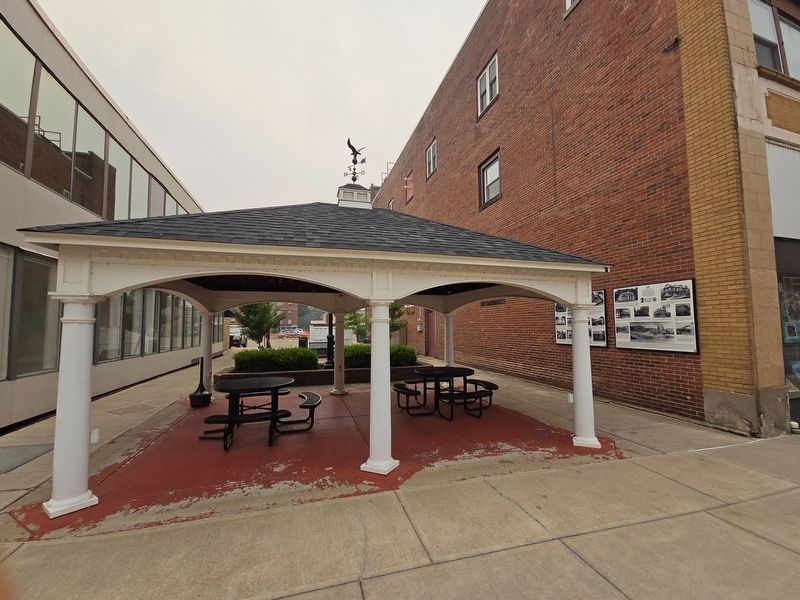
Photographed by Mark Parker, July 16, 2026
2. Third Avenue Kiosk Marker (left) facing the gazebo
By 1936, the first addition was underway, taking longer than originally planned to build due to the 1936 flood causing the Conewango Creek to flood two-thirds of the building site. Carpenters were scarce, and bricks were difficult to obtain. In March 1937, the southwest wing opened, providing eight additional classrooms, a stage, and a library.
Between 1930 and 1947, Beaty School did not meet Pennsylvania standards for a junior high school, so it was classified and known as a sub-high school, housing eighth and ninth grades. By 1948, the state inspection approved Beaty as a three-year junior high school, and seventh grade was brought in.
The student population continued to grow, and more additions were needed in 1953 and 1966.
In 2014, a $16 million renovation was finished and Beaty Middle School became
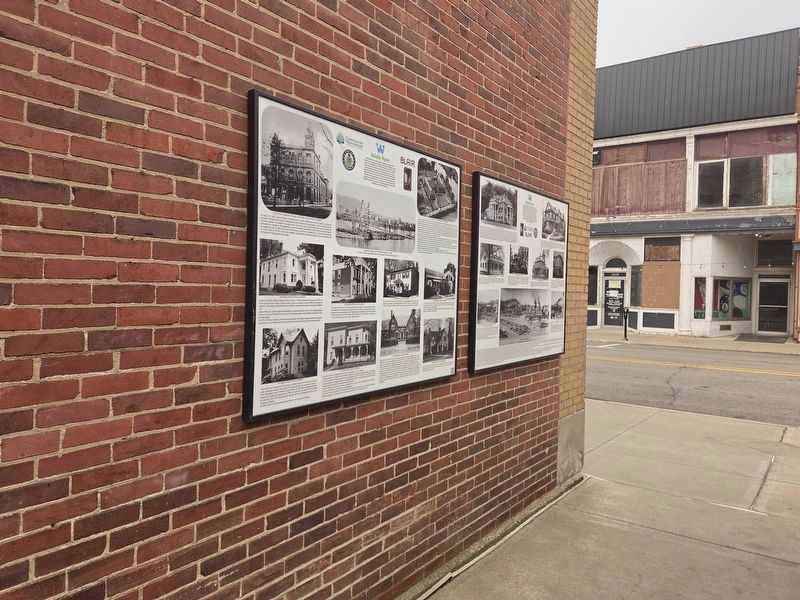
Photographed by Mark Parker, July 16, 2026
3. Third Avenue West kiosk (left) looking towards Liberty Street
108 Third Avenue West, Warren
Theodore and Rose Messner emigrated from Germany in 1842, purchased this property in 1883, and hired contractor Chris Uhdey to build the house. She was a leader of musical affairs and founded the Children’s Aid Society and Children’s Home in Warren County. She lived in the house until her death in 1934.
Hazlett Hubbs, an executive of the United Refinery, owned the house from 1936 to 1952, making changes such as renovating the third-floor ball room into sleeping quarters and enlarging the garage to hold two automobiles.
In 1952, Dr. William Cashman, local surgeon and historian of the highest regard, purchased the property, removing the wood railings from the porch roof and the front and west porches due to deterioration.
406 Third Avenue West, Warren
This house was built in 1851 by Dr. Galbraith Irvine, grandson of General William Irvine. Dr. Galbraith Irvine contained his office on the western side of the house and served as the physician who examined the local Civil War draftees. A small building to the east was added in
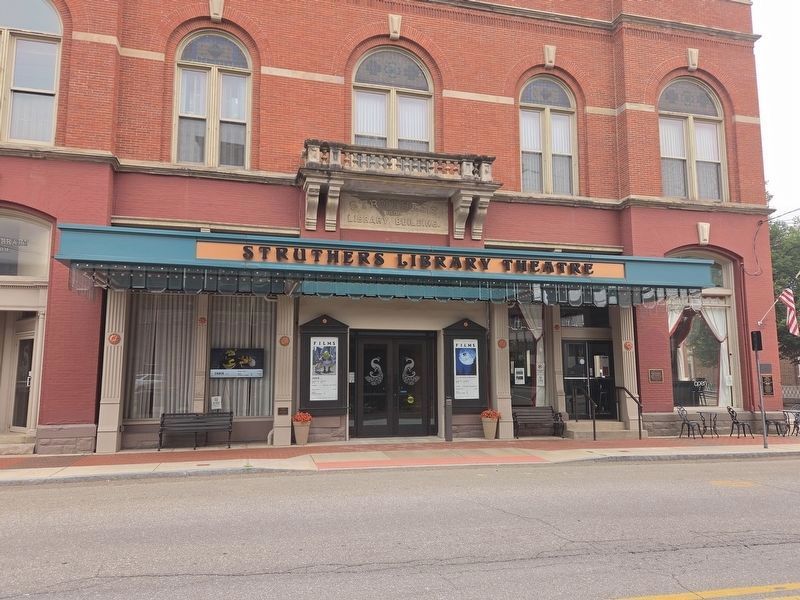
Photographed by Mark Parker, July 16, 2026
4. Struthers Library Theatre
412 Third Avenue West, Warren
One of the oldest homes in town was built by Dr. Abraham Hazeltine in 1823 as a two- room house, standing on an original plot laid out in 1795. Due to several additions, the house is structured with different floor levels, serving as an inn and tea room in the 1930s.
415 Third Avenue West, Warren
The oldest brick house in town was built with star-shaped indentation bricks, made in Starbrick, Warren County. Legend has it that the bricks were transported from Starbrick by wheelbarrow, easily a three-mile walk.
In 1962, the property was purchased and converted into apartments by Joseph H. DeFrees, president of Allegheny Value Company.
419 Third Avenue West, Warren
Orris Hall came to Warren in 1824, serving as a teacher and merchant, making his money in the lumbering business. Orris and his wife Eliza purchased this property on August 7, 1874. Recognized as one of Warren’s pioneer families, the Hall heirs occupied the property for 80 years, building the large house in 1886, five years after the death of Orris. During his lifetime, Orris Hall expended large amounts of money building brick stores and dwellings in Warren.
In 1960, Joseph H. DeFrees purchased the house for use as an office building.
422 Third Avenue West, Warren
Built circa 1850, this, originally Greek Revival was purchased by E.T.F. Valentine.
In 1868, Mr. Brown of Brown Brothers foundry purchased and enlarged the house changing it to Italianate.
In 1872, the Rockwell Family bought the house and occupied it until 1967. In 1892, they conducted a major interior renovation, enlarging the house and expanding the front porch, most likely under the supervision of architect Sanford White of the firm McKim, Mead and White.
In 1967, the house was to be torn down and replaced by a grocery store. Joseph DeFrees purchased it to prevent its demolition and converted it into apartments.
In 1995, the house was purchased by David and Crissi Winans who restored it to a single family residence, added the garage, and replaced the front porch with an exact replica, as it had been removed.
500 Third Avenue West Warren
Built between 1918 and 1920, this grand brick English Tudor features a pillared entryway, steep-pitched roof, and sunken courtyard. Oil baron and founder of the United Refining Company Harry Logan was married to an English actress and wished to make her feel at home. Logan commissioned New York architect Albert Joseph Bodker to design a house reminiscent of the English countryside.
The first floor features oak and walnut paneling; hand-carved, walnut-inlaid ceiling; built-in bookcases; and marble fireplaces. The second floor was originally built with his-and-her suites with separate dressing rooms and a built-in jewelry safe. The third floor, originally the servants quarters, was equipped with a walk-in cedar closet, a sewing room, and plenty of storage room located under the eaves. The finished basement included a workshop, dark room, laundry, fruit cellar, sunken exercise room, and a “safe room” with a giant walk-in safe reportedly used to store liquor during Prohibition.
504 Third Avenue West, Warren
Built in 1919, this Tudor Revival style truly captures the rustic charm of “Merrie Olde England” as the stucco exterior and small paned windows are more representative of the simpler Elizabethan Era style.
Erected by Community Foundation of Warren, Blair, City of Warren.
Topics. This historical marker is listed in these topic lists: Arts, Letters, Music • Bridges & Viaducts • Education • Notable Buildings. A significant historical date for this entry is January 9, 1882.
Location. 41° 50.746′ N, 79° 8.845′ W. Marker is in Warren, Pennsylvania, in Warren County. It is on Liberty Street south of Third Avenue West, on the left when traveling south. The marker is on the north side of the building facing the gazebo. Touch for map. Marker is at or near this postal address: 218 Liberty St, Warren PA 16365, United States of America. Touch for directions.

Regionally, this marker is in Northwestern Pennsylvania and specifically in the Pennsylvania Wilds. It is also in the American Northeast, in the Mid-Atlantic, in Appalachia, and specifically in Northern Appalachia. Globally, it is in North America, the Western Hemisphere, the Western World, and the Anglosphere. Historically, it finds itself in what was once the Haudenosaunee (Iroquois) Confederacy and also one of the original Thirteen Colonies.
Other nearby markers. At least 8 other markers are within walking distance of this marker: Liberty Street Kiosk (here, next to this marker); Struthers Library Building (about 300 feet away, measured in a direct line); The "Point"... Yesterday and Today! (about 500 feet away); Soldiers and Sailors Park (about 600 feet away); Soldiers' and Sailors' Monument (about 600 feet away); JAZz Amphitheatre (about 600 feet away); Celoron's Expedition (about 700 feet away); Warren Suspension Bridge (about 700 feet away). Touch for a list and map of all markers in Warren.
Credits. This page was last revised on September 17, 2026. It was originally submitted on July 29, 2026, by Mark Parker of Hickory, North Carolina. This page has been viewed 11 times since then. Photos: 1, 2, 3, 4. submitted on July 29, 2026, by Mark Parker of Hickory, North Carolina. • Bill Pfingsten was the editor who published this page.
