Warren in Warren County, Pennsylvania — The American Northeast (Mid-Atlantic)
Market Street Kiosk
| — | Walkable Warren | — |
Photographed by Mark Parker, July 16, 2026
1. Market Street Kiosk Marker
[Header]
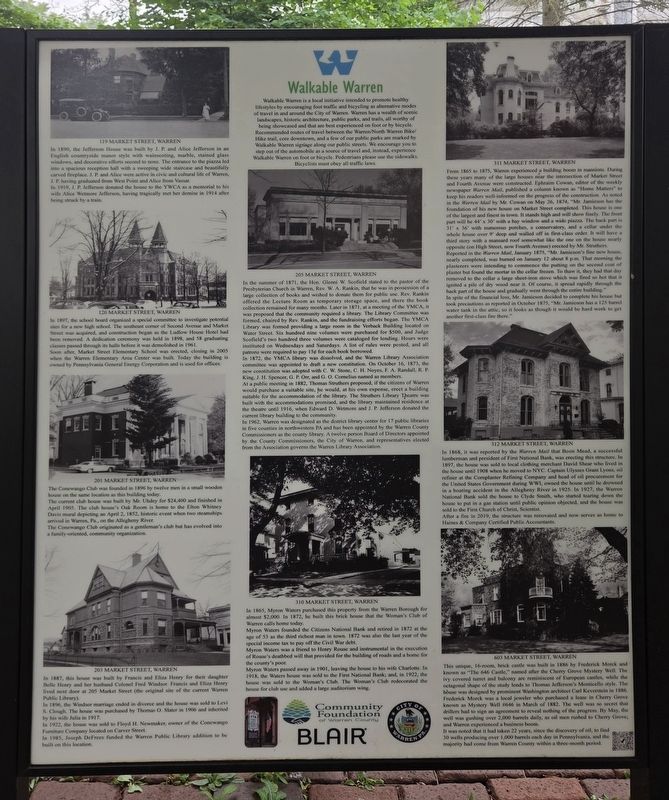
Walkable Warren
Walkable Warren is a local initiative intended to promote healthy lifestyles by encouraging foot traffic and bicycling as alternative modes of travel in and around the City of Warren. Warren has a wealth of scenic landscapes, historic architecture, public parks, and trails, all worthy of being showcased and that are best experienced on foot or by bicycle. Recommended routes of travel between the Warren/North Warren Bike/Hike trail, core downtown, and a few of our public parks are marked by Walkable Warren signage along our public streets. We encourage you to step out of the automobile as a source of travel and, instead, experience Walkable Warren on foot or bicycle. Pedestrians please use the sidewalks. Bicyclists must obey all traffic laws.
119 Market Street, Warren
In 1890, the Jefferson House was built by J. P. and Alice Jefferson in an English countryside manor style with wainscoting, marble, stained glass windows, and decorative efforts second to none. The entrance to the piazza led into a spacious reception hall with a sweeping wide staircase and beautifully carved fireplace.
this page online
In 1919, J. P. Jefferson donated the house to the YWCA as a memorial to his wife Alice Wetmore Jefferson, having tragically met her demise in 1914 after being struck by a train.
120 Market Street, Warren
In 1897, the school board organized a special committee to investigate potential sites for a new high school. The southeast corner of Second Avenue and Market Street was acquired, and construction began as the Ludlow House Hotel had been removed. A dedication ceremony was held in 1898, and 58 graduating classes passed through its halls before it was demolished in 1961
Soon after, Market Street Elementary School was erected, closing in 2005 when the Warren Elementary Area Center was built. Today the building is owned by Pennsylvania General Energy Corporation and is used for offices.
201 Marker Street, Warren
The Conewango Club was founded in 1896 by twelve men in a small wooden house on the same location as this building today.
The current club house was built by Mr. Uhdey for $24,400 and finished
Photographed by Mark Parker, July 16, 2026
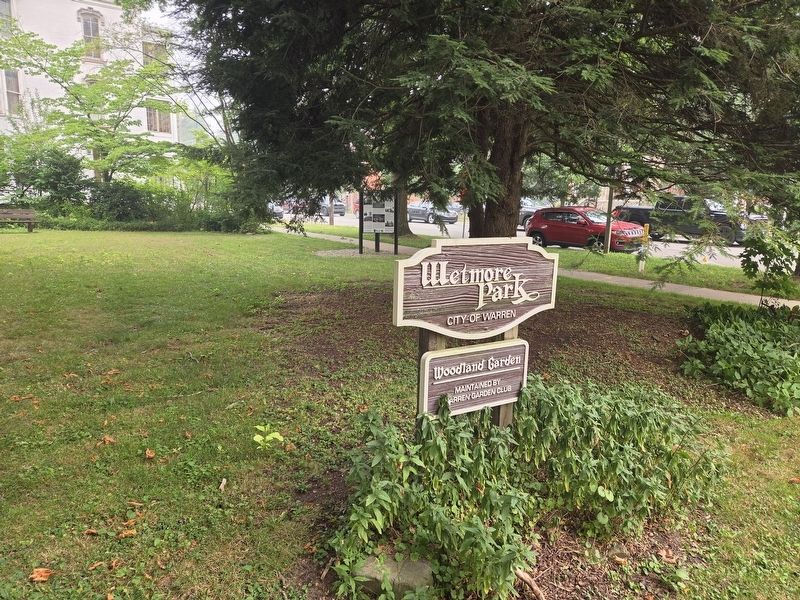
2. Market Street Kiosk Marker at Wetmore Park
The Conewango Club originated as a gentleman’s club but has evolved into a family-oriented, community organization.
203 Market Street, Warren
In 1887, this house was built by Francis and Eliza Henry for their daughter Belle Henry and her husband Colonel Fred Windsor. Francis and Eliza Henry lived next door at 205 Market Street (the original site of the current Warren Public Library).
In 1896, the Windsor marriage ended in divorce and the house was sold to Levi S. Clough. The house was purchased by Thomas O. Slater in 1906 and inherited by his wife Julia in 1917.
In 1922, the house was sold to Floyd H. Newmaker, owner of the Conewango Furniture Company located on Carver Street.
In 1985, Joseph DeFrees funded the Warren Public Library addition to be built on this location.
205 Market Street, Warren
In the summer of 1871, the Hon. Glenni W. Scofield stated to the pastor of the Presbyterian Church in Warren, Rev. W. A. Rankin, that
Photographed by Mark Parker, July 16, 2026
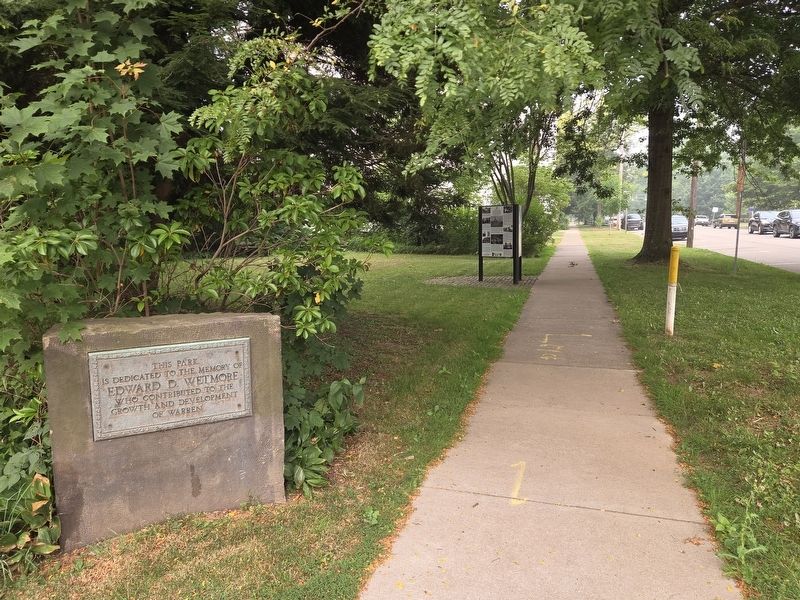
3. Market Street Kiosk along 4th Ave at Wetmore Park
In 1872, the YMCA library was dissolved, and the Warren Library Association committee was appointed to draft a new constitution. On October 16, 1873, the new constitution was adopted with C. W. Stone, C. H. Noyes, F. A. Randall, R. P. King, J. H. Spencer, G. P. Orr, and G. O. Cornelius named as members.
At a public meeting in 1882, Thomas Struthers proposed, if the citizens of Warren would purchase a suitable site, he would, at his own expense, erect a building suitable for the accommodation of the library. The Struthers Library Theatre was built with the accommodations promised, and the library maintained residence at the theatre until 1916, when Edward D. Wetmore and J. P. Jefferson donated the current library building to the community.
In 1962, Warren was designated as the district library center for 17 public libraries in five counties in northwestern PA and has been appointed by the Warren County Commissioners as the county library. A twelve person Board of Directors appointed by the County Commissioners, the City of Warren, and representatives elected from the Association governs the Warren Library Association.
310 Marker Street, Warren
In 1865, Myron Waters purchased this property from the Warren Borough for almost $2,000. In 1872, he built this brick house that the Woman’s Club of Warren calls home today.
Myron Waters founded the Citizens National Bank and retired in 1872 at the age of 53 as the third richest man in town. 1872 was also the last year of the special income tax to pay off the Civil War debt.
Myron Waters was a friend to Henry Rouse and instrumental in the execution of Rouse’s deathbed will that provided for the building of roads and a home for the county’s poor.
Myron Waters passed away in 1901, leaving the house to his wife Charlotte. In 1918, the Waters house was sold to the First National Bank; and, in 1922, the house was sold to the Woman’s Club. The Woman’s Club redecorated the house for club use and added a large auditorium wing.
311 Marker Street, Warren
From 1865 to 1875, Warren experienced a building boom in mansions. During these years many of the large houses near the intersection of Market Street and Fourth Avenue were constructed. Ephraim Cowan, editor of the weekly newspaper Warren Mail, published a column known as “Home Matters” to keep his readers well-informed on the progress of the construction. As noted in the Warren Mail by Mr. Cowan on May 26, 1874, “Mr. Jamieson has the foundation of his new house on Market Street completed. This house is one of the largest and finest in town. It stands high and will show finely. The front part will be 44’ x 30’ with a bay window and a wide piazza. The back part is 31’ x 36’ with numerous porches, a conservatory, and a cellar under the whole house over 9’ deep and walled off in first-class order. It will have a third story with a mansard roof somewhat like the one on the house nearly opposite (on High Street, now Fourth Avenue) erected by Mr. Struthers.
Reported in the Warren Mail, January 1875, “Mr. Jamieson’s fine new house, nearly completed, was burned on January 12 about 8 p.m. That morning the plasterers were intending to commence the putting on the second coat of plaster but found the mortar in the cellar frozen. To thaw it, they had that day removed to the cellar a large sheet-iron stove which was fired so hot that it ignited a pile of dry wood near it. Of course, it spread rapidly through the back part of the house and gradually went through the entire building.”
In spite of the financial loss, Mr. Jamieson decided to complete his house but took precautions as reported in October 1875, “Mr. Jamieson has a 125 barrel water tank in the attic; so it looks as though it would be hard work to get another first-class fire there.”
312 Market Street, Warren
In 1868, it was reported by the Warren Mail that Boon Mead, a successful lumberman and president of First National Bank, was erecting this structure. In 1897, the house was sold to local clothing merchant David Shear who lived in the house until 1908 when he moved to NYC. Captain Ulysses Grant Lyons, oil refiner at the Cornplanter Refining Company and head of oil procurement for the United States Government during WWI, owned the house until he drowned in a boating accident in the Allegheny River in 1925. In 1927, the Warren National Bank sold the house to Clyde Smith, who started tearing down the house to put in a gas station until public opinion objected, and the house was sold to the First Church of Christ, Scientist.
After a fire in 2019, the structure was renovated and now serves as home to Haines & Company Certified Public Accountants.
603 Marker Street, Warren
This unique, 16-room, brick castle was built in 1886 by Frederick Morck and known as “The 646 Castle,” named after the Cherry Grove Mystery Well. The ivy covered turret and balcony are reminiscent of European castles, while the octagonal shape of the study lends to Thomas Jefferson’s Monticello style. The house was designed by prominent Washington architect Carl Keverstein in 1886. Frederick Morck was a local jeweler who purchased a lease in Cherry Grove known as Mystery Well #646 in March of 1882. The well was so secret that drillers had to sign an agreement to reveal nothing of the progress. By May, the well was gushing over 2,000 barrels daily, as oil men rushed to Cherry Grove; and Warren experienced a business boom.
It was noted that it had taken 22 years, since the discovery of oil, to find 30 wells producing over 1,000 barrels each day in Pennsylvania, and the majority had come from Warren County within a three-month period.
Erected by Warren County Historical Society, Blair, Community Foundation of Warren County, City of Warren.
Topics. This historical marker is listed in these topic lists: Architecture • Arts, Letters, Music • Industry & Commerce • Notable Buildings. A significant historical year for this entry is 1890.
Location. 41° 50.875′ N, 79° 8.788′ W. Marker is in Warren, Pennsylvania, in Warren County. It is on 4th Avenue (U.S. 62) west of Market Street, on the right when traveling east. The kiosk location is the north side of Wetmore Park. Touch for map. Marker is at or near this postal address: 211 4th Ave, Warren PA 16365, United States of America. Touch for directions.

Regionally, this marker is in Northwestern Pennsylvania and specifically in the Pennsylvania Wilds. It is also in the American Northeast, in the Mid-Atlantic, in Appalachia, and specifically in Northern Appalachia. Globally, it is in North America, the Western Hemisphere, the Western World, and the Anglosphere. Historically, it finds itself in what was once the Haudenosaunee (Iroquois) Confederacy and also one of the original Thirteen Colonies.
Other nearby markers. At least 8 other markers are within walking distance of this marker: Fourth Avenue Kiosk (here, next to this marker); People in Early Warren (here, next to this marker); Warren County (within shouting distance of this marker); St. Louis Arch (within shouting distance of this marker); Struthers-Wetmore-Schimmelfeng House (within shouting distance of this marker); Struthers Library Building (about 700 feet away, measured in a direct line); Third Avenue Kiosk (approx. 0.2 miles away); Liberty Street Kiosk (approx. 0.2 miles away). Touch for a list and map of all markers in Warren.
Credits. This page was last revised on September 17, 2026. It was originally submitted on July 29, 2026, by Mark Parker of Hickory, North Carolina. This page has been viewed 11 times since then. Photos: 1. submitted on July 29, 2026, by Mark Parker of Hickory, North Carolina. 2, 3. submitted on July 30, 2026, by Mark Parker of Hickory, North Carolina. • Bill Pfingsten was the editor who published this page.
