Saint-Germain-l'Auxerrois in Paris, Paris Region, France — Western Europe
Les bouquinistes de la Seine
Histoire de Paris
⎯⎯⎯
The Booksellers of the Seine
History of Paris
Photographed by James Hulse, July 30, 2026
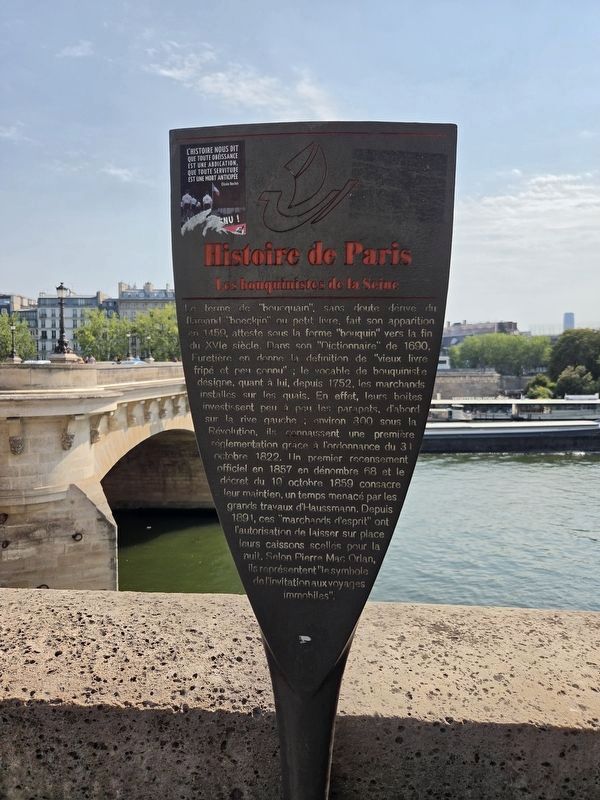
1. Les bouquinistes de la Seine / The Booksellers of the Seine Marker

Le terme de « boucquain », sans doute dérivé du flamand « boeckjin », ou petit livre, fait son apparition en 1459, attesté sous la forme « bouquin » vers la fin du XVIe siècle. Dans son Dictionnaire de 1690, Furetière en donne la définition de « vieux livre fripé et peu connu » ; le vocable de bouquiniste désigne, quant à lui, depuis 1752, les marchands installés sur les quais. En effet, leurs boîtes investissent peu à peu les parapets, d’abord sur la rive gauche. Environ 300 sous la Révolution, ils connaissent une première réglementation grâce à l’ordonnance du 31 octobre 1822. Un premier recensement officiel, en 1857, en dénombre 68, et le décret du 10 octobre 1859 consacre leur maintien, un temps menacé par les grands travaux d’Haussmann. Depuis 1891, ces « marchands d’esprit » ont l’autorisation de laisser sur place leurs caissons scellés pour la nuit. Selon Pierre Mac Orlan, ils représentent « le symbole de l’invitation aux voyages immobiles ».
The term “boucquain,” probably derived from the Flemish word “boeckjin,” meaning a small book, first appeared in 1459 and was recorded
this page online
Topics and series. This historical marker is listed in these topic lists: Arts, Letters, Music • Industry & Commerce. In addition, it is included in the Histoire de Paris series list. A significant historical date for this entry is October 31, 1822.
Location. 48° 51.509′ N, 2° 20.522′ E.
Photographed by James Hulse, July 30, 2026
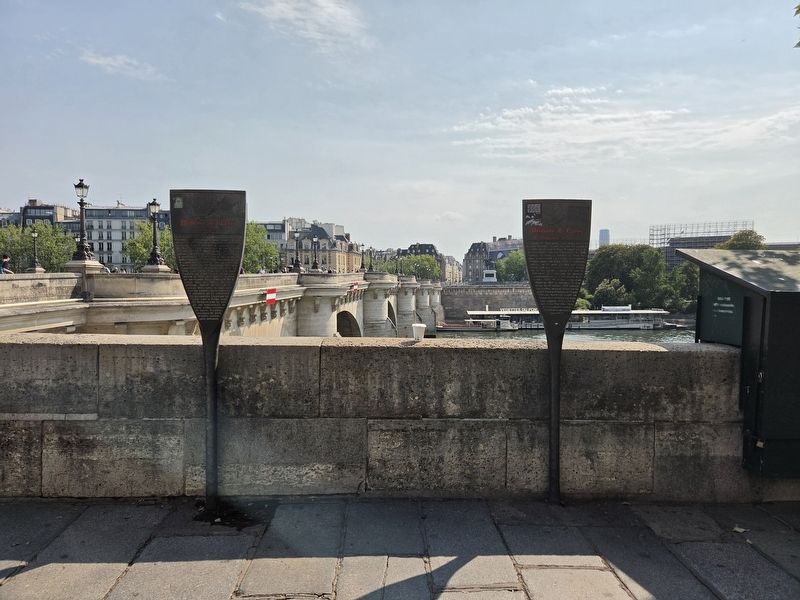
2. Les bouquinistes de la Seine / The Booksellers of the Seine Marker
The Pont-Neuf marker is on the left, and The Booksellers of the Seine marker is on the right.

Regionally, it is in the North Atlantic Region, Europe, the European Union, Atlantic Europe, the Schengen Area, Western Europe, a coastal Mediterranean country, and the Western World. Historically, it finds itself in what was once a French colony and also the Roman Empire.
Other nearby markers. At least 8 other markers are within walking distance of this marker: Pont-Neuf (here, next to this marker); Jacques de Molay (about 180 meters away, measured in a direct line in Île-de-France); André Antoine (1858 - 1943) (about 180 meters away in Île-de-France); Square du Vert-Galant (about 180 meters away in Île-de-France); Martin et Karl Flinker (about 210 meters away in Île-de-France); Square Michel-Caldaguès Jewish Children’s Memorial (about 210 meters away in Île-de-France); Jean-François Cail (approx.

Photographed by James Hulse, July 30, 2026
3. Les bouquinistes de la Seine / The Booksellers of the Seine Marker
The view of the markers long the street and river.
Additional keywords. panneau
Photographed by Editions C.L.C., circa 1904
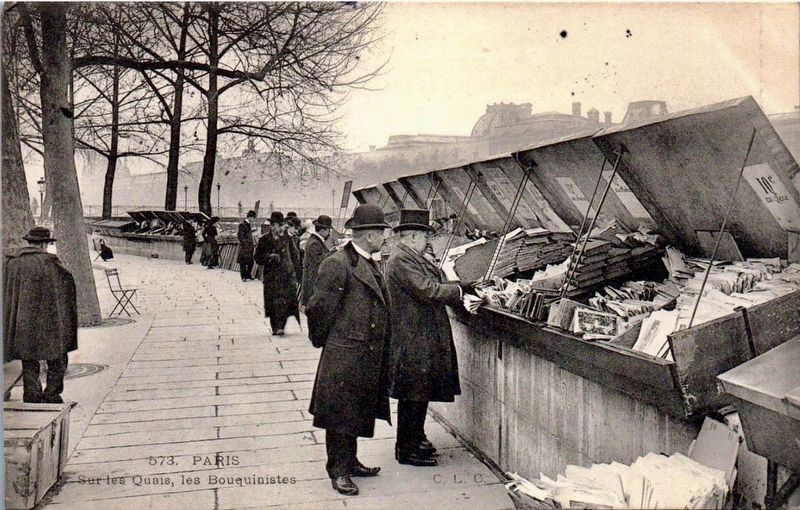
4. Les bouquinistes
Photographed by Adam Margolis, June 19, 2026
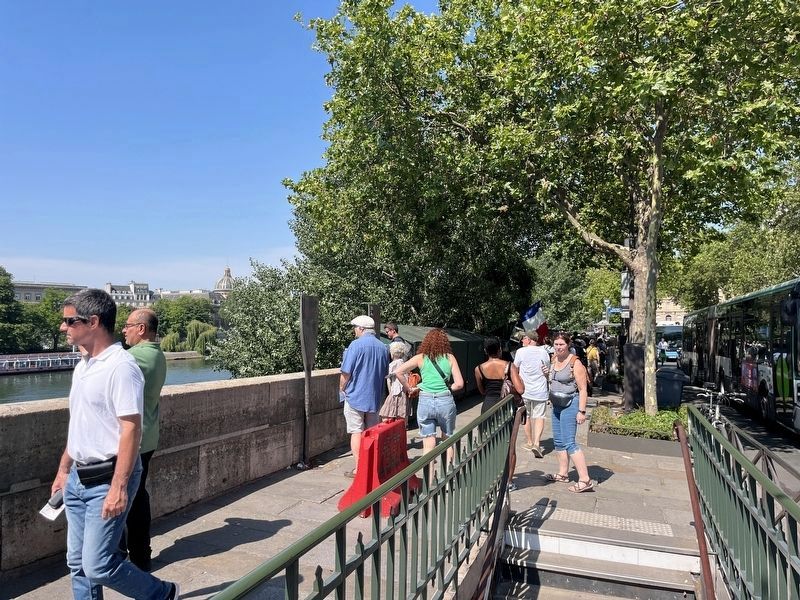
5. Les bouquinistes de la Seine / The Booksellers of the Seine Marker
Credits. This page was last revised on August 6, 2026. It was originally submitted on July 30, 2026, by James Hulse of Medina, Texas. This page has been viewed 25 times since then. Photos: 1, 2, 3. submitted on July 30, 2026, by James Hulse of Medina, Texas. 4. submitted on August 1, 2026. 5. submitted on August 4, 2026, by Adam Margolis of Mission Viejo, California.
