Texas Produce Company/Richie Grocery Building
Est. 1894
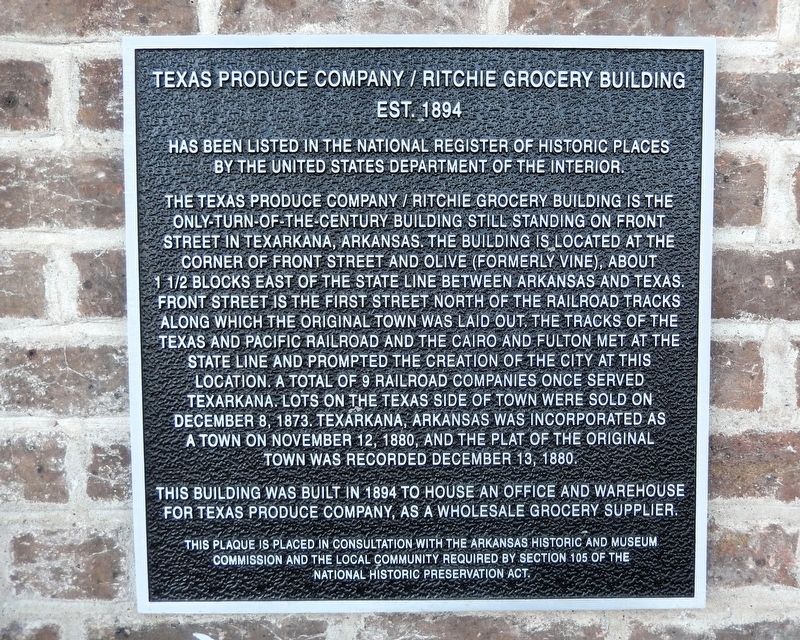
Has been listed in the National Register of Historic Places by the United States Department of the Interior.
The Texas Produce Company / Ritchie Grocery Building is the only turn-of-the-century building still standing on Front Street in Texarkana, Arkansas. The building is located at the corner of front Street and Olive (formerly Vine), about 1½ blocks east of the state line between Arkansas and Texas. Front Street is the first street north of the railroad tracks along which the original town was laid out. The tracks of the Texas and Pacific Railroad and the Cairo and Fulton met at the state line and prompted the creation of the city at this location. A total of 9 railroad companies once served Texarkana. Lots on the Texas side of town were sold on December 8, 1873. Texarkana, Arkansas was incorporated as a town on November 12, 1880, and the plat of the original town was recorded December 13, 1880.
This building was built in 1894 to house an office and warehouse for Texas Produce Company, as a wholesale grocery supplier.
This plaque is placed in consultation with the Arkansas Historic and Museum Commission and the local community required by section 105 of the National Historic Preservation Act.
Topics and series.
this page online
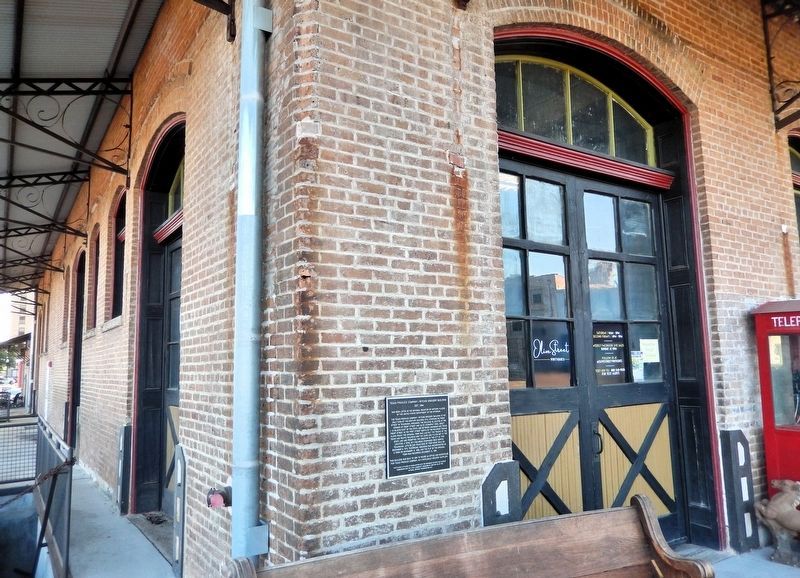
Location. 33° 25.262′ N, 94° 2.486′ W. Marker is in Texarkana, Arkansas, in Miller County. It is at the intersection of Olive Street and East Front Street, on the right when traveling south on Olive Street. The marker is mounted on the southeast corner of the building, facing Olive Street. Touch for map. Marker is at or near this postal address: 105 Olive Street, Texarkana AR 71854, United States of America. Touch for directions.

Regionally, this marker is in the Gulf Coastal Plain. It is also in the American South, specifically in the Upper South, and in the Piney Woods. Globally, it is in North America, the Western Hemisphere, the Western World, and the Anglosphere. Historically, it finds itself in what was once New Spain, the territory of the Mississippian Culture, the Louisiana Purchase, one of the Confederate States of America,
Other nearby markers. At least 8 other markers are within walking distance of this marker: Booth-Rowe Building (about 300 feet away, measured in a direct line); Sandberger-Rowe Building (about 300 feet away); East Broad Street Historic District (about 400 feet away); First Disciples of Christ in Texas (about 700 feet away in Texas); Offenhauser Building (about 700 feet away in Texas); Otis Williams & The Temptations Mural (approx. 0.2 miles away in Texas); Saenger Theatre (approx. 0.2 miles away in Texas); Texarkana Arkansas Municipal Building (approx. 0.2 miles away). Touch for a list and map of all markers in Texarkana.
Regarding Texas Produce Company/Richie Grocery Building. National Register of Historic Places № 90000900.
From the National Register Nomination prepared by Kenneth Story, 5/4/1990:
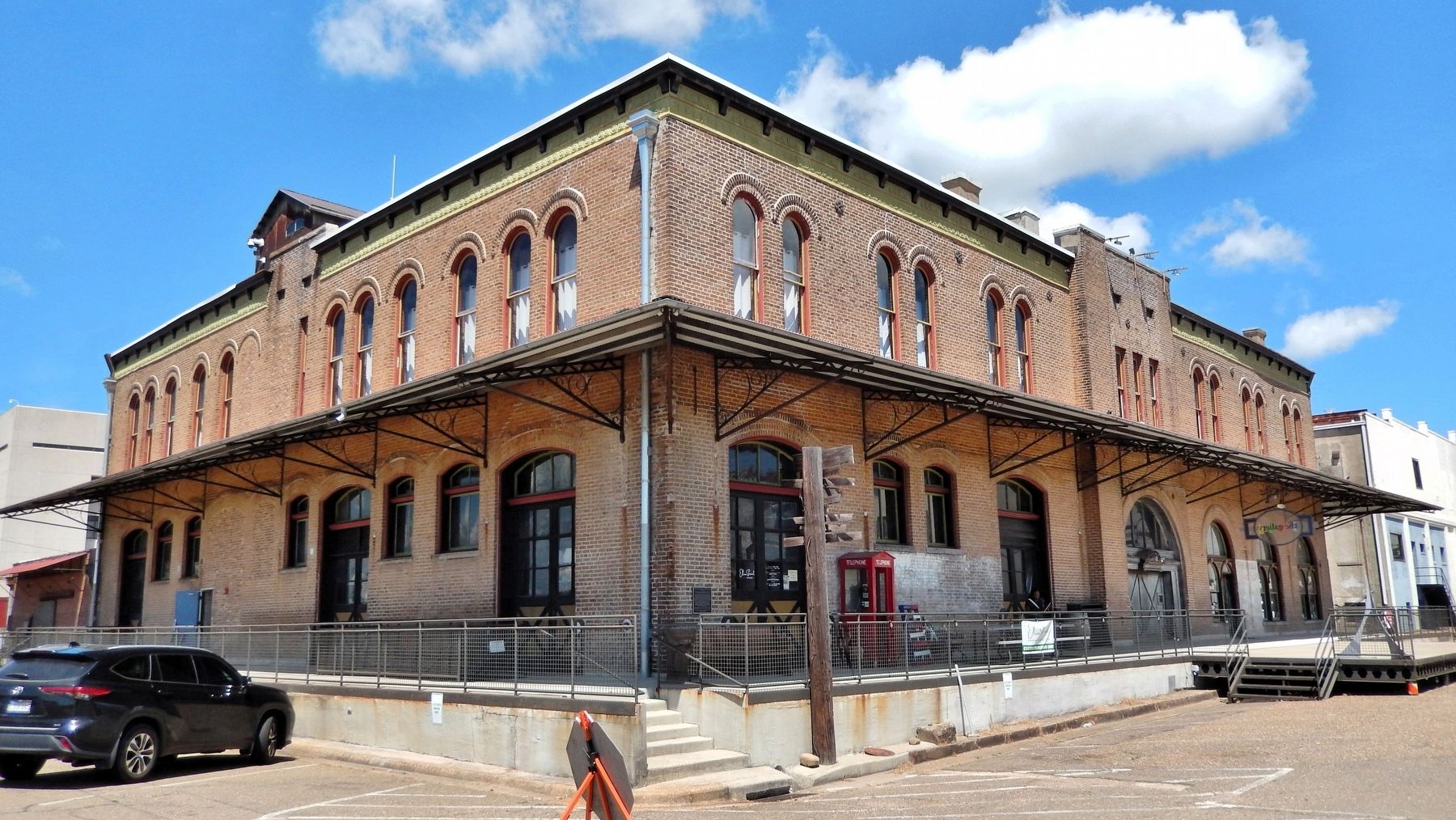
The Ritchie Grocery Building is a two story, brick masonry, commercial retail and warehouse building designed in the later, more delicate interpretation of the Romanesque Revival first made popular in America by the Boston architect H.H. Richardson. Its plan is roughly square with a later metal awningcovering a later concrete loading dock on the southern and eastern elevations and a screened porch on the northern elevation. Three concrete chimneys rise from the interior near the eastern elevation and the gable roofed cover to the elevator shaft rises toward the southern elevation. The flat, built-up tar roof is set behind a brick parapet, the walls are sheathed with brick, and the entire structure is supported by a continuous cast concrete foundation. A partial basement beneath the building originally housed refrigeration equipment.Photographed by Cosmos Mariner, July 1, 20253. Richie Grocery Building (southeast elevation)The eastern or front elevation features a central, slightly projecting bay with a double-leaf cargo door and arched, multi-pane transom in the first floor and three arched windows in the second floor. The first story wall to the south of the projecting bay is punctuated with two double-leaf cargo doors flanking two smaller arched windows. The wall to the north on the first story features three arched window openings — each subdivided into two smaller arched windows with an arched transom above — placed around another arched entry. The second story wall is fenestrated by six pairs of arched windows placed
symmetrically around the central projecting bay. A metal cornice completes the elevation.The southern elevation is accessed by four separate, double-leaf arched entries on the first floor, with smaller arched windows placed between them. The second story is lighted by eleven arched windows, though there were originally thirteen openings (two have since been filled). A metal cornice caps this elevation also.
Frances William Mullins moved to Texarkana in 1884 to establish the Texas Produce Company, a wholesale produce and grocery business and the first in the city. The company was originally located on the Texas side of town on Main Street. This building was built c. 1900 to house the company. Mr. Mullins is credited with revolutionizing the wholesale produce and grocery business by using the railways to make daily shipments of perishable goods to Little Rock, Pine Bluff and points in Texas.
In February of 1926 the building was sold to the Ritchie Grocery Company for $60,000. The Ritchie Grocery Company was organized in Camden, Arkansas in 1886 and headquartered in El Dorado, Arkansas by 1903. It was founded by J.C. Ritchie and W.W. Brown for the primary purpose of selling food stuffs and hay for livestock; however, due to its almost immediate success, it soon expanded into “staple and fancy groceries,” carrying a much broader line of such other items as hardware and appliances. Its success also led to the establishment of one of Arkansas' earliest chain wholesale department stores. In addition to operating the El Dorado and Texarkana stores by 1926, the company opened stores in Pine Bluff and Magnolia at about the same time. The Ritchie Grocery Company operated the Texarkana branch of its wholesale grocery business in this building until the mid-1970's.
Also see . . .
1. Ritchie Grocery Building (Wikipedia).
Excerpt: The Ritchie Grocery Building is a two-story brick and masonry building with a flat roof and a parapet along the main facade. It was built in 1894 by Francis Mullins, owner of the Texas Produce Company, the first major grocery wholesaler in the city, founded in 1884. It is the only surviving Romanesque Revival building in downtown Texarkana, and the building was purchased by the Ritchie Grocery Company in 1926. The building was purchased in 2017 by 1894 LLC and is being renovated to its original glory. The name of the building was changed to 1894 City Market. An art gallery is housed on the first floor, an event room on the second floor, and loft apartments on the third. The building was listed on the National Register of Historic Places in 1990.(Submitted on August 1, 2026, by Cosmos Mariner of Cape Canaveral, Florida.)
2. Texarkana, Texas (Wikipedia).
Excerpt: Railroads were quick to see the possibilities of connecting markets in this vast area. In the late 1850s, the builders of the Cairo and Fulton Railroad were pushing their line steadily south across Arkansas. By 1874, they crossed the Red River and reached the Texas state line. Between February 16 and March 19, 1874, trains ran between the Texas border and the Red River, whence passengers and freight were ferried north to Fulton, Arkansas to continue by rail. The Red River Bridge opened on March 20, 1874. Keen rivalry existed between the 1870s railroad builders. The Texas and Pacific Railroad reached across Texas to the Arkansas state line. The border was the logical place for the different railways to connect.(Submitted on August 1, 2026, by Cosmos Mariner of Cape Canaveral, Florida.)
Credits. This page was last revised on August 1, 2026. It was originally submitted on July 31, 2026, by Cosmos Mariner of Cape Canaveral, Florida. This page has been viewed 11 times since then. Photos: 1, 2, 3. submitted on August 1, 2026, by Cosmos Mariner of Cape Canaveral, Florida.
