Near Brookneal in Campbell County, Virginia — The American South (Mid-Atlantic)
Kitchen
Patrick Henry’s Red Hill
Photographed by Tom Bosse, July 4, 2026
1. Kitchen Marker
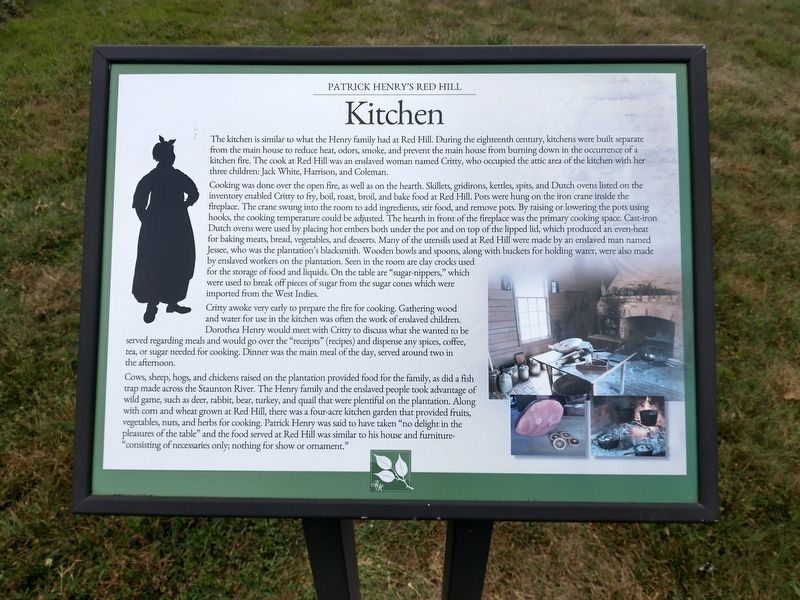
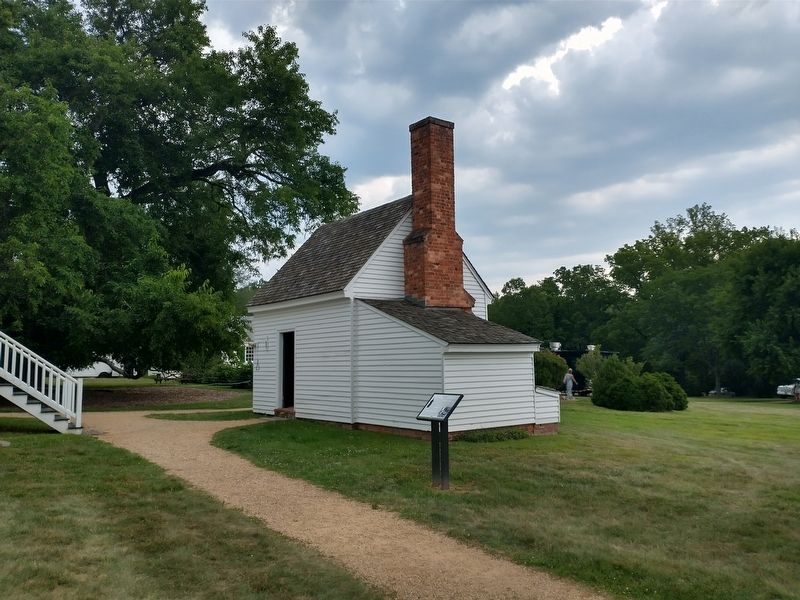
Cooking was done over the open fire, as well as on the hearth. Skillets, gridirons, kettles, spits, and Dutch ovens listed on the inventory enabled Critty to fry, boil, roast, broil, and bake food at Red Hill. Pots were hung on the iron crane inside the fireplace. The crane swung into the room to add ingredients, stir food, and remove pots. By raising or lowering the pots using hooks, the cooking temperature could be adjusted. The hearth in front of the fireplace was the primary cooking space. Cast-iron Dutch ovens were used by placing hot embers both under the pot and on top of the lipped lid, which produced an even-heat for baking meats, bread, vegetables, and desserts. Many of the utensils used at Red Hill
this page online
Critty awoke very early to prepare the fire for cooking, Gathering wood and water for use in the kitchen was often the work of enslaved children. Dorothea Henry would meet with Critty to discuss what she wanted to be served regarding meals and would go over the "receipts" (recipes) and dispense any spices, coffee, tea, or sugar needed for cooking. Dinner was the main meal of the day, served around two in the afternoon.
Cows, sheep, hogs, and chickens raised on the plantation provided food for the family, as did a fish trap made across the Staunton River. The Henry family and the enslaved people took advantage of wild game, such as deer, rabbit, bear, turkey, and quail that were plentiful on the plantation. Along with com
Photographed by Tom Bosse, July 4, 2026
2. Kitchen Marker
Erected by Patrick Henry National Memorial.
Topics. This historical marker is listed in these topic lists: African Americans • Architecture.
Location. 37° 1.93′ N, 78° 53.873′ W. Marker is near Brookneal, Virginia, in Campbell County. It can be reached from Red Hill Road (County Route 677) 1.2 miles south of Patrick Henry Road, on the left when traveling south. Marker is located at Red Hill Patrick Henry National Memorial. Touch for map. Marker is at or near this postal address: 1250 Red Hill Road, Brookneal VA 24528, United States of America. Touch for directions.

Regionally, this marker is in the Piedmont and in Central Virginia. It is also in the American South and specifically in the Upper South. Globally, it is in North America, the Western Hemisphere, the Western World, and the Anglosphere. Historically, it finds itself in what was once the territory of the Mississippian Culture, one of the original Thirteen Colonies, one of the Confederate States of America, and the Antebellum South.
Other nearby markers. At least 8 other markers are within walking distance of this marker: Osage Orange Tree (a few steps from this marker); Patrick Henry House (a few steps from this marker); Harrison's Cabin (a few steps from this marker); The Henry House (within shouting distance of this marker); Slave Cabin (within shouting distance of this marker); Henry's Law Office (within shouting distance of this marker); a different marker also named Osage Orange Tree (within shouting distance of this marker); The Nancy Case Kelly Memorial Herb Garden (within shouting distance of this marker). Touch for a list and map of all markers in Brookneal.
Also see . . . Red Hill. Patrick Henry National Memorial (Submitted on August 1, 2026.)
Credits. This page was last revised on August 1, 2026. It was originally submitted on August 1, 2026, by Tom Bosse of Jefferson City, Tennessee. This page has been viewed 8 times since then. Photos: 1, 2. submitted on August 1, 2026, by Tom Bosse of Jefferson City, Tennessee. • Bernard Fisher was the editor who published this page.
