Granville in Licking County, Ohio — The American Midwest (Great Lakes)
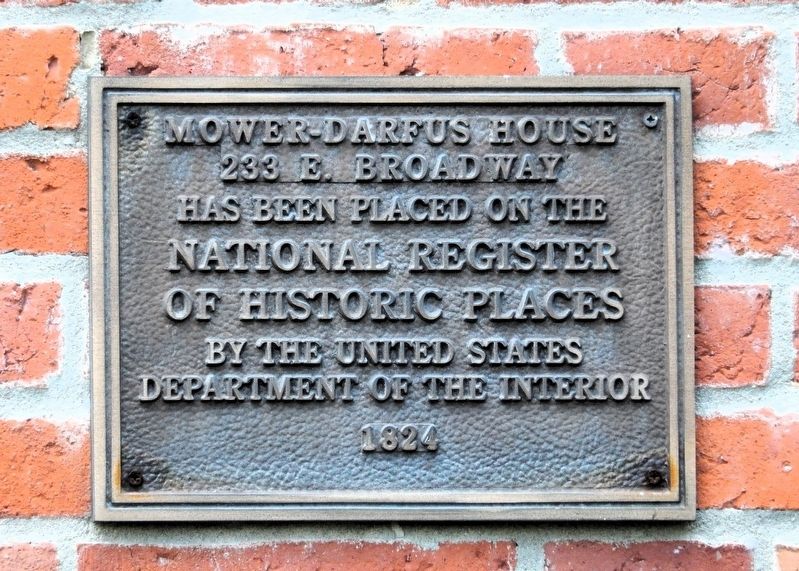
Mower-Darfus House
233 E. Broadway
Photographed by Cosmos Mariner, September 12, 2022
1. Mower-Darfus House Marker
233 E. Broadway
has been placed on the
National Register of Historic Places
by the United States Department of the Interior
1824
Topics and series. This historical marker is listed in this topic list: Architecture. In addition, it is included in the National Register of Historic Places (NRHP) series list. A significant historical year for this entry is 1824.
Location. 40° 4.054′ N, 82° 31.032′ W. Marker is in Granville, Ohio, in Licking County. It is on East Broadway (State Highway 661) just west of South Pearl Street, on the right when traveling east. The marker is mounted directly on the subject house, on the right side of the front entrance. Touch for map. Marker is at or near this postal address: 233 East Broadway, Granville OH 43023, United States of America. Touch for directions.

Regionally, this marker is in the Columbus Metropolitan Area. It is also in the American Midwest, in the Corn Belt, in Appalachia, and specifically in Northern Appalachia. Globally, it is in North America, the Western Hemisphere, the Western World, and the Anglosphere. Historically, it finds itself in what was once the
this page online
Other nearby markers. At least 8 other markers are within walking distance of this marker: The Robbins Hunter Museum Avery-Downer House (within shouting distance of this marker); Granville Inn (about 400 feet away, measured in a direct line); Bancroft House (about 400 feet away); 223 East Elm Street (about 400 feet away); George T. Jones House (about 400 feet away); Utter House (about 400 feet away); College Town House (about 500 feet away); Roswell Graves House (about 600 feet away). Touch for a list and map of all markers in Granville.
Regarding Mower-Darfus House. Contributing property, Granville Historic District, National Register of Historic Places № 80003138.
From the National Register Nomination prepared by P. Reed, 11/28/1980:
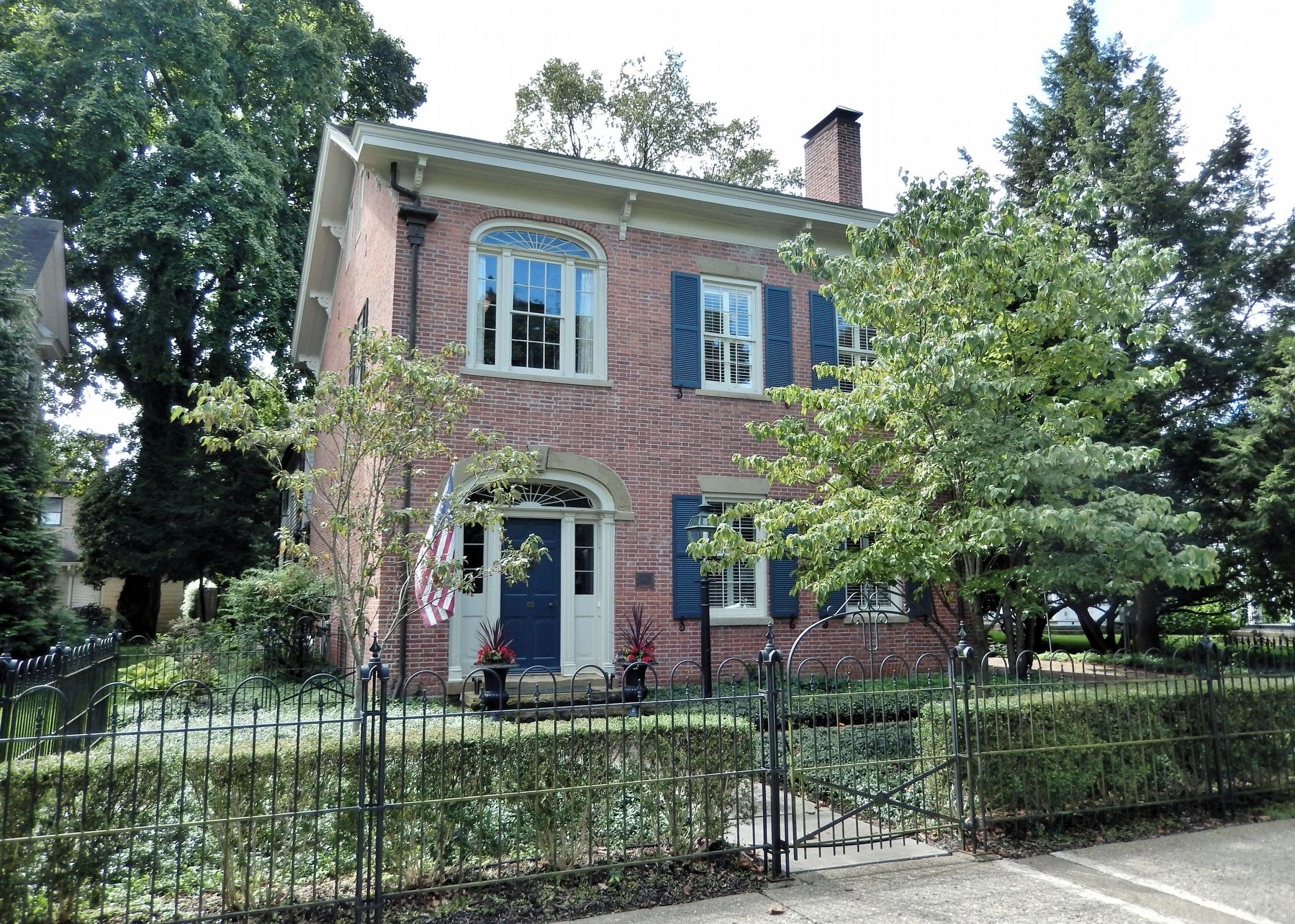
Granville is rich in both architecture and history. The nominated properties include an historic district in the center of town and additional individual properties within the corporation limits. The nomination is based on a comprehensive inventory conducted by Dr. Horace King,an expert on Granville architecture and history. The district is roughly bounded by Denison University on Prospect Hill and College Street on the north, the eastern and western boundaries of the town — Sugar Loaf Hill and Mt. Parnassus and by Elm Street on the south. The length of Broadway, the major east-west thoroughfare, forms the backbone of the district. It can be divided easily into three components. The western section is residential in character with a few University buildings on the north side of the street and with a landscaped island down the center of the street; the corner of Broadway and Main streets is the village center and has three churches and an opera house (originally a church) on the four corners; the eastern section is commercial in nature with a row of commercial structures, the Granville and Buxton Inns with private residences interspersed among them. The remainder of the district consists of attractive residential streets and a portion of the Denison University campus.Photographed by Cosmos Mariner, September 12, 20222. Mower-Darfus House (north/front elevation)The marker is on the right side of the front entrance.Constructed in 1824, the Lucius Mower house is an excellent example of Federal architecture in Granville. The house is constructed of brick
laid in Flemish bond. Carved wood trim surrounds the fanlight entrance and Palladian window above. Lucius Mower was 12 when he arrived from Granville, Mass. and was 31 when he completed this house. He was a master craftsman.
Also see . . .
1. Mower-Darfus House (Granville Historic Landmarks).
(by Lindy Wicks) Excerpt: Col. Lucius D. Mower was 12 years old when he came from Granville, Mass., and he was 31 when he finished building this house. He was a smart merchant, money manager, and supporter of the Ohio and Erie Canals, as well as a talented craftsman. After he died and after his wife, Lucy Munson Mower, passed away, the house was used as a bank for several years. The iron vault from the Old Alexandrian Society Bank is housed there.(Submitted on August 2, 2026, by Cosmos Mariner of Cape Canaveral, Florida.)
2. Lucius D. Mower (1793-1834) (Granville Historical Society).
Excerpt: Lucius Doolittle Mower was early Granville’s most prominent and successful businessman, exercising a substantial beneficial impact on the Granville economy of the 1820s and early 1830s. His enterprises ran the gamut from canal construction to general store proprietorship to livestock, and notably to part-ownership of the Granville Furnace, the village’s briefly successful iron foundry. Mower’s financial success, however, was no protection from an early death – a fate that plagued others in his family as well. Lucius Mower died in 1834 at the age of 41, a victim of “consumption,” the illness that probably was the disease we call tuberculosis today. His untimely death rocked the Granville community financially, putting a damper on his businesses and reducing the availability of capital locally.(Submitted on August 2, 2026, by Cosmos Mariner of Cape Canaveral, Florida.)
Credits. This page was last revised on August 2, 2026. It was originally submitted on August 1, 2026, by Cosmos Mariner of Cape Canaveral, Florida. This page has been viewed 12 times since then. Photos: 1, 2. submitted on August 2, 2026, by Cosmos Mariner of Cape Canaveral, Florida.
