Near Brookneal in Campbell County, Virginia — The American South (Mid-Atlantic)
Henry's Law Office
Patrick Henry's Red Hill

Photographed by Tom Bosse, July 4, 2026
1. Henry's Law Office Marker
In the main room, Patrick Henry recorded his plantation expenses and credits in his ledger book, composed letters to family members, clients, and friends, which included a letter to President Washington, declining the position of Chief Justice of the Supreme Court. He also educated his children in a variety of subjects including mathematics, geography, history, poetry, and religion. A devout Christian, Patrick Henry retired to his office at the end of each day for an hour of prayer and meditation.
In the office, there is a framed copy of the entry in the court order book evidencing Patrick Henry's right to practice law in Goochland
this page online
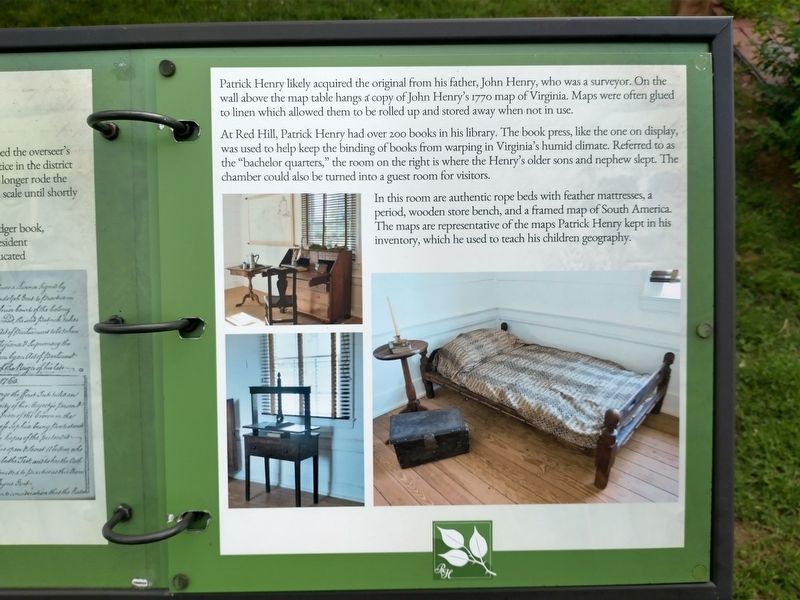
The reproduction of Patrick Henry's "map table" has arms that fold out to view large documents.
Patrick Henry likely acquired the original from his father, John Henry, who was a surveyor. On the all above the map table hands a coy of John Henry's 1770 map of Virginia. Maps were often glued to linen which allowed them to be rolled up and stored away when not in use.
At Red Hill, Patrick Henry had over 200 books in his library. The book press, like the one on display, was used to help keep the binding of books from warping in Virginia's humid climate. Referred to as the "bachelor quarters", the room on the right is where the Henry's older sons and nephew slept. The chamber could also be turned into a guest room for visitors.
In this room are authentic rope beds with feather mattresses, a period, wooden store bench, and a framed map of South America. The maps are representative
Photographed by Tom Bosse, July 4, 2026
2. Henry's Law Office Marker
Erected by Patrick Henry National Memorial.
Topics. This historical marker is listed in these topic lists: Notable Buildings • Patriots & Patriotism. A significant historical year for this entry is 1794.
Location. 37° 1.942′ N, 78° 53.858′ W. Marker is near Brookneal, Virginia, in Campbell County. It can be reached from Red Hill Road (County Route 677) 1.2 miles south of Patrick Henry Road (County Route 619), on the left when traveling south. Marker is located at the Red Hill Patrick Henry National Memorial. Touch for map. Marker is at or near this postal address: 1250 Red Hill Rd, Brookneal VA 24528, United States of America. Touch for directions.

Regionally, this marker is in the Piedmont and in Central Virginia. It is also in the American South and specifically in the Upper South. Globally, it is in North America, the Western Hemisphere, the Western World, and the Anglosphere. Historically, it finds itself in what was once the territory of the Mississippian Culture, one of the original Thirteen Colonies, one of the
Photographed by Tom Bosse, July 4, 2026
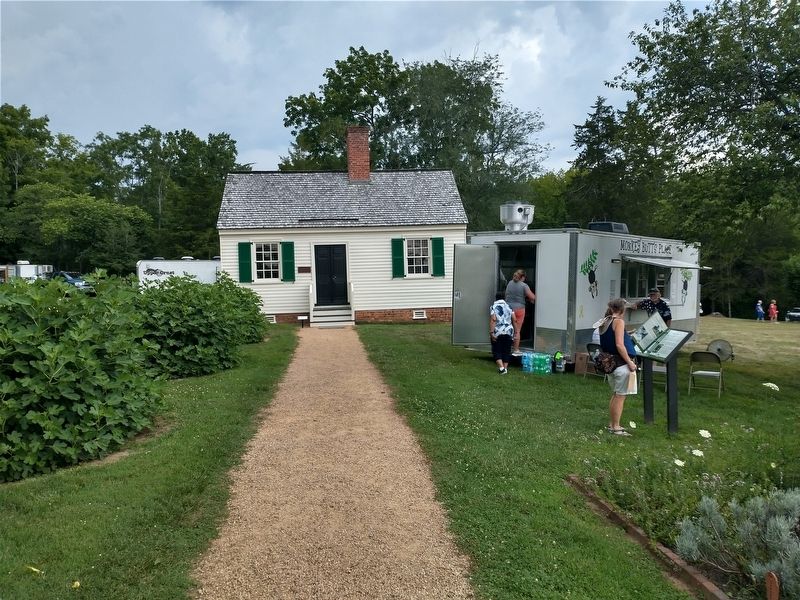
3. Henry's Law Office
Other nearby markers. At least 8 other markers are within walking distance of this marker: Osage Orange Tree (here, next to this marker); The Nancy Case Kelly Memorial Herb Garden (here, next to this marker); Last Law Office of Patrick Henry (a few steps from this marker); Kitchen (within shouting distance of this marker); The Henry House (within shouting distance of this marker); a different marker also named Osage Orange Tree (within shouting distance of this marker); Patrick Henry House (within shouting distance of this marker); Henry Family Graveyard (within shouting distance of this marker). Touch for a list and map of all markers in Brookneal.
Also see . . . Red Hill. Patrick Henry National Memorial (Submitted on August 4, 2026.)
Credits. This page was last revised on August 4, 2026. It was originally submitted on August 2, 2026, by Tom Bosse of Jefferson City, Tennessee. This page has been viewed 16 times since then. Photos: 1, 2, 3. submitted on August 2, 2026, by Tom Bosse of Jefferson City, Tennessee. • Bernard Fisher was the editor who published this page.
