Youngstown in Mahoning County, Ohio — The American Midwest (Great Lakes)
St. Augustine Episcopal Chapel
Photographed by Mike Wintermantel, December 8, 2014
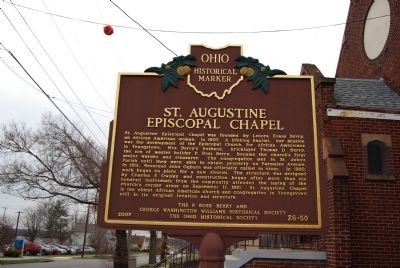
1. St. Augustine Episcopal Chapel Marker
St. Augustine Episcopal Chapel was founded by Lenora Evans Berry, an African American woman, in 1907. A lifelong Baptist, her mission was the development of the Episcopal Church for African Americans in Youngstown. Mrs. Berry's husband, bricklayer Thomas D. Berry, the son of master builder P. Ross Berry, became the church's first senior warden and treasurer. The congregation met in St. John's Parish until they were able to obtain property on Parmalee Avenue. In 1912, Reverend John Ogburn was officially called to vicar. In 1920, work began on plans for a new church. The structure was designed by Charles F. Owsley and construction began after more than six hundred individuals from the community attended the laying of the church's corner stone on September 11, 1921. St. Augustine Chapel is the oldest African American church and congregation in Youngstown still in its original location and structure.
Erected 2007 by The P. Ross Berry and George Washington Williams Historical Society and The Ohio Historical Society. (Marker Number 26-50.)
Topics and series. This historical marker is listed in these topic lists:
this page online
Location. 41° 6.213′ N, 80° 38.787′ W. Marker is in Youngstown, Ohio, in Mahoning County. It is at the intersection of Wick Avenue and Lincoln Avenue, on the right when traveling north on Wick Avenue. Touch for map. Marker is at or near this postal address: 323 Wick Ave, Youngstown OH 44510, United States of America. Touch for directions.

Regionally, this marker is in the Western Reserve and in the Mahoning Valley. It is also in the American Midwest. Globally, it is in North America, the Western Hemisphere, the Western World, and the Anglosphere. Historically, it finds itself in what was once the Haudenosaunee (Iroquois) Confederacy, the territory of the Mississippian Culture, and the Northwest Territory.
Other nearby markers. At least 8 other markers are within walking distance of this marker: Little Steel Strike (approx. ¼ mile away); A Little Bit of Youngstown’s History (approx. ¼ mile away); Working Class Heroes
Photographed by Mike Wintermantel, December 8, 2014
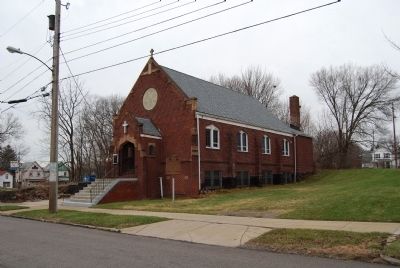
2. St. Augustine Episcopal Chapel Marker
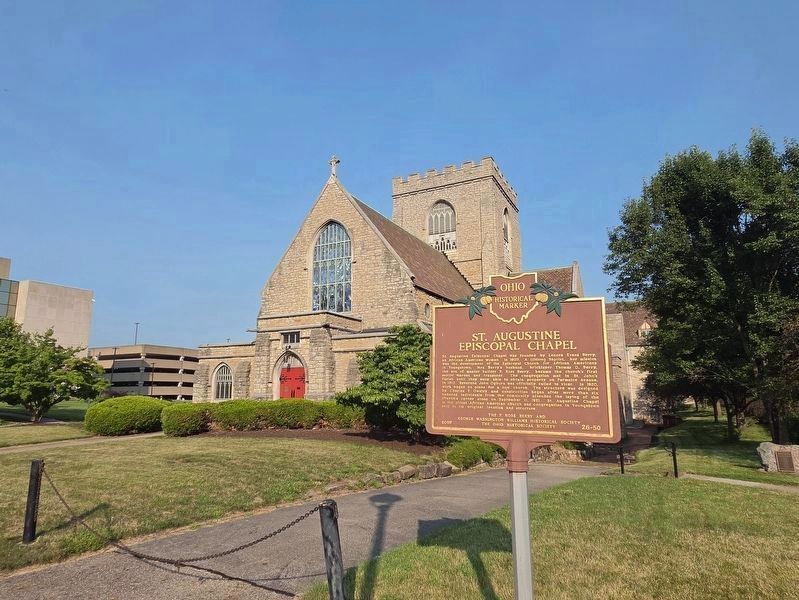
Regarding St. Augustine Episcopal Chapel. St Augustine Episcopal Chapel was torn down in 2019 to make room for the expansion of Mercy Hospital. The marker was moved to the grounds of St. John's Episcopal Church.
Also see . . .
1. St. Augustine's Episcopal Church. (Submitted on December 8, 2014, by Mike Wintermantel of Pittsburgh, Pennsylvania.)
2. Former Youngstown church, ‘heart’ of north side neighborhood torn down. Report from Keely Lovern of WKBN News, Sept 26, 2019
The heart of a once-thriving North Side neighborhood in Youngstown was demolished Thursday.(Submitted on August 3, 2026, by Mark Parker of Hickory, North Carolina.)
The former Saint Augustine Episcopal Church on Parmalee Avenue was built in 1921, but the congregation got its start years before — in 1907.
The building waslabeled a historical site in 2008 by the Ohio Historical Society because it was the oldest African American congregation still in its original building in Youngstown.Photographed by Mark Parker, July 14, 20263. St. Augustine Episcopal Chapel Marker at St John's Episcopal ChurchNo changes were made to the text with its relocation.
Credits. This page was last revised on August 6, 2026. It was originally submitted on December 8, 2014, by Mike Wintermantel of Pittsburgh, Pennsylvania. This page has been viewed 792 times since then and 65 times this year. Last updated on August 3, 2026, by Mark Parker of Hickory, North Carolina. Photos: 1, 2. submitted on December 8, 2014, by Mike Wintermantel of Pittsburgh, Pennsylvania. 3. submitted on August 3, 2026, by Mark Parker of Hickory, North Carolina. • Devry Becker Jones was the editor who published this page.
