Dupo in St. Clair County, Illinois — The American Midwest (Great Lakes)
The Village of Dupo
Photographed by Jason Voigt, September 12, 2026
1. The Village of Dupo Marker
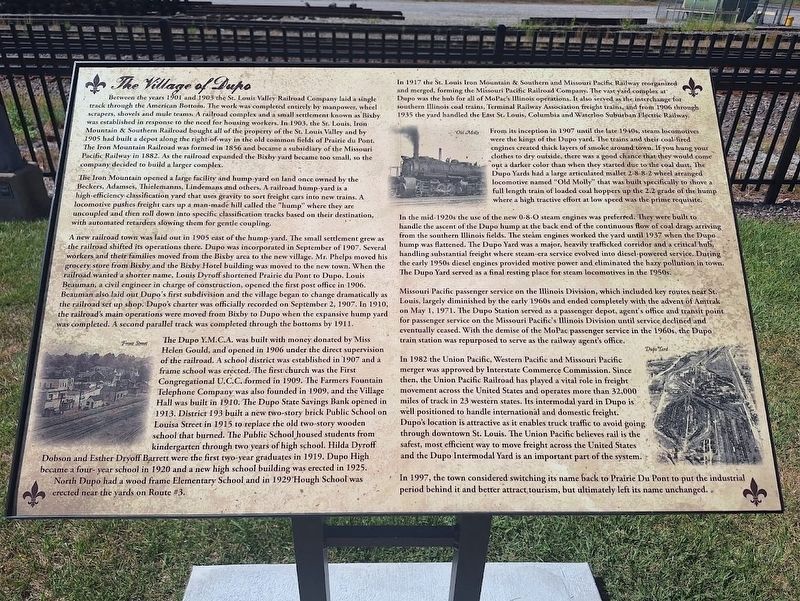
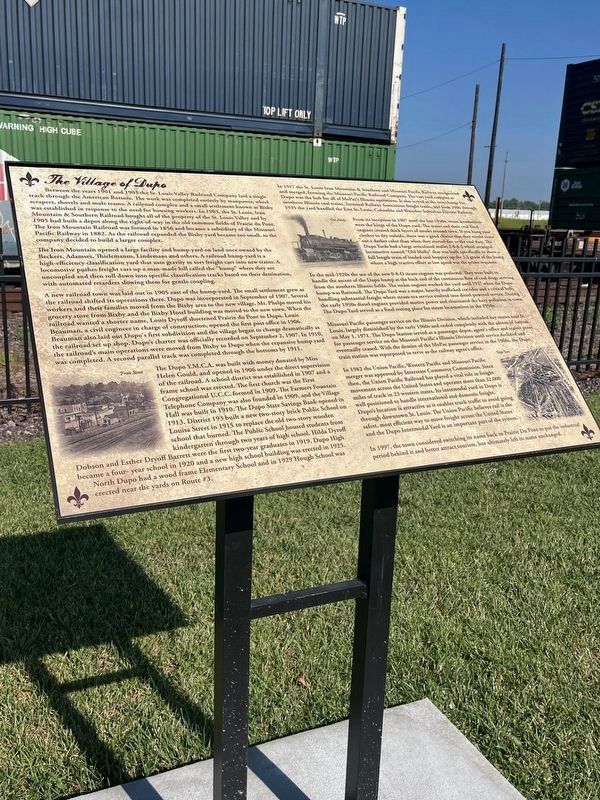
Between the years 1901 and 1903 the St. Louis Railroad Company laid a single track through the American Bottom. The work was completed entirely by manpower, wheel scrapers, shovels and mule teams. A railroad complex and a small settlement known as Bixby was established in response to the need for housing workers. In 1903, the St. Louis, Iron Mountain & Southern Railroad bought all of the property of the St. Louis Valley and by 1905 had built a depot along the right way in the old common field of Prairie du Pont. The Iron Mountain Railroad was formed in 1856 and became a subsidiary of the Missouri Pacific Railway in 1882. As the railroad expanded the Bixby yard became too small, so company decided to build a larger complex.
The Iron Mountain opened a large facility and hump-yard on land once owned by the Beckers, Adamses, Thielemans, Lindemans and others. A railroad hump-yard is a high-efficiency classification yard that was gravity to sort freight cars into new trains. A locomotive pushes freight cars up a man made hill called the "hump" where they are uncoupled and then roll down into specific classification tracks
this page online
A new railroad town was laid out in 1905 east of the hump-yard. The small settlement grew as the railroad shifted its operations there. Dupo was incorporated in September of 1907. Several workers and their families moved from the Bisby area to the village. Mr. Phelps moved his grocery store from Bixby and the Bixby Hotel building was moved to the new town. When the railroad wanted a shorter name, Louis Dyroff shortened Prairie de Pont to Dupo. Louis Beauman, a civil engineer in charge of construction, opened the first post office in 1906. Beauman also laid out Dupo's first subdivision and the village began to change dramatically as the railroad set up shop. Dupo's charter was officially recorded on September 2, 1907. In 1910, the railroad's main operations were moved from Bixby to Dupo when the expansive hump yard was completed. A second parallel track was completed through the bottoms by 1911.
The Dupo YMCA was built with money donated by Miss Helen Gould, and opened in 1906 under the direct supervision of the railroad. A school district
Photographed by Thomas Smith, August 3, 2026
2. The Village of Dupo Marker
In 1917 the St. Louis Iron Mountain & Southern and Missouri Pacific Railway reorganized and merged, forming the Missouri Pacific Railroad Company. The vast yard complex at Dupo was the hub for all of MoPac's Illinois operation. It also served as the interchange for southern Illinois coal train, Terminal Railway Association freight trains, and from 1906 through
Photographed by Jason Voigt, September 12, 2026
3. The Village of Dupo Marker
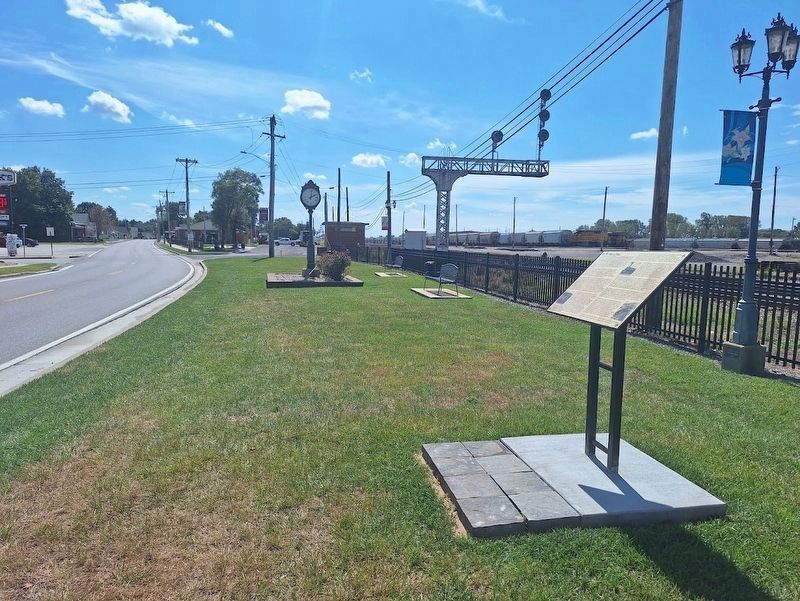
Looking south on Main Street
From its inception in 1907 until the late 1940's steam locomotives were the King of the Dupo yard. The trains and their coal fired engines created thick layers of smoke around town. If you hung your clothes to dry outside there was a good chance that they would come out a darker color than when they started due to the coal dust. The Dupo yard had a large articulated mallet 2-8-8-2 wheel arranged locomotive named "Old Molly" that was built specifically to shove a full length train load coal hoppers up the 2.2 grade of the hump where a tractive effort at low speed was the prime requisite.
In the mid-1920s the use of the new 0-8-0msteam engines was preferred. They were built to handle the ascent of the Dupo hump at the back end of the continuous flow of coal drags arriving from the southern Illinois fields. The steam engines worked the yard until 1937 when the Dupo hump was flattened. The Dupo Yard was a major, heavily trafficked corridor and a critical hub, handling substantial freight where stem-era service evolved into diesel-powered service. During the early 1950s diesel engines proved motive power and eliminated the hazy pollution in town. The Dupo yard served as a final resting place for steam locomotives in the 1950s.
Missouri Pacific passenger service on the Illinois Division, which included key routes near St. Louis, largely diminished by the early 1960s and ended completely with the advent of Amtrak on May 1, 1971. The Dupo Station served as a passenger depot, agent's office and transit point for passenger service on the Missouri Pacific's Illinois Division until service declined and eventually ceased. With the demise of the MoPac passenger service in the 1960s. the Dupo train station was repurposed to serve as the railway agent's office.
In 1982 the Union Pacific, western Pacific and Missouri Pacific merger was approved by Interstate Commerce Commission. Since then, the Union Pacific Railroad has played a vital role in freight movement across the United states and operate more than 32,000 miles of track in 23 western states. Its intermodal yard in Dupo is well position to handle international and domestic freight, Dupo's location is attractive as it enables truck traffic to avoid going through downtown St. Louis. The Union Pacific believes rail is the safest, most efficient way to move freight across the United States and Dupo Intermodal Yard is an important part of the system.
In 1997, the town considered switching its name back to Prairie Du Pont to put the industrial period behind it and better attract tourism, but ultimately left its name unchanged.
Erected 2026 by Kaskaskia-Cahokia Trail Coalition.
Topics. This historical marker is listed in these topic lists: Railroads & Streetcars • Settlements & Settlers. A significant historical year for this entry is 1882.
Location. 38° 31.187′ N, 90° 12.644′ W. Marker is in Dupo, Illinois, in St. Clair County. It is at the intersection of North Main Street and Lindeman Avenue, on the right when traveling south on North Main Street. Marker is located at Dupo Main Street Historical Park (across from Village Hall). Touch for map. Marker is at or near this postal address: 116 N Main St, Dupo IL 62239, United States of America. Touch for directions.

Regionally, this marker is in Greater St. Louis. It is also in the American Midwest, in the Lewis & Clark Corridor, in the Corn Belt, and in the Great River Road Region. Globally, it is in North America, the Western Hemisphere, the Western World, and the Anglosphere. Historically, it finds itself in what was once the Viceroyalty of New France, the territory of the Mississippian Culture, and the Northwest Territory.
Other nearby markers. At least 8 other markers are within 4 miles of this marker, measured as the crow flies: Dedicated to the Memory of Our Honored Heroes (approx. 0.2 miles away); In Memory of Those That Have Served (approx. 0.3 miles away); Prairie du Pont (approx. 0.6 miles away); Jefferson Barracks - A River Flowing Through Time (approx. 3.1 miles away in Missouri); French Settlement (approx. 3.2 miles away in Missouri); Carondelet Hotel (approx. 3.2 miles away in Missouri); Carondelet Drum Corps (approx. 3.2 miles away in Missouri); Susan Blow (approx. 3.2 miles away in Missouri). Touch for a list and map of all markers in Dupo.
Another marker is no longer nearby. Martin-Boismenue House (was approx. 2 miles away but has been confirmed missing).
Credits. This page was last revised on September 12, 2026. It was originally submitted on August 3, 2026, by Thomas Smith of Waterloo, Ill. This page has been viewed 16 times since then. Photos: 1. submitted on September 12, 2026, by Jason Voigt of Glen Carbon, Illinois. 2. submitted on August 3, 2026, by Thomas Smith of Waterloo, Ill. 3. submitted on September 12, 2026, by Jason Voigt of Glen Carbon, Illinois. • Devry Becker Jones was the editor who published this page.
