Burfordville in Cape Girardeau County, Missouri — The American Midwest (Upper Plains)
Basic Truss Designs for Covered Bridges

Photographed by Cosmos Mariner, August 20, 2021
1. Basic Truss Designs for Covered Bridges Marker
King Post
The king post was the first and simplest truss structure used in America. Its basic design consisted of a center post, the king post, with compression beams slanting downward and outward toward each shore. The original king post design was somewhat limited in size due to the length of the compression beams.
Queen Post
The queen post was an adaptation for building longer bridges than the king post design permitted. This truss design consists of an inverted “V” between two center posts and then compressed with beams slanting downward and outward toward each shore.
Warren Truss
The Warren truss was the first major variation in bridge design. This truss structure consisted of an “X” brace rather than a “V” in the middle of the queen post truss resulting in a much stronger design.
All three, king post, queen post, and Warren truss, were commonly used in building barns; thus they made an easy transition to covered bridges.
Truss Design Variations
Burr Arch
In 1817, Theodore Burr patented the Burr arch truss. In later years, Burr became known as the “Father of American bridge building” due to the large number of bridges that
this page online
Joseph Elliot, in building the Union Covered Bridge, put in two arches instead of one. This design is commonly referred to as a double Burr arch.
Town Lattice
In 1820, Ithiel Town obtained a patent for his lattice truss. Besides adding strength, this system had the advantage of requiring shorter timbers. The design employed a large number of parallel diagonal timbers running in opposite directions. The resulting network supported covered bridges up to 220 feet in length.
Howe Truss
In 1840, William Howe (uncle of Elias Howe who invented the sewing machine) patented the design that bears his name. The Howe truss was the first system to routinely employ both wood and wrought iron. The wrought iron rods were used as vertical braces, while the timber continued to serve as diagonal braces. This design was very popular after 1850 and was strong enough to be adapted for railroad use. Three of the four covered bridges in Missouri employ the Howe truss design.
The Building of a Bridge
There were two popular ways
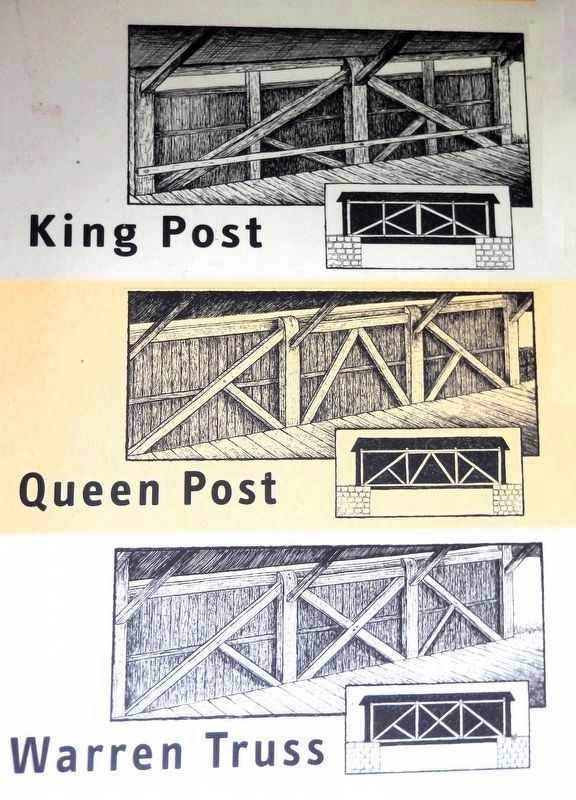
2. Marker detail: King Post, Queen Post and Warren Truss
The other method, known as hoisting, involved placing each beam separately across the river starting with the bottom chord or cross beams and then working beam by beam to complete the truss structure.
Erected by Missouri Department of Natural Resources.
Topics and series. This historical marker is listed in these topic lists: Architecture • Bridges & Viaducts. In addition, it is included in the Covered Bridges series list.
Location. 37° 22.051′ N, 89° 48.165′ W. Marker is in Burfordville, Missouri, in Cape Girardeau County. It is on Bollinger Mill Road just south of State Highway HH, on the left when traveling south. The marker is on the interpretive kiosk at Bollinger Mill State Historic Site. Touch for map. Marker is at or near this postal address: 113 Bollinger Mill Road, Burfordville MO 63739, United States of America. Touch for directions.

Regionally,
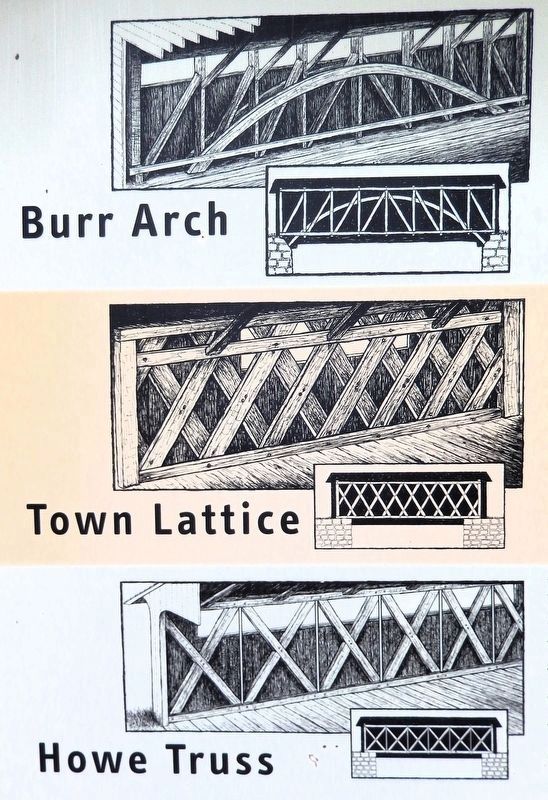
3. Marker detail: Burr Arch, Town Lattice and Howe Truss
Other nearby markers. At least 8 other markers are within 8 miles of this marker, measured as the crow flies: History of Covered Bridges in America (here, next to this marker); Genealogy of Howe Truss Design (here, next to this marker); Covered Bridges in Missouri (here, next to this marker); Restoration of the Burfordville Covered Bridge (here, next to this marker); History of Burfordville Covered Bridge (here, next to this marker); Bollinger Mill / Burfordville Covered Bridge (a few steps from this marker); "Historical Marker" (approx. 6.3 miles away); Most…are poor and exceedingly dissipated. (approx. 7½ miles away). Touch for a list and map of all markers in Burfordville.
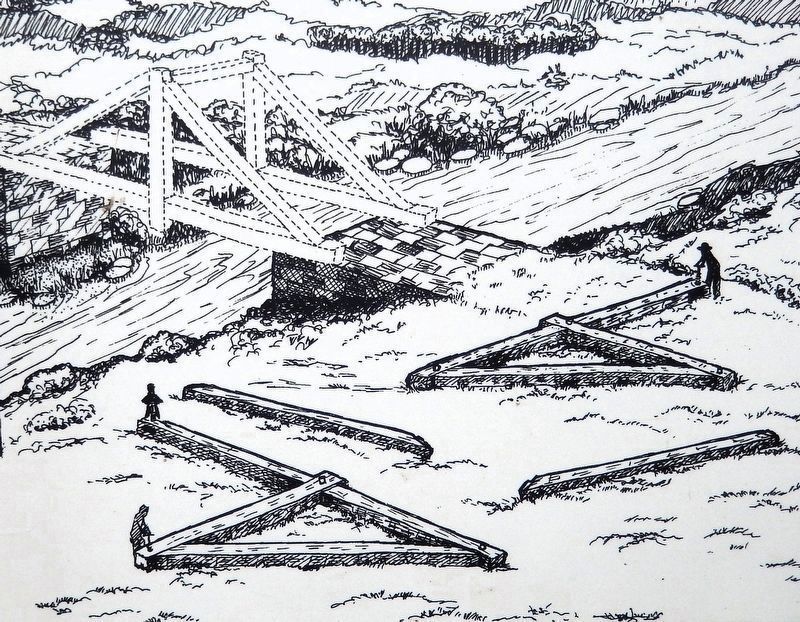
4. Marker detail: Raising the Sections

5. Marker detail: Hoisting Beams
Photographed by Cosmos Mariner, August 20, 2021
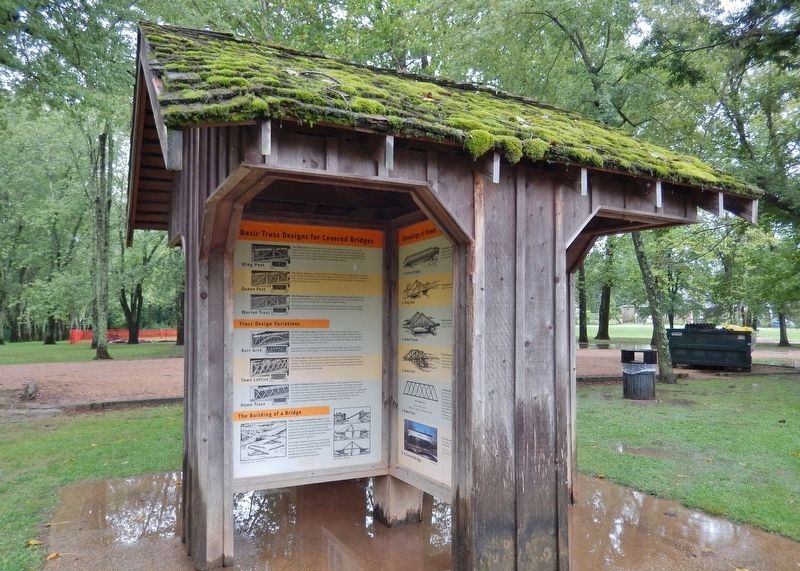
6. Basic Truss Designs for Covered Bridges Marker
This marker is on the east side of the interpretive kiosk at Bollinger Mill State Historic Site.
Credits. This page was last revised on August 4, 2026. It was originally submitted on August 3, 2026, by Cosmos Mariner of Cape Canaveral, Florida. This page has been viewed 20 times since then. Photos: 1, 2, 3, 4, 5, 6. submitted on August 3, 2026, by Cosmos Mariner of Cape Canaveral, Florida.
