Burfordville in Cape Girardeau County, Missouri — The American Midwest (Upper Plains)
Covered Bridges in Missouri
Photographed by Cosmos Mariner, August 20, 2021
1. Covered Bridges in Missouri Marker
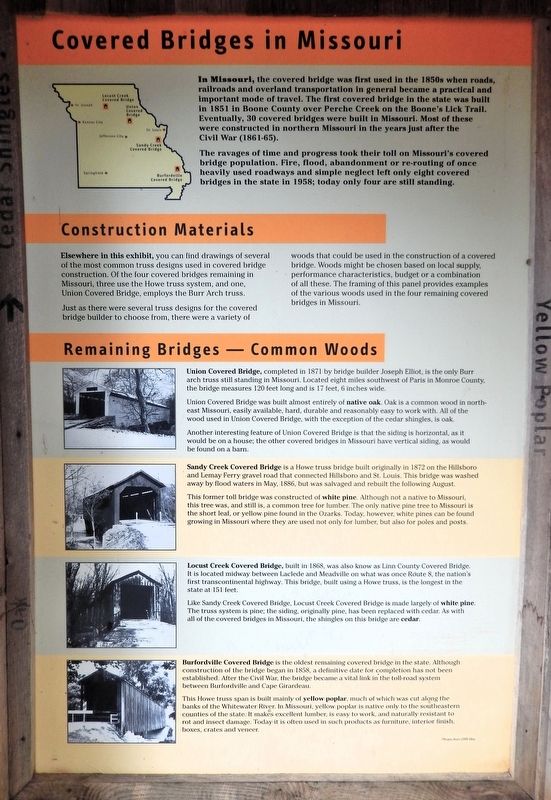
In Missouri, the covered bridge was first used in the 1850s when roads, railroads and overland transportation in general became a practical and important mode of travel. The first covered bridge in the state was built in 1851 in Boone County over Perche Creek on the Boone's Lick Trail. Eventually, 30 covered bridges were built in Missouri. Most of these were constructed in northern Missouri in the years just after the Civil War (1861-65).
The ravages of time and progress took their toll on Missouri's covered bridge population. Fire, flood, abandonment or re-routing of once heavily used roadways and simple neglect left only eight covered bridges in the state in 1958; today only four are still standing.
Construction Materials
Elsewhere in this exhibit, you can find drawings of several of the most common truss designs used in covered bridge construction. Of the four covered bridges remaining in Missouri, three use the Howe truss system, and one, Union Covered Bridge, employs the Burr arch truss.
Just as there were several truss designs for the covered bridge builder to choose from, there were a variety of woods that could be
this page online
Remaining Bridges — Common Woods
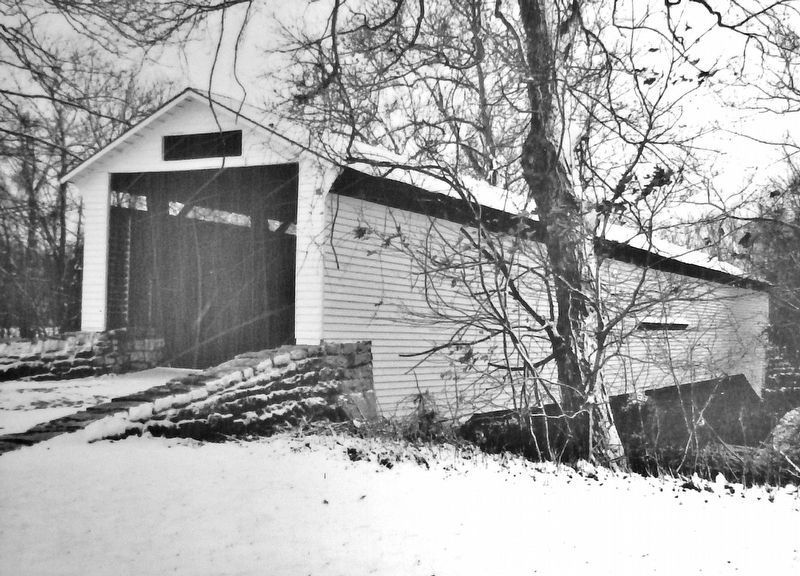
Union Covered Bridge, completed in 1871 by bridge builder Joseph Elliot, is the only Burr arch truss still standing in Missouri. Located eight miles southwest of Paris in Monroe County, the bridge measures 120 feet long and is 17 feet, 6 inches wide.
Union Covered Bridge was built almost entirely of native oak. Oak is a common wood in northeast Missouri, easily available, hard, durable and reasonably easy to work with. All of the wood used in Union Covered Bridge, with the exception of the cedar shingles, is oak.
Another interesting feature of Union Covered Bridge is that the siding is horizontal, as it would be on a house; the other covered bridges in Missouri have vertical siding, as would be found on a barn.
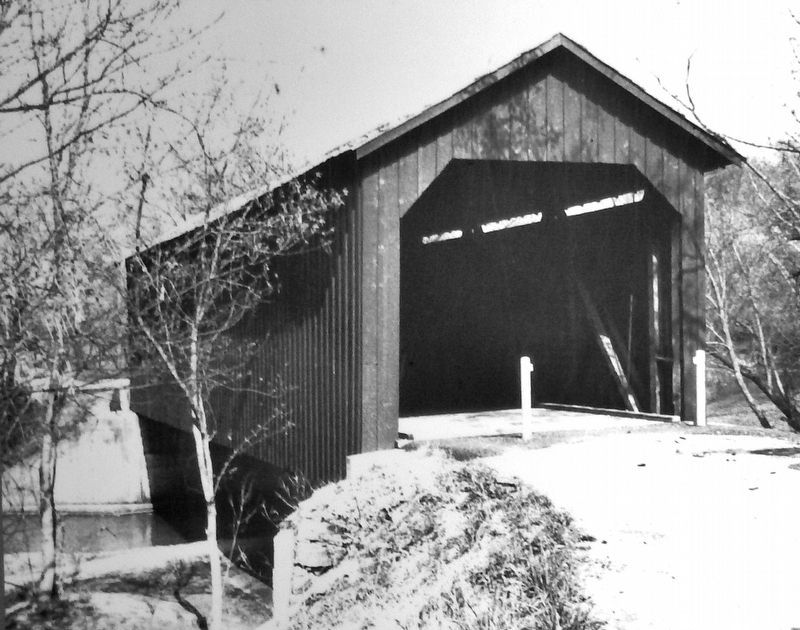
Sandy Creek Covered Bridge is a Howe truss bridge built originally in 1872 on the Hillsboro and Lemay Ferry gravel road
Courtesy Missouri Department of Natural Resources
2. Marker detail: Union Covered Bridge
This former toll bridge was constructed of white pine. Although not a native to Missouri, this tree was, and still is, a common tree for lumber. The only native pine tree to Missouri is the shortleaf, or yellow pine found in the Ozarks. Today, however, white pines can be found growing in Missouri where they are used not only for lumber, but also for poles and posts.
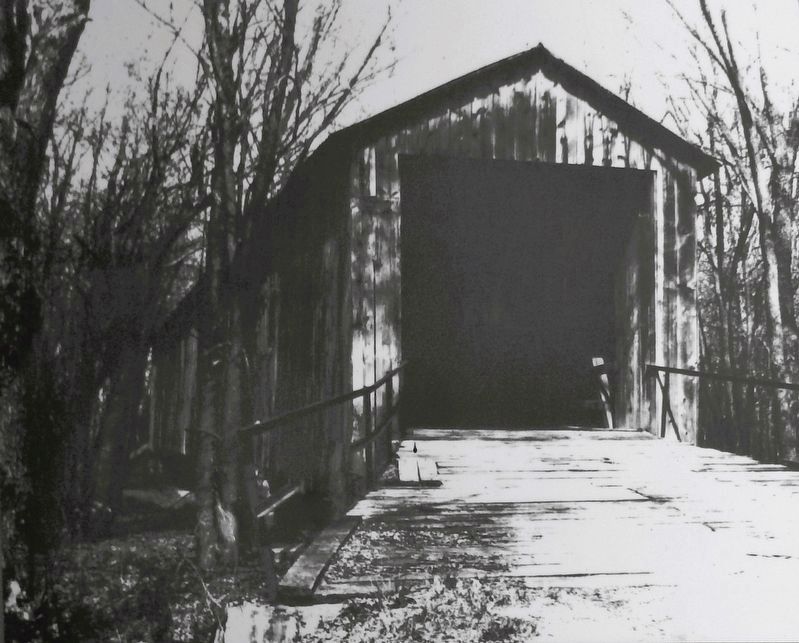
Locust Creek Covered Bridge, built in 1868, was also known as Linn County Covered Bridge. It is located midway between Laclede and Meadville on what was once Route 8, the nation's first transcontinental highway. This bridge, built using a Howe truss, is the longest in the state at 151 feet.
Like Sandy Creek Covered Bridge, Locust Creek Covered Bridge is made largely of white pine. The truss system is pine; the siding, originally pine, has been replaced with cedar. As with all of the covered bridges in Missouri, the shingles on this bridge are cedar.
Burfordville Covered Bridge is the oldest remaining covered bridge in the state.
Courtesy Missouri Department of Natural Resources
3. Marker detail: Sandy Creek Covered Bridge
This Howe truss span is built mainly of yellow poplar, much of which was cut along the banks of the Whitewater River. In Missouri, yellow poplar is native only to the southeastern counties of the state. It makes excellent lumber, is easy to work, and naturally resistant to rot and insect damage. Today it is often used in such products as furniture, interior finish, boxes, crates and veneer.
Erected by Missouri Department of Natural Resources.
Topics and series. This historical marker is listed in these topic lists: Architecture • Bridges & Viaducts. In addition, it is included in the Covered Bridges series list. A significant historical year for this entry is 1851.
Location. 37° 22.05′ N, 89° 48.167′ W. Marker is in Burfordville, Missouri, in Cape Girardeau County. It is on Bollinger Mill Road just south of State Highway HH, on the left when traveling south. The marker is on the interpretive kiosk at Bollinger
Courtesy Missouri Department of Natural Resources
4. Marker detail: Locust Creek Covered Bridge

Regionally, this marker is in Southeast Missouri. It is also in the American Ozarks, in the Lewis & Clark Corridor, in the Corn Belt, and in the Great River Road Region. Globally, it is in North America, the Western Hemisphere, the Western World, and the Anglosphere. Historically, it finds itself in what was once the territory of the Mississippian Culture, the Louisiana Purchase, and the Antebellum South.
Other nearby markers. At least 8 other markers are within 8 miles of this marker, measured as the crow flies: Restoration of the Burfordville Covered Bridge (here, next to this marker); Genealogy of Howe Truss Design (here, next to this marker); History of Burfordville Covered Bridge (here, next to this marker); Basic Truss Designs for Covered Bridges (here, next to this marker); History of Covered Bridges in America (here, next to this marker); Bollinger Mill / Burfordville Covered Bridge (a few steps from this marker); "Historical Marker" (approx.
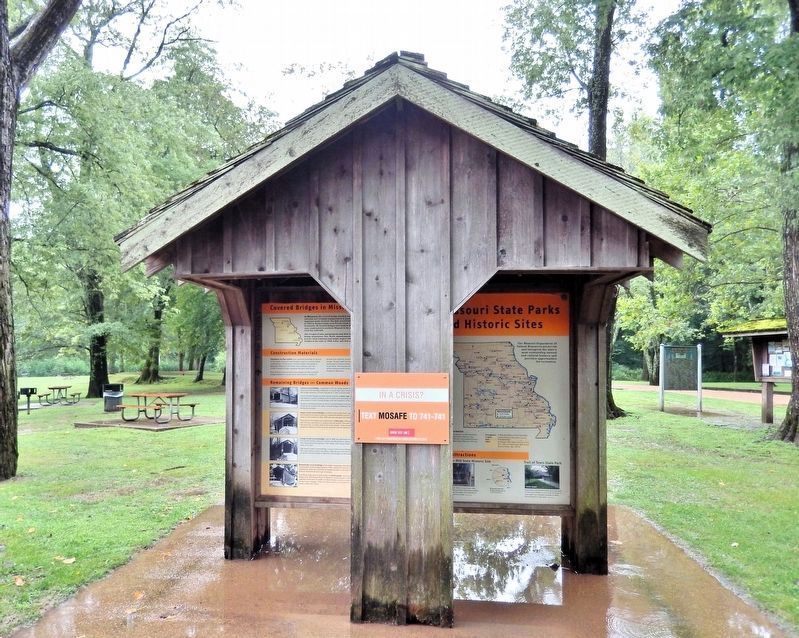
Photographed by Cosmos Mariner, August 20, 2021
5. Covered Bridges in Missouri Marker
This marker is on the south side of the interpretive kiosk at Bollinger Mill State Historic Site. It is on the left side of this photo.

Photographed by Cosmos Mariner, August 20, 2021
6. Burfordville Covered Bridge
Credits. This page was last revised on August 4, 2026. It was originally submitted on August 4, 2026, by Cosmos Mariner of Cape Canaveral, Florida. This page has been viewed 17 times since then. Photos: 1, 2, 3, 4, 5, 6. submitted on August 4, 2026, by Cosmos Mariner of Cape Canaveral, Florida.
