
Moulineaux in Seine-Maritime, Normandy, France — Western Europe
Une forteresse médiévale
⎯⎯⎯
A Medieval Fortress
Photographed by James Hulse
1. Une forteresse médiévale / A Medieval Fortress Marker

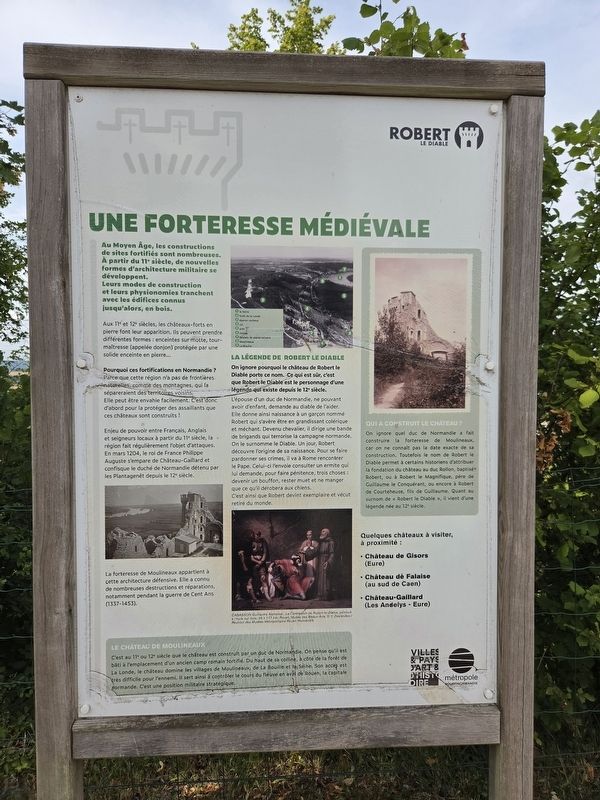
Au Moyen Âge, les constructions de sites fortifiés sont nombreuses. À partir du 11ᵉ siècle, de nouvelles formes d’architecture militaire se développent. Leurs modes de construction et leurs physionomies tranchent avec les édifices connus jusqu’alors, en bois.
Aux 11ᵉ et 12ᵉ siècles, les châteaux-forts en pierre font leur apparition. Ils peuvent prendre différentes formes : enceintes sur motte, tour-maîtresse (appelée donjon) protégée par une solide enceinte en pierre…
Pourquoi ces fortifications en Normandie ?
Parce que cette région n’a pas de frontières naturelles, comme des montagnes, qui la sépareraient des territoires voisins. Elle peut être envahie facilement. C’est donc d’abord pour la protéger des assaillants que ces châteaux sont construits !
Enjeu de pouvoir entre Français, Anglais et seigneurs locaux à partir du 11ᵉ siècle, la région fait régulièrement l’objet d’attaques. En mars 1204, le roi de France Philippe Auguste s’empare de Château-Gaillard et confisque le duché de Normandie détenu par les Plantagenêts depuis le 12ᵉ siècle.
La forteresse de Moulineaux appartient à cette architecture défensive. Elle a connu de nombreuses destructions et réparations, notamment pendant la guerre de Cent Ans (1337-1453).
La légende de Robert le Diable
On ignore pourquoi le château de Robert le Diable porte ce nom. Ce qui est sûr, c’est que Robert le Diable est le personnage d’une légende qui existe depuis le 12ᵉ siècle.
L’épouse d’un duc de Normandie, ne pouvant avoir d’enfant, demande au diable de l’aider. Elle donne ainsi naissance à un garçon nommé Robert qui, en grandissant, s’avère colérique et méchant. Devenu chevalier, il dirige une bande de brigands qui terrorise la campagne normande. On le surnomme le Diable. Un jour, Robert découvre l’origine de sa naissance. Pour se faire pardonner ses crimes, il va à Rome rencontrer le pape. Celui-ci l’envoie consulter un ermite qui lui demande, pour faire pénitence, trois choses : devenir un bouffon, rester muet et ne manger que ce qu’il dérobera aux chiens. C’est ainsi que Robert devint exemplaire et vécut retiré du monde.
Qui a construit le château ?
On ignore quel duc de Normandie a fait construire la forteresse de Moulineaux, car on ne connaît pas la date exacte de sa construction. Toutefois, le nom de Robert le Diable permet à certains historiens d’attribuer la fondation du château au duc Rollon, baptisé Robert, ou à Robert le Magnifique, père de Guillaume le Conquérant, ou encore à Robert Courteheuse, fils de Guillaume. Quant au surnom de « Robert le Diable », il vient d’une légende née au 12ᵉ siècle.
Le château de Moulineaux
C’est au XIᵉ ou XIIᵉ siècle que le château est construit par un duc de Normandie. On pense qu’il est bâti à l’emplacement d’un ancien camp romain fortifié. Du haut de sa colline, à côté de la forêt de La Londe, le château domine les villages de Moulineaux et de La Bouille ainsi que la Seine. Son accès est très difficile pour l’ennemi. Il sert ainsi à contrôler le cours du fleuve en aval de Rouen, la capitale normande. C’est une position militaire stratégique.
Cabasson Guillaume Alphonse, La Conversion de Robert-le-Diable, peinture à l'huile sur toile, 95 x 117 cm, Rouen, Musée des Beaux-Arts, © Y. Deslandes / Réunion des Musées Métropolitains Rouen Normandie
During the Middle Ages, many fortified sites were constructed. Beginning in the 11th century, new forms of military architecture developed. Their construction methods and appearance differed greatly from the wooden buildings known until then.
In the 11th and 12th centuries, stone castles began to appear. They could take different forms: enclosures built on mounds, or a main tower—called a keep—protected by a strong stone wall.
Why were these fortifications built in Normandy?
Because the region has no natural borders, such as mountains, separating it from neighboring territories. It could therefore be invaded easily. These castles were built primarily to protect it from attackers.
From the 11th century onward, the region was frequently attacked because it was the focus of power struggles among the French, the English, and local lords. In March 1204, King Philip Augustus of France captured Château Gaillard and seized the Duchy of Normandy, which had been held by the Plantagenets since the 12th century.
The fortress of Moulineaux belongs to this tradition of defensive architecture. It underwent numerous destructions and repairs, particularly during the Hundred Years’ War (1337–1453).
The Legend of Robert the Devil
No one knows why Robert the Devil’s Castle bears this name. What is certain is that Robert the Devil is the central figure in a legend that has existed since the 12th century.
The wife of a Duke of Normandy, unable to have a child, asks the devil to help her. She gives birth to a boy named Robert, who grows up to be angry and cruel. After becoming a knight, he leads a band of brigands who terrorize the Norman countryside. He is given the nickname “the Devil.” One day, Robert discovers the circumstances of his birth. Seeking forgiveness for his crimes, he travels to Rome to meet the pope. The pope sends him to consult a hermit, who requires him to do three things as penance: become a fool, remain silent, and eat only food that he steals from dogs. In this way, Robert became an exemplary man and lived apart from the world.
Who built the castle?
It is not known which Duke of Normandy had the fortress of Moulineaux built, because the exact date of its construction is unknown. However, the name Robert the Devil has led some historians to attribute the castle’s foundation to Duke Rollo, who was baptized Robert; Robert the Magnificent, father of William the Conqueror; or Robert Curthose, William’s son. The name “Robert the Devil” itself comes from a legend that originated in the 12th century.
The Château de Moulineaux
The castle was built in the 11th or 12th century by a Duke of Normandy. It is believed to have been constructed on the site of an ancient fortified Roman camp. From the top of its hill, beside the Forest of La Londe, the castle overlooks the villages of Moulineaux and La Bouille, as well as the Seine. It was very difficult for an enemy to reach. It therefore served to control the course of the river downstream from Rouen, the Norman capital. It was a strategic military position.
Cabasson, Guillaume Alphonse, The Conversion of Robert the Devil, oil painting on canvas, 95 × 117 cm, Rouen, Museum of Fine Arts, © Y. Deslandes / Réunion des Musées Métropolitains Rouen Normandie.
Erected by Métropole
this page online
Topics. This historical marker is listed in this topic list: Forts and Castles. A significant historical month for this entry is March 1204.
Location. 49° 20.4′ N, 0° 57.61′ E. Marker is in Moulineaux, Normandie (Normandy), in Seine-Maritime. It is at the intersection of State Road D64 and Rue Pierre Gosselin (Route D67A) on State Road D64. Touch for map. Marker is in this post office area: Moulineaux, Normandie 76530, France. Touch for directions.

Regionally, it is in the North Atlantic Region, Europe, the European Union, Atlantic Europe, the Schengen Area, Western Europe, a coastal Mediterranean country, and the Western World. Historically, it finds itself in what was once a French colony and also the Roman Empire.
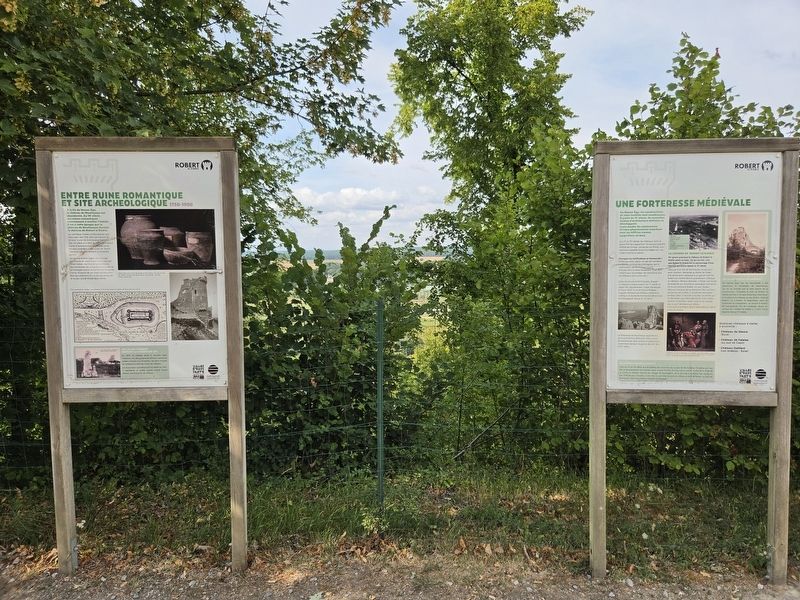
Other nearby markers. At least 8 other markers are within 16 kilometers of this marker, measured as the crow flies: Entre ruine romantique et site archéologique / Between Romantic Ruin and Archaeological Site (here, next to this marker); La renaissance du château / The Restoration of the Castle (within shouting distance of this marker); Les ruines du château de Robert le Diable / The ruins of Robert the Devil’s Castle
Photographed by James Hulse, July 31, 2026
2. Une forteresse médiévale / A Medieval Fortress Marker
Photographed by James Hulse
3. Une forteresse médiévale / A Medieval Fortress Marker
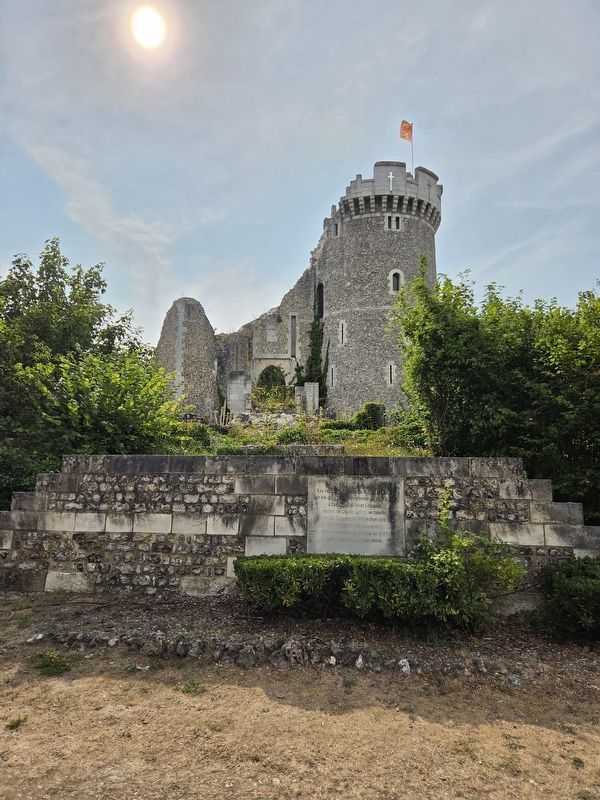
The main entrance to the castle.
Photographed by James Hulse, July 31, 2026
4. Une forteresse médiévale / A Medieval Fortress Marker
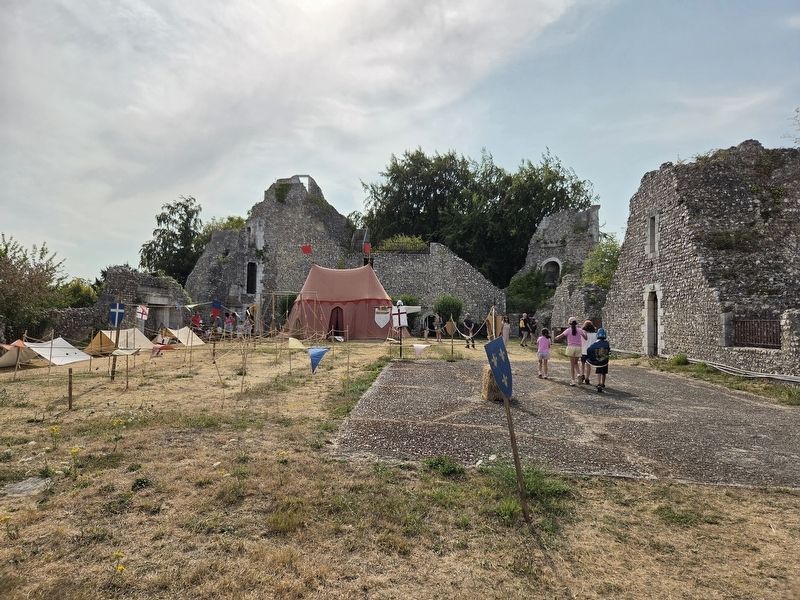
The view of the inside courtyard of the castle.
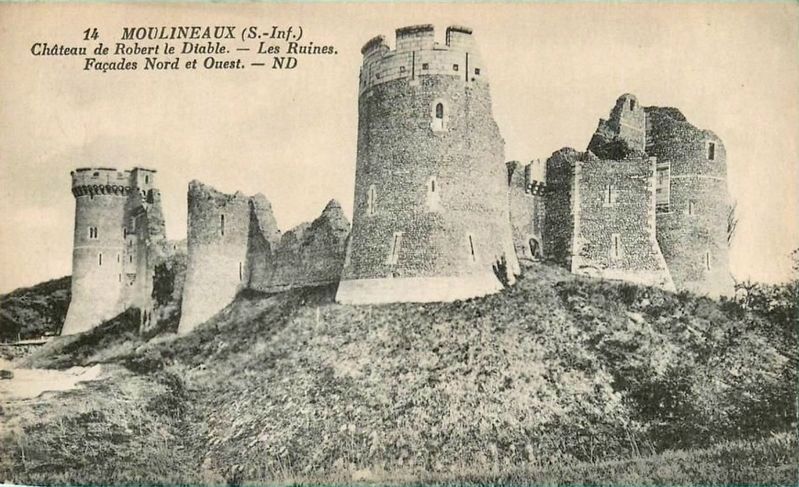
Photographed by Levy et Neurdein Regnis, Paris, circa 1900
5. Château de Robert le Diable
Credits. This page was last revised on August 5, 2026. It was originally submitted on August 4, 2026, by James Hulse of Medina, Texas. This page has been viewed 5 times since then. Photos: 1, 2, 3, 4. submitted on August 5, 2026, by James Hulse of Medina, Texas. 5. submitted on August 5, 2026.
