Sorbonne in Paris, Paris Region, France — Western Europe
Le berceau de l'Université
⎯⎯⎯
The Cradle of the University
| — | Histoire de Paris | — |

Photographed by Adam Margolis, June 19, 2026
1. Le berceau de l'Université Marker

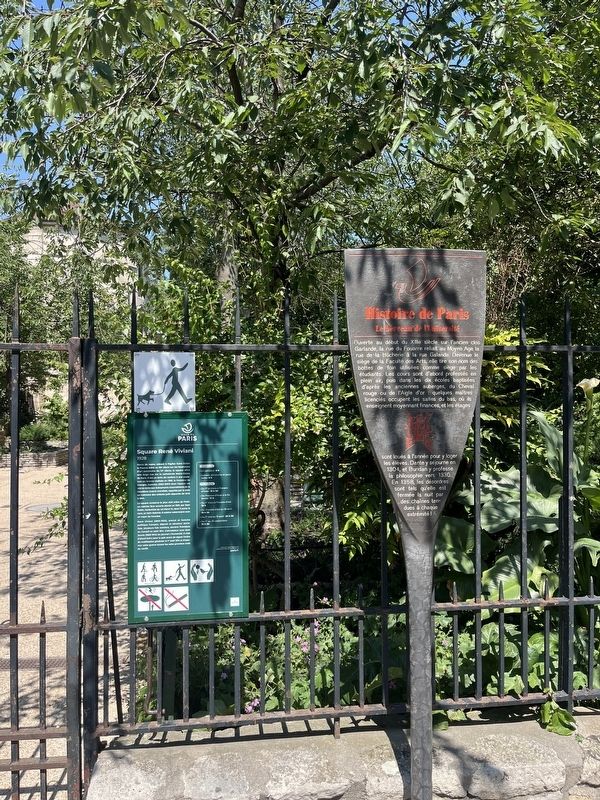
Ouverte au début du XIIIe siècle sur l'ancien clos Garlande, la rue due Fouarre reliait au Moyen Age la rue de la Bûcherie a la rue Galande. Devenue le siège de la Faculté des Arts, elle tire son nom des bottes de foin utilisées comme siège par les étudiants. Les cours sont d'abord professés en plein air, puis dans les dix écoles baptisées d'apres les anciennes auberges, du Cheval rouge ou de l’Aigle d'or : quelques mâitres licenciés occupent les salles due bas, où ils enseignment moyennant finances, et les étages sont loués à l'année pour y loger les eleves. Dante y séjourne en 1304, et Buridan y professe la philosphie vers 1330. En 1358, les desordres sont tels qu'elle est fermée la nuit par des châines tendues à chaque extrémité!
The Cradle of the University
Opened in the early 13th century on the former Clos Garlande, Rue du Fouarre connected Rue de la Bûcherie to Rue Galande during the Middle Ages. It became the home of the Faculty of Arts and took its name from the bundles of hay (fouarre) that students used as seats. Classes were initially held outdoors, and later in ten schools named after old inns — such as the Cheval Rouge (“Red Horse”) or the Aigle d'Or (“Golden Eagle”) — where licensed masters taught for a fee in the ground-floor rooms and on the upper floors they were rented on a yearly basis to house students. Dante stayed there in 1304, and Buridan taught philosophy there around 1330. By 1358, the disorder was so great that the street was closed off at night by chains stretched across each end!
Topics and series. This historical marker is listed in this topic list: Education. In addition, it is included in the Histoire de Paris series list. A significant historical year for this entry is 1304.
Location. 48° 51.107′ N, 2° 20.86′ E.
this page online

Regionally, it is in the North Atlantic Region, Europe, the European Union, Atlantic Europe, the Schengen Area, Western Europe, a coastal Mediterranean country, and the Western World. Historically, it finds itself in what was once a French colony and also the Roman Empire.
Other nearby markers. At least 8 other markers are within walking distance of this marker: Dante rédige la Divine Comédie (a few steps from this marker in Île-de-France); Square René-Viviani Jewish Children’s Memorial (within shouting distance of this marker in Île-de-France); Robinier faux-acacia (Robinia pseudoacacia L.) (within shouting distance of this marker in Île-de-France); Eglise Saint-Julien-le-Pauvre (within shouting distance of this marker in Île-de-France); a different marker also named Eglise Saint-Julien-le-Pauvre (within shouting
Photographed by Adam Margolis, June 19, 2026
2. Le berceau de l'Université Marker
Also see . . . University of Paris (Wikipedia). Overview:
The University of Paris (French: Université de Paris) was the leading university in Paris, France, from 1150 to 1970, except for 1793–1806 during the French Revolution. Emerging around 1150 as a corporation associated with the cathedral school of Paris, it was considered the second-oldest university in Europe. Officially chartered in 1200 by King Philip II and recognised in 1215 by Pope Innocent III, it was nicknamed after its theological College of Sorbonne, founded by Robert de Sorbon and chartered by King Louis IX around 1257.(Submitted on August 8, 2026.)
Highly reputed internationally for its academic performance in the humanities ever since the Middle Ages – particularly in theology and philosophy – it introduced academic standards andtraditions that have endured and spread, such as doctoral degrees and student nations. Notable popes, royalty, scientists, and intellectuals were educated at the University of Paris….Photographed by Adam Margolis, June 19, 20263. Le berceau de l'Université Marker
Additional keywords. panneau
Credits. This page was last revised on August 8, 2026. It was originally submitted on August 8, 2026, by Adam Margolis of Mission Viejo, California. This page has been viewed 13 times since then. Photos: 1. submitted on August 8, 2026, by Andrew Ruppenstein of Lamorinda, California. 2, 3. submitted on August 8, 2026, by Adam Margolis of Mission Viejo, California. • Andrew Ruppenstein was the editor who published this page.
