St. Johns in Austin in Travis County, Texas — The American South (West South Central)
St. John Community
August 8, 2026
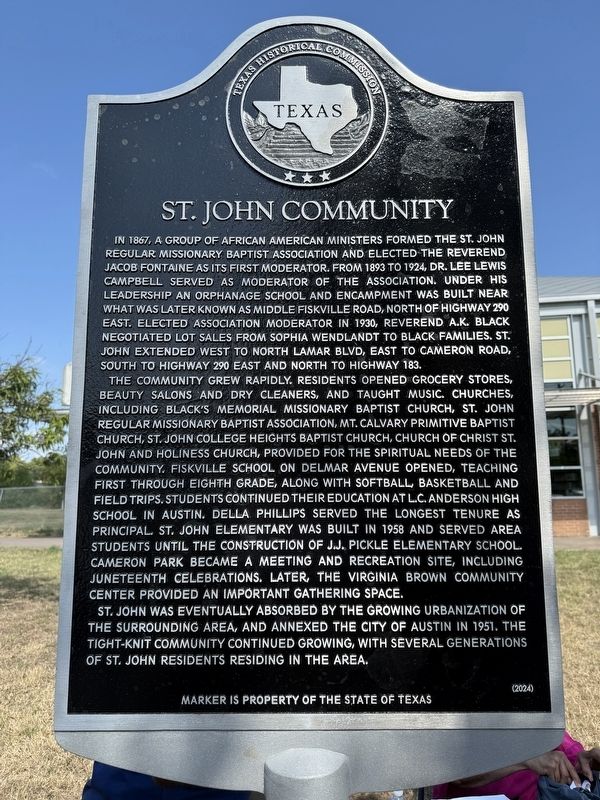
1. St. John Community Marker
In 1867, a group of African American ministers formed the St. John Regular Missionary Baptist Association and elected the Reverend Jacob Fontaine as its first moderator. From 1893 to 1924, Dr. Lee Lewis Campbell served as moderator of the association. Under his leadership an orphanage school and encampment was built near what was later known as Middle Fiskville Road, and north of Highway 290 East. Elected association moderator in 1930, Reverend A.K. Black negotiated lot sales from Sophia Wendlandt to Black families. St. John extended west to north Lamar Blvd, east to Cameron Road, south to Highway 290 East and north to Highway 183.
The community grew rapidly. Residents opened grocery stores, beauty salons and dry cleaners, and taught music. Churches, including Black's Memorial Missionary Baptist Church, St. John Regular Missionary Baptist Association, Mt. Calvary Primitive Baptist Church, St. John College Heights Baptist Church, Church of Christ St. John and Holiness Church, provided for the spiritual needs of the community. Fiskville School on Delmar Avenue opened, teaching first through eighth grade, along with softball,
this page online
St. John was eventually absorbed by the growing urbanization of the surrounding area, and annexed the City of Austin in 1951. The tight-knit community continued growing, with several generations of St. John residents residing in the area.
Erected 2024 by Texas Historical Commission. (Marker Number 24314.)
Topics. This historical marker is listed in these topic lists: African Americans • Education • Religion & Religious Structures. A significant historical year for this entry is 1867.
Location. 30° 19.907′ N, 97° 41.623′ W. Marker is in Austin, Texas, in Travis County. It is in St. Johns. It can be reached from Delmar Avenue south of Wheatley Ave, on the left when traveling north.
August 8, 2026
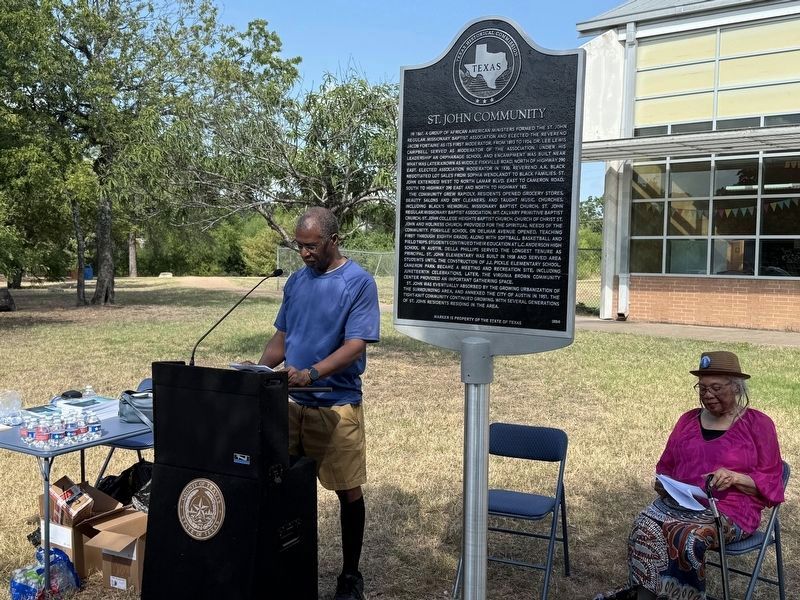
2. St. John Community Marker
Marker dedication with Travis County Historical Commission. St. John Branch, Austin Public Library, visible in background.

Regionally, this marker is in Central Texas. It is also in the American South. Globally, it is in North America, a Gulf of Mexico state, the Western Hemisphere, the Western World, and the Anglosphere. Historically, it finds itself in what was once New Spain, the Republic of Texas, one of the Confederate States of America, and the Antebellum South.
Other nearby markers. At least 8 other markers are within 3 miles of this marker, measured as the crow flies: St. John Orphanage and Industrial Institute (approx. 1.1 miles away); Annie Webb Blanton (approx. 1.7 miles away); Fiskville (approx. 1.8 miles away); Austin State Hospital Cemetery (approx. 2.1 miles away); Wells-LaRue House (approx. 2½ miles away); The Old Zimmerman Home (approx. 2½ miles away); Elisabet Ney (approx. 2.6 miles away); Hodnette House (approx. 2.7 miles away). Touch for a list and map of all markers in Austin.
Other markers no longer nearby. First Cumberland Presbyterian Church of Austin (was approx. 2.1 miles away but has been permanently removed); Site of Pecan Springs School (was approx. 2.4 miles away but has been confirmed missing).
Credits. This page was last revised on August 10, 2026. It was originally submitted on August 9, 2026, by Richard Denney of Austin, Texas. This page has been viewed 27 times since then. Photos: 1, 2. submitted on August 9, 2026, by Richard Denney of Austin, Texas. • James Hulse was the editor who published this page.
