Bayeux in Calvados, Normandy, France — Western Europe
Le parvis de la cathédrale
⎯⎯⎯
Cathedral Square
| — | Bayeux, la qualité a ses racines | — |
Photographed by James Hulse, August 1, 2026
1. Le parvis de la cathédrale / Cathedral Square Marker

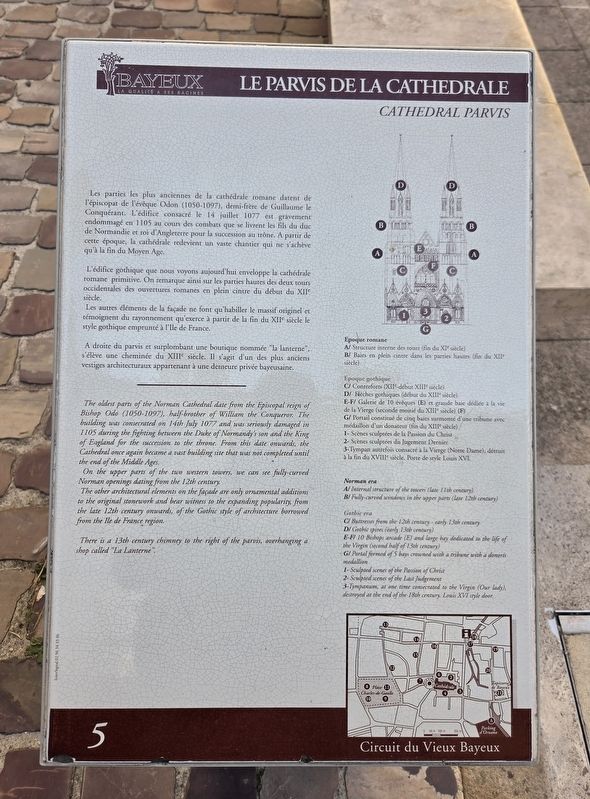
Les parties les plus anciennes de la cathédrale romane datent de l'épiscopat de l'évêque Odon (1050-1097), demi-frère de Guillaume le Conquérant. L'édifice consacré le 14 juillet 1077 est gravement endommagé en 1105 au cours des combats que se livrent les fils du duc de Normandie et roi d'Angleterre pour la succession au trône. À partir de cette époque, la cathédrale redevient un vaste chantier qui ne s'achève qu'à la fin du Moyen Âge.
L'édifice gothique que nous voyons aujourd'hui enveloppe la cathédrale romane primitive. On remarque ainsi sur les parties hautes des deux tours occidentales des ouvertures romanes en plein cintre du début du XIIᵉ siècle.
Les autres éléments de la façade ne font qu'habiller le massif originel et témoignent du rayonnement qu'exerce à partir de la fin du XIIᵉ siècle le style gothique emprunté à l'Île-de-France.
À droite du parvis et surplombant une boutique nommée « la Lanterne », s'élève une cheminée du XIIIᵉ siècle. Il s'agit d'un des plus anciens vestiges architecturaux appartenant à une demeure privée bayeusaine.
Époque romane
A/ Structure interne des tours (fin du XIᵉ siècle)
B/ Baies en plein cintre dans les parties hautes (fin du XIIᵉ siècle)
Époque gothique
C/ Contreforts (XIIᵉ-début XIIIᵉ siècle)
D/ Flèches gothiques (début du XIIIᵉ siècle)
E-F/ Galerie de 10 évêques (E) et grande baie dédiée à la vie de la Vierge (seconde moitié du XIIIᵉ siècle) (F)
G/ Portail constitué de cinq baies surmonté d'une tribune avec médaillon d'un donateur (fin du XIIIᵉ siècle)
1- Scènes sculptées de la Passion du Christ
2- Scènes sculptées du Jugement Dernier
3- Tympan autrefois consacré à la Vierge (Notre Dame), détruit à la fin du XVIIIᵉ siècle. Porte de style Louis XVI.
this page online
On the upper parts of the two western towers, fully rounded Romanesque openings dating from the beginning of the 12th century can be seen.
The other architectural elements on the façade are only ornamental additions to the original stonework and bear witness to the expanding popularity, from the late 12th century onwards, of the Gothic style of architecture borrowed from the Île-de-France region.
There is a 13th-century chimney to the right of the parvis, overhanging a shop called “La Lanterne.”
Norman era
A/ Internal structure of the towers (late 11th century)
B/ Fully curved windows in the upper parts (late 12th century)
Gothic era
C/ Buttresses from the 12th century and early 13th century
D/ Gothic spires (early 13th century)
E-F/ Arcade of 10 bishops (E) and large bay dedicated to the life of the Virgin (second half of the 13th century)
G/ Portal formed of 5 bays crowned with a tribune with a donor’s medallion
1/ Sculpted scenes of the Passion of Christ
2/ Sculpted scenes of the Last Judgement
3/ Tympanum, formerly dedicated to the Virgin (Our Lady), destroyed at the end of the 18th century. Louis XVI-style door.
Erected by La
Photographed by James Hulse
2. Le parvis de la cathédrale / Cathedral Square Marker
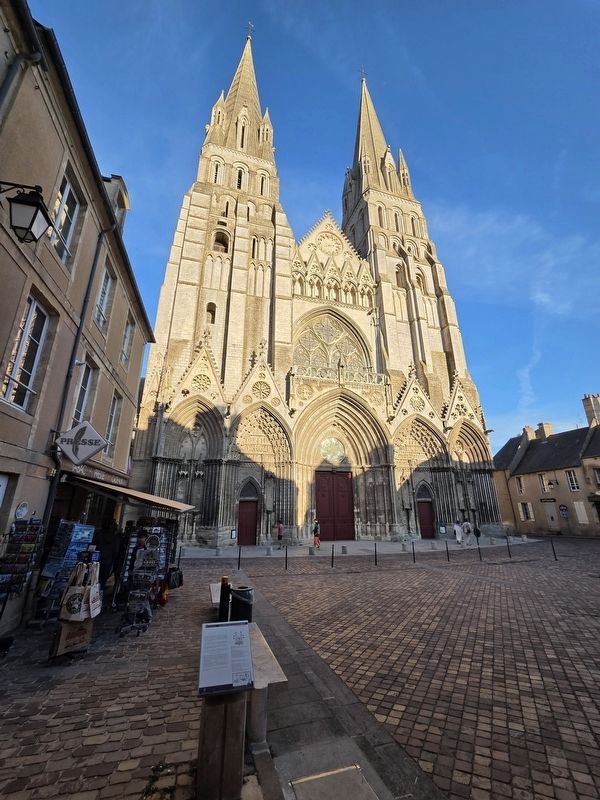
The view of the marker in the Cathedral Square.
Topics. This historical marker is listed in these topic lists: Architecture • Religion & Religious Structures. A significant historical date for this entry is July 14, 1077 CE.
Location. 49° 16.553′ N, 0° 42.258′ W. Marker is in Bayeux, Normandie (Normandy), in Calvados. It is at the intersection of Rue du Bienvenu and Rue de la Maîtrise, on the right when traveling south on Rue du Bienvenu. Touch for map. Marker is at or near this postal address: 10 Rue du Bienvenu, Bayeux, Normandie 14400, France. Touch for directions.

Regionally, it is in the North Atlantic Region, Europe, the European Union, Atlantic Europe, the Schengen Area, Western Europe, a coastal Mediterranean country, and the Western World. Historically, it finds itself in what was once a French colony and also the Roman Empire.
Other nearby markers. At least 8 other markers are within walking distance of this marker: L'Esplanade Flachat (within shouting distance of this marker); Le Doyen du Chapitre (within shouting distance of this marker); La Rue de la Maîtrise / Rue de la Maîtrise (about 90 meters away, measured in a direct line);
Photographed by James Hulse, June 1, 2025
3. Le parvis de la cathédrale / Cathedral Square Marker
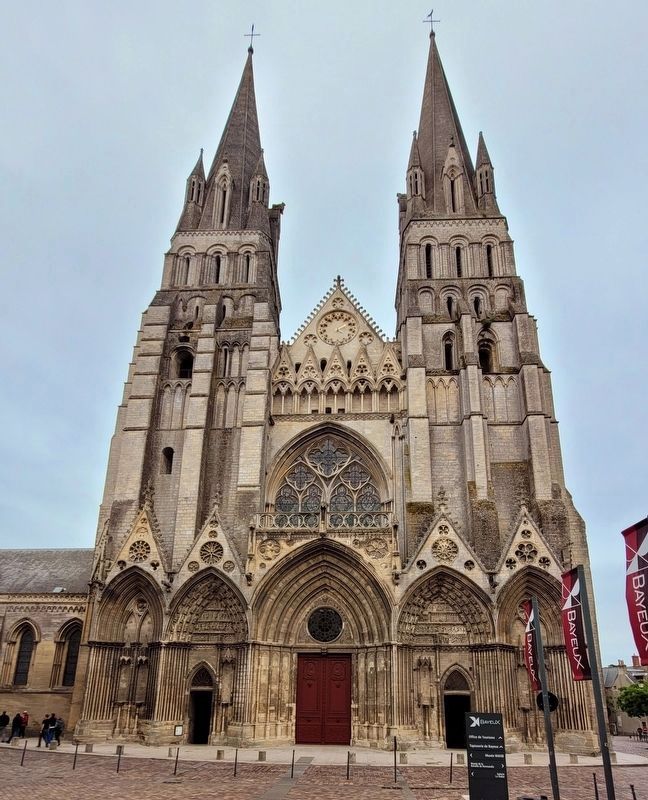
View of the front of the Cathedral.
Photographed by James Hulse, June 1, 2025
4. Le parvis de la cathédrale / Cathedral Square Marker
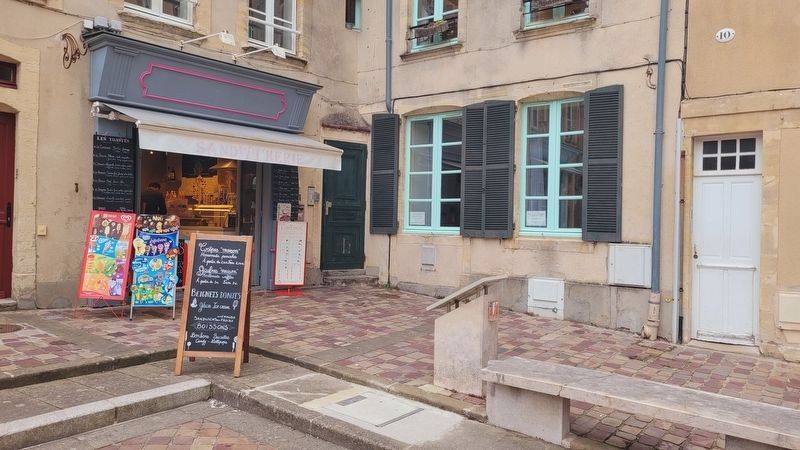
View of the marker in the square.
Photographed by James Hulse, August 4, 2026
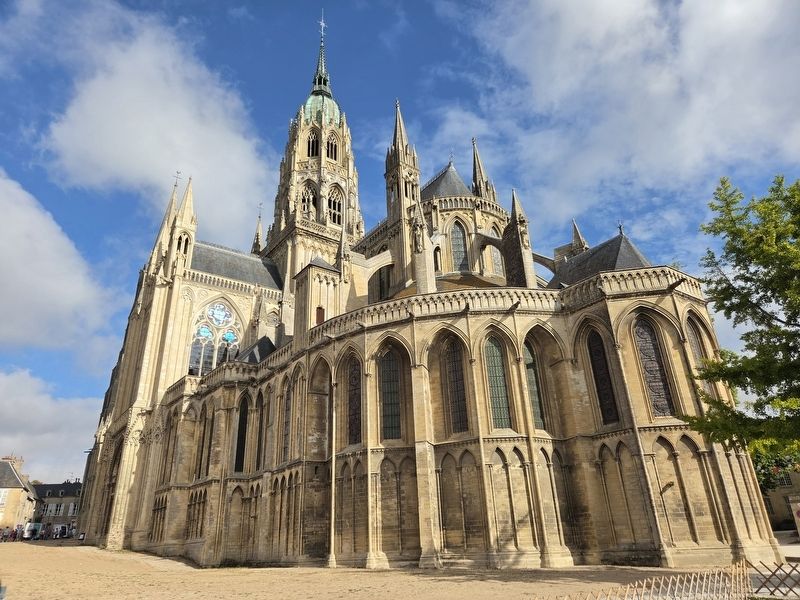
5. Le parvis de la cathédrale / Cathedral Square Marker
Rear of the Cathedral.
Photographed by James Hulse, August 4, 2026
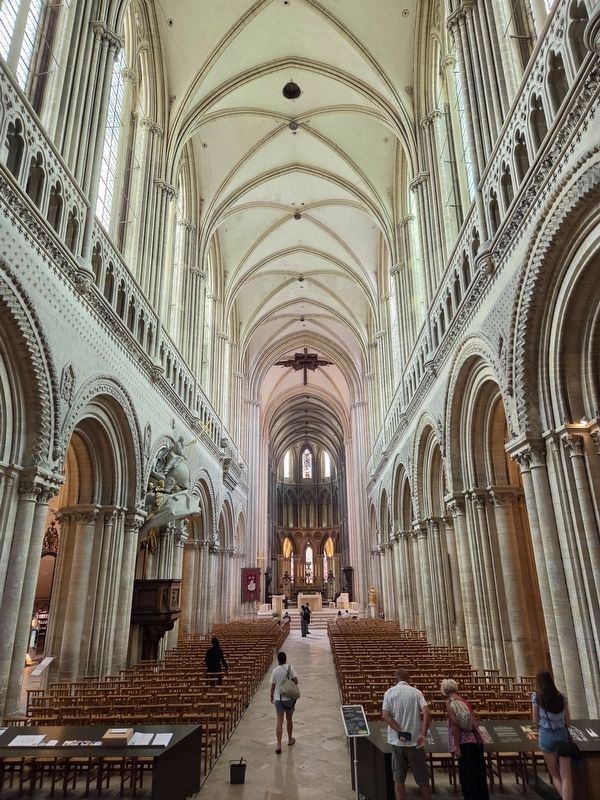
6. Le parvis de la cathédrale / Cathedral Square Marker
Interior of the Cathedral.
Credits. This page was last revised on August 11, 2026. It was originally submitted on August 10, 2026, by James Hulse of Medina, Texas. This page has been viewed 11 times since then. Photos: 1, 2, 3, 4, 5, 6. submitted on August 11, 2026, by James Hulse of Medina, Texas.
