Keyser in Mineral County, West Virginia — The American South (Appalachia)
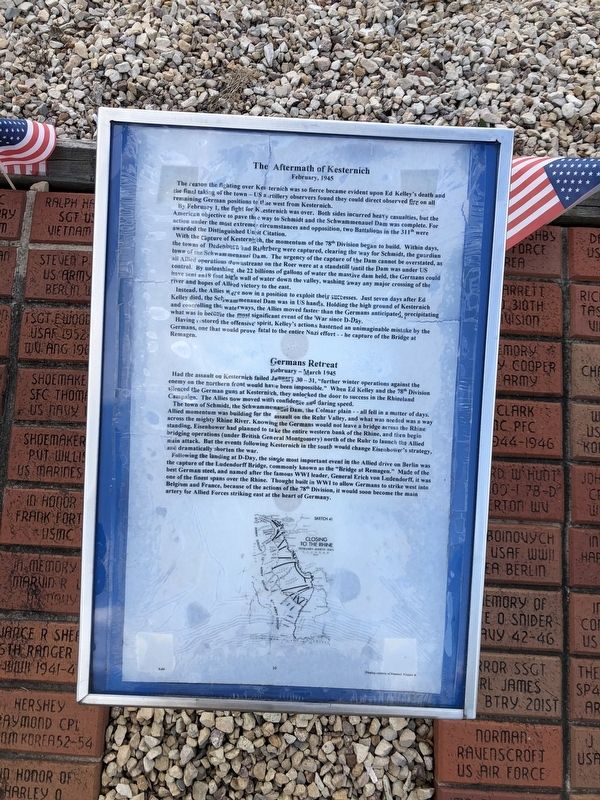
The Aftermath of Kesternich
⎯⎯⎯
Germans Retreat
Photographed by Devry Becker Jones (CC0), July 12, 2020
1. The Aftermath of Kesternich / Germans Retreat Marker
February, 1945
By February 1, the fight for Kesternich was over. Both sides incurred heavy casualties, but the American objective to pave the way to Schmidt and the Schwammenauel Dam was complete. For action under the most extreme circumstances and opposition, two Battalions in the 311th were awarded the Distinguished Unit Citation.
With the capture of Kesternich, the momentum of the 78th Division began to build. Within days, the towns of Dedenborn and Ruhrberg were captured, clearing the way for Schmidt, the guardian town of the Schwammenauel Dam. The urgency of the capture of the Dam cannot be overstated as all Allied operations downstream on the Roer were at a standstill until the Dam was under US control. By unleashing the 22 billions of gallons of water the massive dam held, the Germans could have sent an 18 foot high wall of water
this page online
Instead, the Allies were now in a position to exploit their successes. Just seven days after Ed Kelley died, the Schwammenauel Dam was in US hands. Holding the high ground of Kesternich and controlling the waterways, the Allies moved faster than the Germans anticipated, precipitating what was to become the most significant event of the War since D-Day.
Having restored the offensive spirit, Kelley's actions hastened an unimaginable mistake by the Germans, one that would prove fatal to the entire Nazi effort - - he capture of the Bridge at Remagen.
February - March, 1945
The town of Schmidt, the Schwammenauel Dam, the Colmar plain - - all fell in a matter of days. Allied
July 12, 2020
2. Ed Kelley Memorial Plaza
Following the landing at D-Day, the single most important event in the Allied drive on Berlin was the capture of the Ludendorff Bridge, commonly known as the "Bridge at Remagen." Made of the best German steel, and named after the famous WWI leader, General Erich von Ludendorff, it was one of the finest spans over the Rhine. Thought built in WWI to allow Germans to strike west into Belgium and France, because of the actions of the 78th Division, it would soon become the main artery for Allied Forces striking east at the heart of Germany.
Topics and series. This historical marker is listed in these topic lists: Bridges & Viaducts •
Photographed by Craig Doda, August 1, 2026
3. Ed Kelley Memorial Plaza
Location. This marker has been replaced by another marker nearby. It was located near 39° 26.385′ N, 78° 58.618′ W. Marker was in Keyser, West Virginia, in Mineral County. It was on East Piedmont Street (West Virginia Route 46) just west of North Davis Street, on the left when traveling west. Touch for map. Marker was at or near this postal address: 31 E Piedmont St, Keyser WV 26726, United States of America. Touch for directions.

Regionally, this marker was in the Eastern Panhandle. It was also in the American South, specifically in the Upper South, in Appalachia, and specifically in Northern Appalachia. Globally, it was in North America, the Western Hemisphere, the Western World, and the Anglosphere. Historically, it found itself in what was once the territory of the Mississippian Culture.
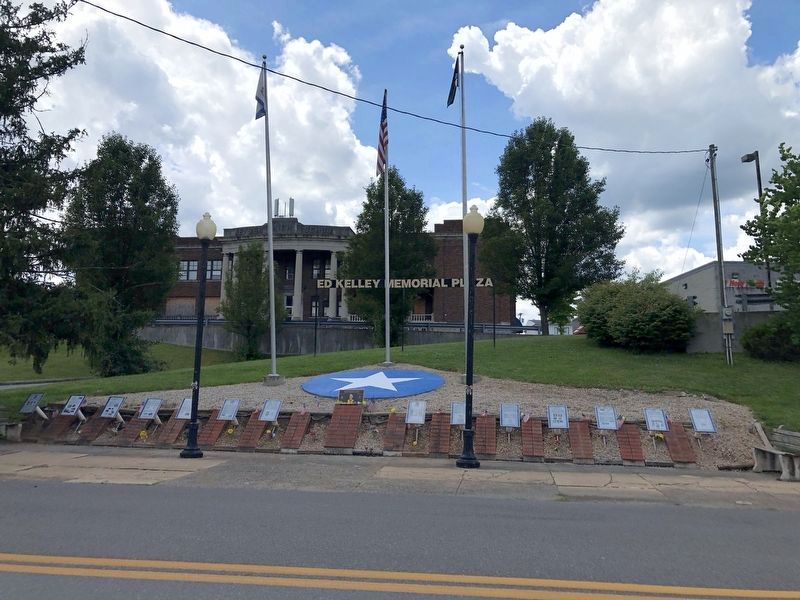
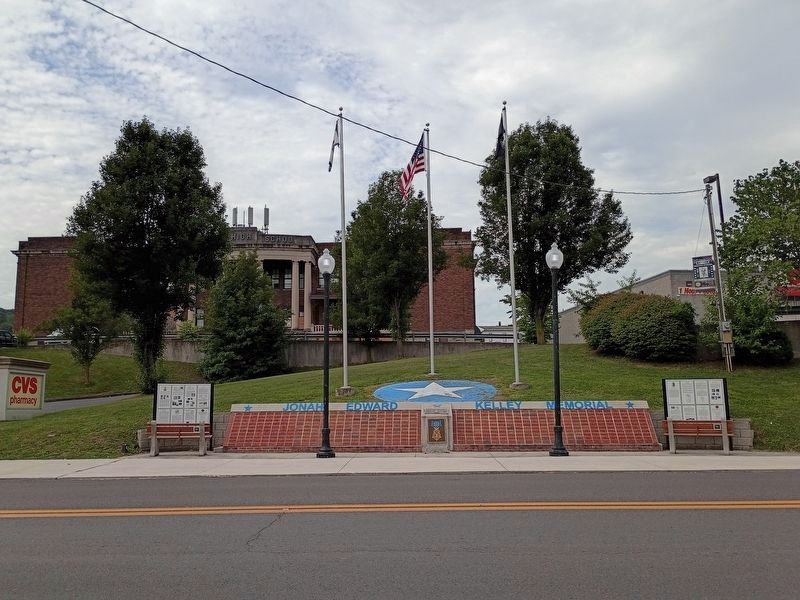
Other nearby markers. At least 3 other markers are within walking distance of this location: Jonah Edward Kelley (here, next to this marker); a different marker also named The Medal of Honor (here, next to this marker); The Ed Kelley Memorial Plaza (a few steps from this marker). Touch for a list and map of all markers in Keyser.
Other markers no longer nearby. The Battle for Kesternich (was here, next to this marker but has been replaced with another marker now near it); The Medal of Honor (was here, next to this marker but has been replaced with another marker now near it); The Bridge at Remagen (was here, next to this marker but has been replaced with another marker now near it); a different marker also named The Bridge at Remagen (was here, next to this marker but has been replaced with another marker now near it); a different marker also named The Bridge at Remagen (was here, next to this marker but has been replaced with another marker now near it); Encircling the Nazi War Machine & German Capitulation (was here, next to this marker but has been replaced with another marker now near it); Regaining the Initiative (was here, next to this marker but has been replaced with another marker now near it); The Battle of the Bulge (was here, next to this marker but has been replaced with another marker now near it); The First Battle of Kesternich (was here, next to this marker but has been replaced with another marker now near it); Key Terrain (was here, next to this marker but has been replaced with another marker now near it); D-Day (was here, next to this marker but has been replaced with another marker now near it); World War II (was a few steps from this marker but has been replaced with another marker now near it); Kelley Memorial Plaza (was a few steps from this marker but has been replaced with another marker now near it).
Credits. This page was last revised on August 12, 2026. It was originally submitted on July 14, 2020, by Devry Becker Jones of Washington, District of Columbia. This page has been viewed 323 times since then and 40 times this year. Last updated on August 12, 2026, by Craig Doda of Napoleon, Ohio. Photos: 1. submitted on July 14, 2020, by Devry Becker Jones of Washington, District of Columbia. 2. submitted on July 14, 2020. 3. submitted on August 12, 2026, by Craig Doda of Napoleon, Ohio.
