Keyser in Mineral County, West Virginia — The American South (Appalachia)
The Medal of Honor
Staff Sergeant Jonah "Ed" Kelly
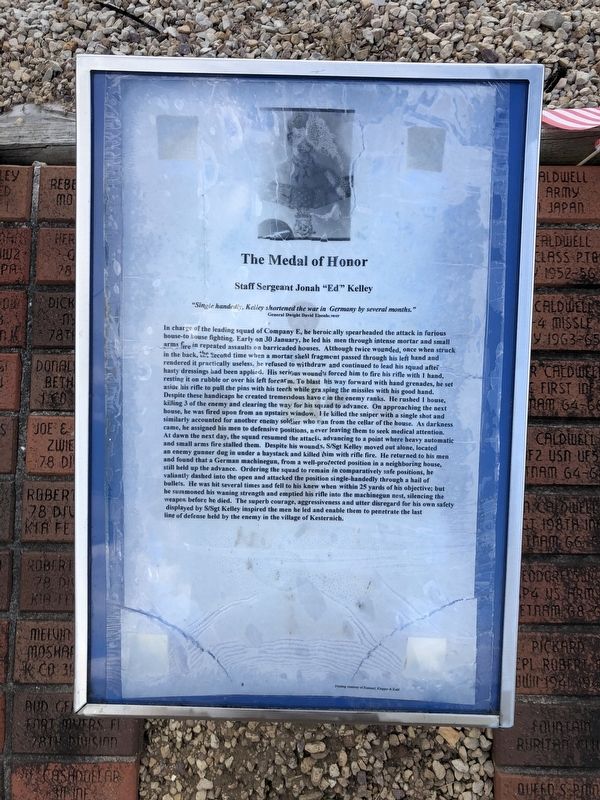
"Single handedly, Kelley shortened the war in Germany by several months."
General Dwight David Eisenhower
In charge of the leading squad of Company E, he heroically spearheaded the attack in furious house-to house fighting. Early on 30 January, he led his men through intense mortar and small arms fire in repeated assaults on barricaded houses. Although twice wounded, once when struck in the back, the second time when a mortar shell fragment passed through his left hand and rendered it practically useless, he refused to withdraw and continued to lead his squad after hasty dressings had been applied. His serious wounds forced him to fire his rifle with 1 hand, resting it on rubble over his left forearm. To blast his way forward with hand grenades, he set aside his rifle to pull the pins with his teeth while grasping the missiles with his good hand. Despite these handicaps he created tremendous havoc in the enemy ranks. He rushed 1 house, killing 3 of the enemy and clearing the way for his squad to advance. On approaching the next house, he was fired upon from an upstairs window. He killed the sniper with a single shot
this page online
July 12, 2020
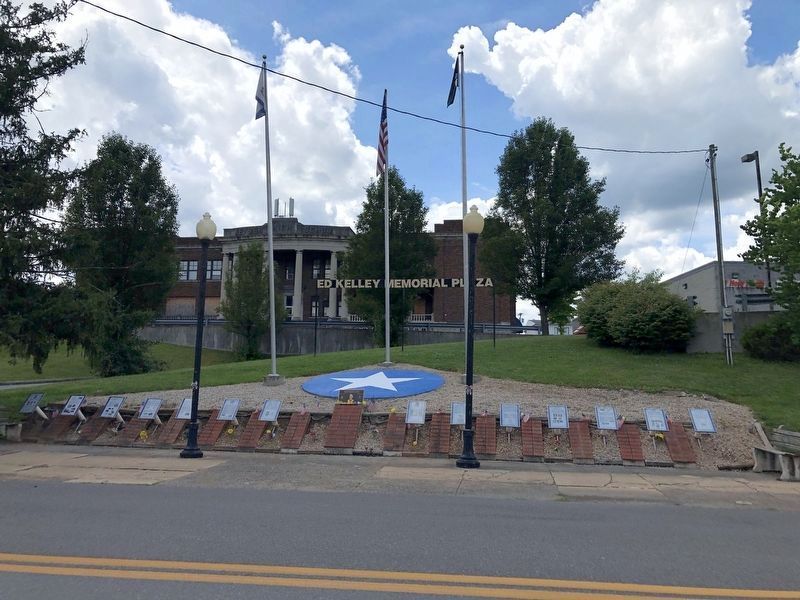
2. Ed Kelley Memorial Plaza
Topics and series. This historical marker is listed in this topic list: War, World II. In addition, it is included in the Former U.S. Presidents: #34 Dwight D. Eisenhower, and the Medal of Honor Recipients series lists. A significant historical date for this entry is January 30, 1944.
Location. This marker has been replaced by another marker nearby. It was located near 39° 26.384′ N, 78° 58.617′ W. Marker was in Keyser, West Virginia, in Mineral County. It was on East Piedmont Street (West Virginia Route 46) just west of North Davis Street, on the left when traveling west. Touch for map. Marker was at or near this postal address: 31 E Piedmont St, Keyser WV 26726, United States of America. Touch for directions.

Regionally, this marker was in the Eastern Panhandle. It was also in the American South, specifically in the Upper South, in Appalachia, and specifically in Northern Appalachia. Globally, it was in North America, the Western Hemisphere, the Western World, and the Anglosphere. Historically, it found itself in what was once the territory of the Mississippian Culture.
Other nearby markers. At
Photographed by Craig Doda, August 1, 2026
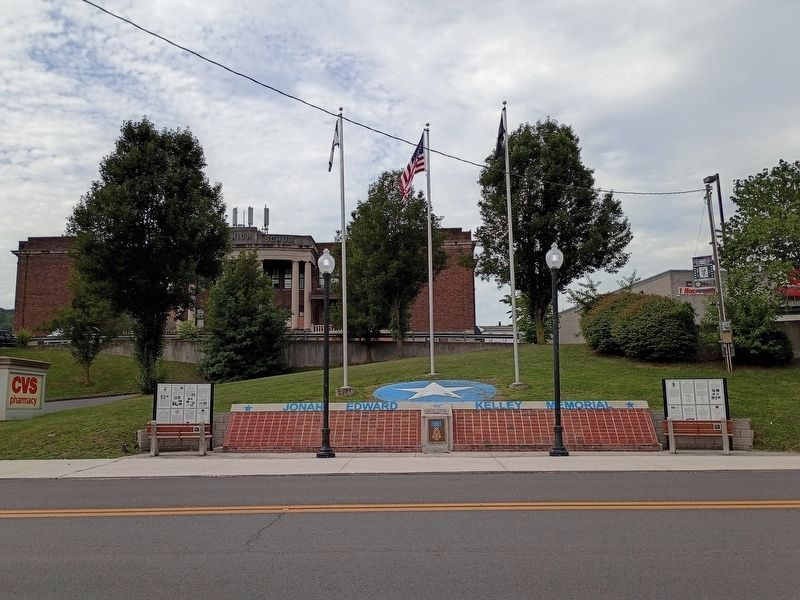
3. The Medal of Honor Marker
Other markers no longer nearby. The Battle for Kesternich (was here, next to this marker but has been replaced with another marker now near it); The Aftermath of Kesternich / Germans Retreat (was here, next to this marker but has been replaced with another marker now near it); Regaining the Initiative (was here, next to this marker but has been replaced with another marker now near it); The Battle of the Bulge (was here, next to this marker but has been replaced with another marker now near it); The First Battle of Kesternich (was here, next to this marker but has been replaced with another marker now near it); Key Terrain (was here, next to this marker but has been replaced with another marker now near it); The Bridge at Remagen (was here, next to this marker but has been replaced with another marker now near it); a different marker also named The Bridge at Remagen (was here, next to this marker but has been replaced with another marker now near it); D-Day (was here, next to this marker but has been replaced with another marker now near it); a different marker also named The Bridge at Remagen (was here, next to this marker but has been replaced with another marker now near it); Encircling the Nazi War Machine & German Capitulation (was here, next to this marker but has been replaced with another marker now near it); World War II (was here, next to this marker but has been replaced with another marker now near it); Kelley Memorial Plaza (was here, next to this marker but has been replaced with another marker now near it).
Credits. This page was last revised on August 20, 2026. It was originally submitted on July 14, 2020, by Devry Becker Jones of Washington, District of Columbia. This page has been viewed 269 times since then and 28 times this year. Last updated on August 12, 2026, by Craig Doda of Napoleon, Ohio. Photos: 1. submitted on July 14, 2020, by Devry Becker Jones of Washington, District of Columbia. 2. submitted on July 14, 2020. 3. submitted on August 12, 2026, by Craig Doda of Napoleon, Ohio.
