Santa Fe Depot
1897

1897
Dodge City, Kansas
Historical Landmark
Topics and series. This historical marker is listed in these topic lists: Architecture • Industry & Commerce • Railroads & Streetcars. In addition, it is included in the National Register of Historic Places (NRHP) series list. A significant historical year for this entry is 1897.
Location. 37° 45.149′ N, 100° 0.988′ W. Marker is in Dodge City, Kansas, in Ford County. It is on East Wyatt Earp Boulevard just east of Central Avenue, on the right when traveling east. The marker is beside the lobby entrance on the north/front side of the historic Santa Fe Depot. Touch for map. Marker is at or near this postal address: 101 East Wyatt Earp Boulevard, Dodge City KS 67801, United States of America. Touch for directions.

Regionally, this marker is in the American Midwest, in the Corn Belt, on the prairies, on the Great Plains, on the Southern Plains, on the High Plains, and on the Santa Fe Trail Corridor. Globally, it is in North America, the Western Hemisphere, the Western World, and the Anglosphere. Historically, it finds itself in what was once the Comanchería,
this page online
Other nearby markers. At least 8 other markers are within walking distance of this marker: Dennis Hopper (a few steps from this marker); Fred Harvey (a few steps from this marker); General Grenville Dodge (within shouting distance of this marker); Don Steele (within shouting distance of this marker); Wyatt Earp (within shouting distance of this marker); The 100th Meridian, Where East Meets West (within shouting distance of this marker); Dodge City, a railroad town (within shouting distance of this marker); "Doc" Holliday (within shouting distance of this marker). Touch for a list and map of all markers in Dodge City.
Regarding Santa Fe Depot. National Register of Historic Places № 00000791.
From the National Register Nomination prepared 6/2/2000:
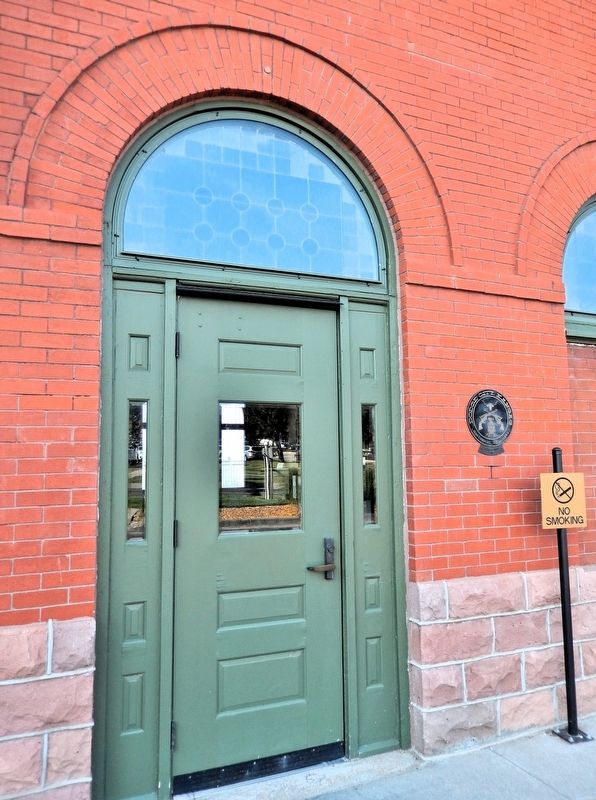
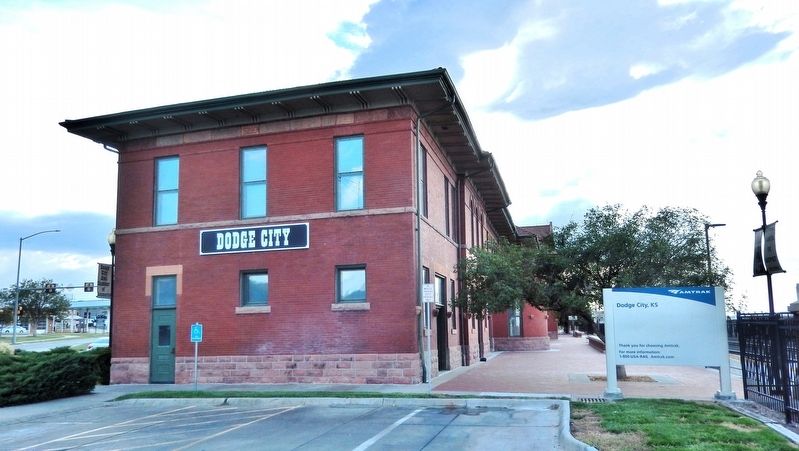
The Dodge City Santa Fe Railway Passenger Depot serves as Dodge City's premier example of Richardsonian Romanesque architecture. Designed by J. G. Holland and Co., Topeka, KS., and constructed by Fellows and Van Sant Company, the depot's heavy stone foundation, masonry walls, stonework, round-topped arches, bandsof windows, and tower are hallmarks of that style. The two-story (a middle section has three stories) red brick and stone depot is roofed with red, clay tiles and copper valleys. The building's 32,000 square feet includes the first and second floors, the third-floor observatory and a basement space under the original main building. The structure measures three hundred fifty feet long from east to west and thirty feet wide from north to south.Photographed by Cosmos Mariner, August 19, 20222. Santa Fe Depot MarkerThe marker is on the right side of the north/front entrance.All facades of the exterior building walls have a base of stone quarried from Castle Rock, Colorado. Red brick bearing walls extend from the stone base to the roof line. A horizontal buff colored masonry follows the building below the bottom of the second-floor window openings, except for three block components on the west end. Instead of buff colored masonry, this decorative feature is stone. The buff-colored masonry also adorns the peaked red brick walls on the third floor on the north and south facades. A decorative terra cotta cornice surrounds the building under the roof line and at the top of red brick walls.
The Dodge City Santa Fe Railway Passenger Depot is also significant for its association
with the growth and development of Dodge City as well as its association with the Atchison, Topeka and Santa Fe Railway Company. The importance of the ATSF Railway Company to the establishment and growth of Dodge City is indicated by the town charter date of 1872, the same year that Atchison, Topeka and Santa Fe Railway Company built rails into the Dodge City area. Dodge City Town Company's earliest advertisements proclaimed advantages of settlement at Dodge City — prominent among these advantages was the location of an Atchison, Topeka and Santa Fe Railway depot in Dodge CityPhotographed by Cosmos Mariner, August 19, 20223. Santa Fe Depot (southwest elevation)There are active railroad tracks on the south side of the building, still in use as an AMTRACK station. Today the renovated structure houses a passenger waiting area, meeting space and a repertory company.In articles on the actual construction of the building, printed September 30, 1897, the Globe Republican describes the building's interior and details related to the structure:
• 500,000 bricks were used in the construction.
• The total cost of copper for the roof was $2,000.
• The west room is for the depot and adjoining on the east are the express and baggage rooms; ladies' and gents' waiting rooms; lunch counter; dining room; hotel office; kitchen; storeroom; on the first floor.
• In the basement is the boiler room, root cellar, coal house, storeroom, laundry.Photographed by Cosmos Mariner, August 19, 20224. Santa Fe Depot (southeast elevation)Today the Santa Fe Depot Theater is housed in a newer addition at the northeast (right) corner of the historic railroad depot.
• The bakery and refrigerator rooms are on the first floor and room for milk and butter and pantry, etc.
• A large sample room for commercial traders is on the first floor.
• In the second story there are 28 sleeping rooms, besides ladies' parlor, and five sleeping rooms in the third story.
• The kitchen, laundry, bakery and wherever fire is kept are made fireproof with corrugated iron and eyebeams (sic).
• No wood is used except the doors and frames.
• James Guthbert, a resident of Topeka has had charge of the masonry and brick work.ATSF added a third one story addition (and basement) in 1925 to the north side of the Depot providing room for food preparation and storage to support the Dodge City Harvey House operations as well as supporting the dining car service that Fred Harvey managed on the Santa Fe passenger trains. The March 26, 1925 Dodge City Daily Globe reported: "The changes which are to be made will make El Vaquero one of the best Harvey Hotels on the Santa Fe system." The company also renovated hotel rooms in the west end.
After World War II, passenger travel decreased. First to feel the rapid decline after 1946, was the
Harvey system which established their famous eating houses every 100 miles along the Santa Fe rails through Kansas, Colorado, Texas, New Mexico, Arizona and California. In 1948, the Dodge City Fred Harvey Hotel dining portion (El Vaquero) closed its doors. The closing of the El Vaquero, synonymous with Dodge City and good food for half a century, was caused by dining cars on all transcontinental trains taking the place of the famous eating houses. Hotel rooms continued to be available, and a newsstand was kept in operation for a time after the closure of the Harvey House. With the growth of automobile travel and the subsequent decline of rail passenger traffic and sleeping cars, in the mid-1950s, the hotel portion of the Harvey complex also closed.Photographed by Cosmos Mariner, August 19, 20225. Santa Fe Depot (southwest elevation)From the National Register Nomination: Projecting from the first-floor elevation of the third block component from the west end on the southern trackside facade elevation is a flat roofed three-quarter rounded bay. Early photographs show a turret roof on the rounded bay.Though Dodge City continues to retain its division point status with the Santa Fe Railway Company, most train traffic is freight except for one eastbound and one westbound AMTRAK passenger train daily. The Depot is no longer utilized as it was the first fifty years after construction. An extremely visible feature of the Dodge City community, the structure's immense size and location on the
main thoroughfare of the city constantly reminds local citizens and travelers of the importance of railroad shipping and passenger travel in the development of Dodge City as well as the nation.Photographed by Cosmos Mariner, August 19, 20226. Santa Fe Depot (northeast elevation)


Also see . . .
1. Atchison, Topeka and Santa Fe Railway Depot (Wikipedia).
Excerpt: The original station structure was built by the Atchison, Topeka and Santa Fe Railway in 1896 to a design by architect James C. Holland and Company, a Topeka firm, in the Richardsonian Romanesque architectural style. Dodge City's importance as a division point on the railroad, with yards, a roundhouse and shops, and as the last significant rest stop for westbound passengers before a large undeveloped region, led the railroad to build a large structure with a Harvey House lunchroom and dining room.(Submitted on August 13, 2026, by Cosmos Mariner of Cape Canaveral, Florida.)The station was added to and remodeled several times in the style of the original structure. An addition was made between 1907 and 1909 to the first and second floors on the west end to add hotel rooms. An addition built between 1912 and 1914 to first and second floors of the east end added railway employee offices and sleeping spaces, and expanded
the Harvey House lunchroom and dining room. The north facade was changed and a basement added for Harvey House food preparation and storage between 1924 and 1925. The station is of two stories with a three-story center section, constructed of stone, red-brick and terra cotta.The station was added to the National Register of Historic Places in 2000 for its historical significance in the growth of Dodge City and its association with the Atchison, Topeka and Santa Fe, and for its architectural significance as the finest example of Romanesque design in Dodge City. The station has been renovated and restored, and is also used as a theater and for other recreational, cultural, and social uses.
2. Historic Santa Fe Depot (City of Dodge City).
Excerpt: The Amtrak stop in Dodge City is located at the former El Vaquero Harvey House and depot, a two-story red brick Richardsonian Romanesque style structure that was built in 1898 by the Atchison, Topeka and Santa Fe Railway (ATSF) and subsequently enlarged and altered. Occupying almost two blocks, the building included a passenger depot and railroad offices, as well as a hotel and eating house run by Fred Harvey. The “Harvey Houses,” as they were known, dotted the ATSF tracks across the West. In the days before dining cars became common, passengers had to detrain to eat a meal at a trackside restaurant.(Submitted on August 13, 2026, by Cosmos Mariner of Cape Canaveral, Florida.)The Santa Fe Depot, the largest depot still standing in the state of Kansas, has been completely rehabilitated to its early appearance. The city rehabilitated the second and third floors of the depot for office space in 2016. The former hotel lobby is the main gathering room and features many of the original fixtures, flooring, counter, woodwork and leaded glass windows. The Harvey House dining room has been restored for use as a meeting and special event space. City staff open the waiting room for Amtrak customers one hour prior to the arrival of the Southwest Chief. The Amtrak area also houses the offices of Dodge City Public Transit, whose bus routes all serve the depot.
Credits. This page was last revised on August 13, 2026. It was originally submitted on August 12, 2026, by Cosmos Mariner of Cape Canaveral, Florida. This page has been viewed 19 times since then. Photos: 1, 2, 3, 4, 5, 6. submitted on August 13, 2026, by Cosmos Mariner of Cape Canaveral, Florida.
