Riverwalk District in Reno in Washoe County, Nevada — The American Mountains (Southwest)
Fish of the Truckee River

Photographed by Douglass Halvorsen, August 7, 2026
1. Fish of the Truckee River Marker
Prior to the arrival of white settlers, there were only two kinds of fish found in the river that today are considered game fish - Lahontan Cutthroat Trout and Mountain Whitefish.
An amazing fish, Lahontan Cutthroat Trout were first discovered and described by John C. Fremont in 1844. Fremont called this fish “salmon trout” because it resembled Columbia River Salmon more than it resembled trout. The fish Fremont described were “from two to four feet in length” and “some were in excess of forty pounds.”
The Lahontan Cutthroat Trout is a remnant of inhabitants that lived in ancient Lake Lahontan, which covered much of the Great Basin including Pyramid Lake. Historically, Lahontan Cutthroat Trout lived most of the year in Pyramid Lake, and returned to the Truckee River in the early spring to spawn. The trout moved up the river to gravel beds to deposit their eggs and ensure the survival of future generations. After the construction of Derby Dam on the lower Truckee River, the fish could not move upstream to spawn and this decimated the population. Most Lahontan Cuttthroat
this page online
Mountain Whitefish (Prosopium Williamsoni)
Similar to Ocean Bonefish, Mountain Whitefish are the only other native game fish in the Truckee River. The Whitefish still thrive in the river from Lake Tahoe to Reno. Usually less than two pounds in size, the Whitefish is a wonderful game fish and fights much like a Brown Trout. They are found in the deep pools of the river and below riffles and runs.
Brown Trout (Salmo trutta)
The two non-native game fish found in the river are Brown Trout and Rainbow Trout. First introduced in the late 1800s and early 1900s, these fish are now more numerous than the natives are. The Nevada Division of Wildlife (NDOW) maintains a stocking program for both of these fish and the Truckee River is one of the state’s most popular recreation fishing waters.
Other native fish found in the river are the Dace, Tui Chub, Tahoe Sucker and the Paiute Sculpin. Most of these fish are relatively small and provide food for the larger game fish.
Bass, Carp and other species are found in a variety of locations on the
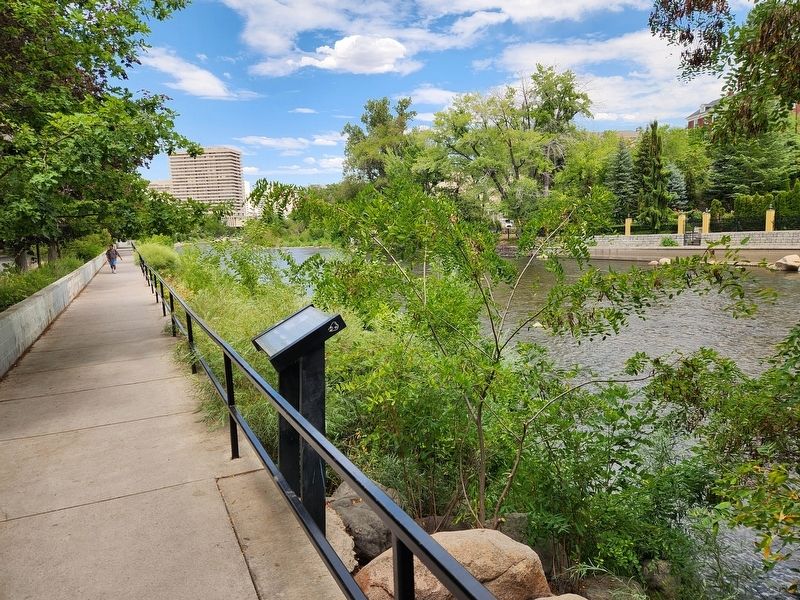
Photographed by Douglass Halvorsen, August 7, 2026
2. Fish of the Truckee River Marker
Erected by City of Reno River Trail.
Topics. This historical marker is listed in this topic list: Animals. A significant historical year for this entry is 1844.
Location. 39° 31.342′ N, 119° 49.264′ W. Marker is in Reno, Nevada, in Washoe County. It is in the Riverwalk District. It is on Riverside Drive, on the left when traveling west. Touch for map. Marker is at or near this postal address: 727 Riverside Drive, Reno NV 89503, United States of America. Touch for directions.

Regionally, this marker is in the Sierra Nevada and in the Lake Tahoe Basin. It is also in the American Mountain West. Globally, it is in North America, the Western Hemisphere, the Western World, and the Anglosphere. Historically, it finds itself in what was once New Spain and also Mexico’s Alta California.
Other nearby markers. At least 8 other markers are within walking distance of this marker: Powning’s Addition Conservation District (a few steps from this marker); The Coming of the Iron Horse (a few steps from this marker); About Your Journey... (a few steps from this marker); First Church of Christ, Scientist, Reno (about 600 feet away, measured in a direct line); Culture and History (about 700 feet away); McKinley Park School (approx. 0.2 miles away); The Humboldt Trail (approx. 0.2 miles away); Wingfield Park (approx. ¼ mile away). Touch for a list and map of all markers in Reno.
Credits. This page was last revised on August 13, 2026. It was originally submitted on August 13, 2026, by Douglass Halvorsen of Klamath Falls, Oregon. This page has been viewed 13 times since then. Photos: 1, 2. submitted on August 13, 2026, by Douglass Halvorsen of Klamath Falls, Oregon. • Andrew Ruppenstein was the editor who published this page.
