Butte in Silver Bow County, Montana — The American West (Mountains)
Caplice & McCune Store
Butte–Anaconda Historic District
Photographed by Cosmos Mariner, July 6, 2024
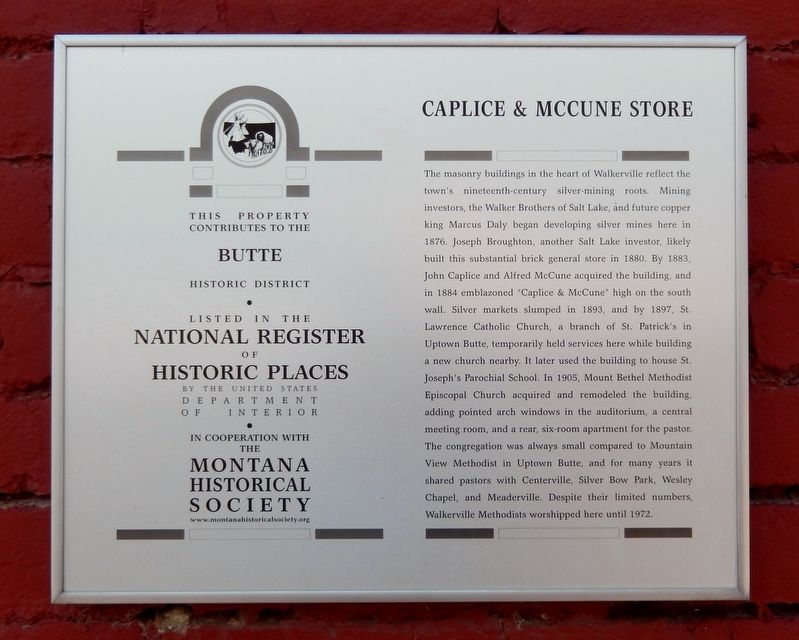
1. Caplice & McCune Store Marker
The masonry buildings in the heart of Walkerville reflect the town's nineteenth-century silver-mining roots. Mining investors, the Walker Brothers of Salt Lake, and future copper king Marcus Daly began developing silver mines here in 1876. Joseph Broughton, another Salt Lake investor, likely built this substantial brick general store in 1880. By 1883, John Caplice and Alfred McCune acquired the building, and in 1884 emblazoned “Caplice & McCune” high on the south wall. Silver markets slumped in 1893, and by 1897, St. Lawrence Catholic Church, a branch of St. Patrick's in Uptown Butte, temporarily held services here while building a new church nearby. It later used the building to house St. Joseph's Parochial School. In 1905, Mount Bethel Methodist Episcopal Church acquired and remodeled the building, adding pointed arch windows in the auditorium, a central meeting room, and a rear, six-room apartment for the pastor. The congregation was always small compared to Mountain View Methodist in Uptown Butte, and for many years it shared pastors with Centerville, Silver Bow Park, Wesley Chapel, and Meaderville. Despite their limited
this page online
Erected by Montana Historical Society.
Topics and series. This historical marker is listed in these topic lists: Architecture • Industry & Commerce • Religion & Religious Structures. In addition, it is included in the Montana National Register Sign Program, and the National Register of Historic Places (NRHP) series lists. A significant historical year for this entry is 1883.
Location. 46° 1.838′ N, 112° 32.12′ W. Marker is in Butte, Montana, in Silver Bow County. It is at the intersection of North Main Street and North Street, on the right when traveling south on North Main Street. The marker is mounted directly on the east/front facade of the subject building, facing North Main Street. Touch for map. Marker is at or near this postal address: 1613 North Main Street, Butte MT 59701, United States of America. Touch for directions.

Regionally, this marker is in andspecifically outhwest Montana, in Gold West Country, in Mining Country. It is also in the American Mountain West and in the Lewis & Clark Corridor. Globally, it is in North America, the Rocky Mountains,
Photographed by Cosmos Mariner, July 6, 2024
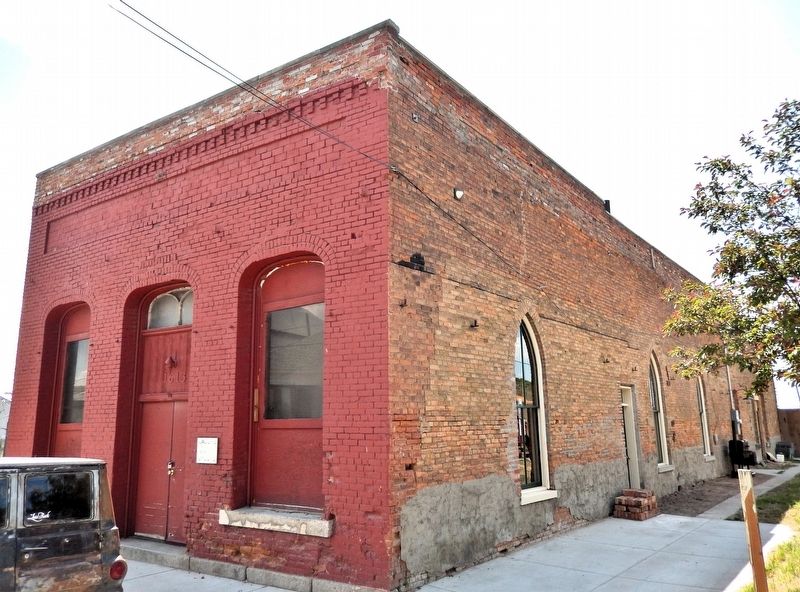
2. Caplice & McCune Store (northeast elevation)
The marker is mounted on the right side of the east/front entrance, between the door and the window.
Other nearby markers. At least 8 other markers are within walking distance of this marker: 1600 North Main (within shouting distance of this marker); Butte-Anaconda Historic District (about 400 feet away, measured in a direct line); Butte-Anaconda-Walkerville (about 500 feet away); Walkerville and the Lex (approx. 0.2 miles away); St. Lawrence O’Toole Church (approx. ¼ mile away); The Con Hoist House (approx. half a mile away); Mines of Centerville (approx. half a mile away); The Irish of Centerville (approx. half a mile away). Touch for a list and map of all markers in Butte.
Regarding Caplice & McCune Store. The Caplice & McCune Store is a contributing property in Butte–Anaconda Historic District, National Register of Historic Places № 66000438.
From the National Register Nomination prepared by Derek Strahn, 1/2006:
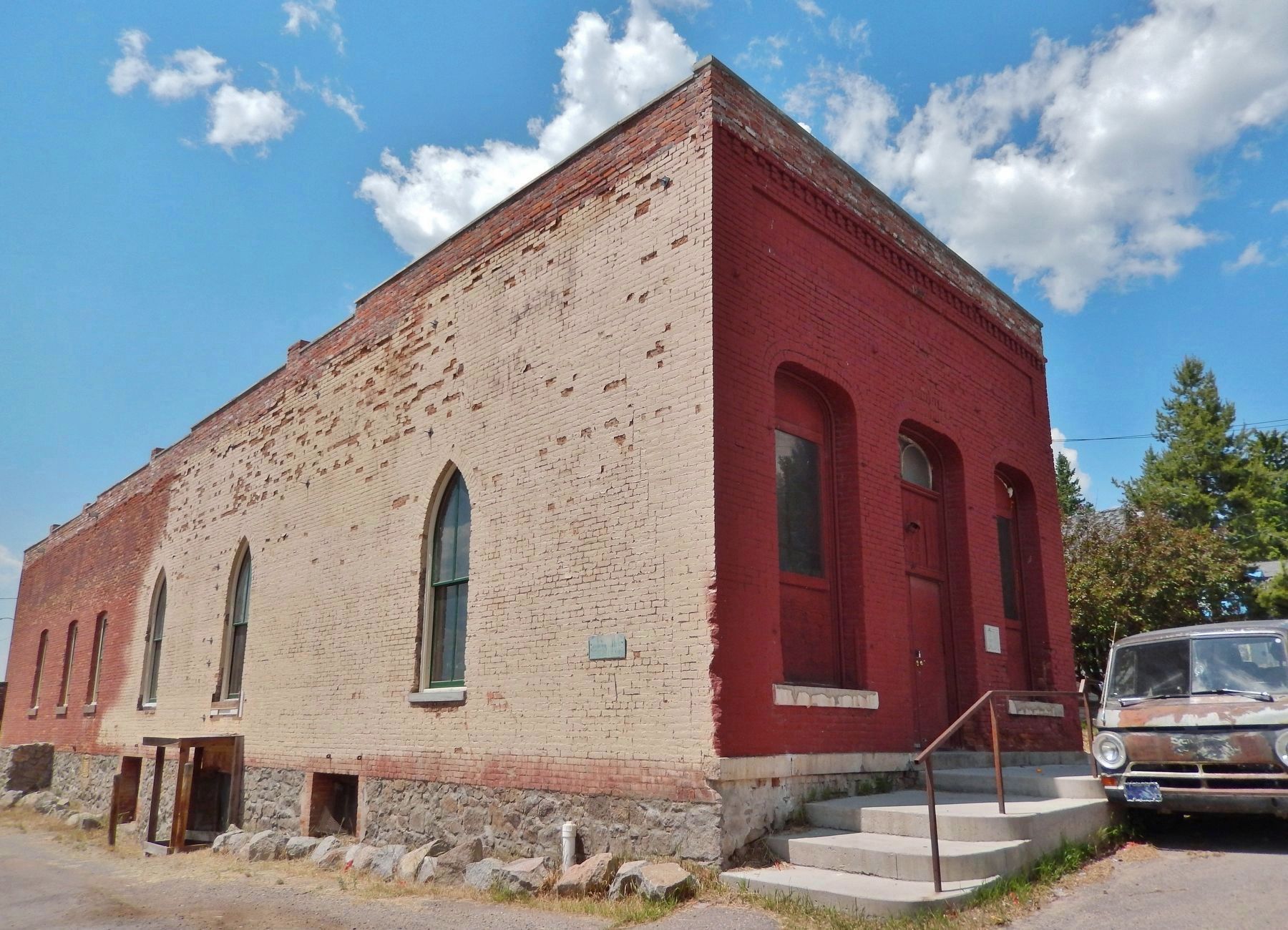
The silver industry attracted miners, while the mining camp drew a variety of entrepreneurs and merchants purveying the basics of everyday life:grains, vegetables, meat, liquor, boots, clothing, building materials and mining equipment. Investment opportunities attracted merchants with considerable business acumen from other Western gold and silver camps. For example, John Caplice drove a load of supplies to Bannack via Denver in 1863, and within 20 years operated five stores in southwestern Montana, including a provisionary with his partner McCune in Walkerville.Photographed by Cosmos Mariner, July 6, 20243. Caplice & McCune Store (southeast elevation)Notice the pointed arch windows — an oddity for a commercial building — added later by Mount Bethel Methodist Episcopal Church.Many sturdy business buildings still stand along Main and Daly Streets, and represent commercial building patterns of the nineteenth-century Rocky Mountain mining frontier. These buildings are one or two stories in height, with heavy ashlar native stone on the first story and wooden construction above. Examples include the Joseph Broughton Co., the John Caplice & A.W. McCune Co.; the Bielenberg & Bruhn Meat Market; and the Schonsberg Brothers store and Saloon.
Located just west of the Continental Divide, on the northern slope of the Summit Valley in southwestern Montana's Silver Bow County, the city of Butte is concentrated on a furrowed outcropping that once was appropriately nicknamed the “Richest Hill on Earth.”
Both Butte and Walkerville owe their life to mining and a labyrinth of precious metals deposited deep beneath the earth's surface. These geologic patterns directed mining and milling operations to be concentrated mostly along the steeply sloping upper Butte Hill and on the ridge crests. It was mining, smelting, and railroading that shaped the built environment of the Butte-Anaconda Historic District throughout the period of significance from 1876-1934. Supported by complex technology, outside capital, and railroads, the mines on Butte Hill represented industrial mining on a colossal scale. In 1961, Butte's national prominence as a copper-producing center was recognized with its designation as a National Historic Landmark.
Also see . . .
1. Caplice & McCune Store (Montana Historical Society). (Submitted on August 15, 2026, by Cosmos Mariner of Cape Canaveral, Florida.)
2. Butte–Anaconda Historic District (Wikipedia).
Excerpt: The Butte–Anaconda Historic District is a National Historic Landmark that spans parts of Walkerville, Butte and Anaconda, Montana. It was declared an National Historic Landmark in 1961. The district's national significance relates to its long history of copper production as well as to its role in the development of the labor union movement in the United States. As the source of nearly one-third of all the world's copper in the early 1900s, Butte's mines provided one of the metals that were critical to American industrialization. Walkerville represents some of the earliest mines in the district and preserves the early mining camp flavor present in the 1890s to 1910s. Butte itself is an urban metropolis where industrial relics such as mine yards and head frames are juxtaposed with a wide variety of residential and business structures. Anaconda was created as a company town that contained the smelters for Butte's ore.(Submitted on August 15, 2026, by Cosmos Mariner of Cape Canaveral, Florida.)
Credits. This page was last revised on August 15, 2026. It was originally submitted on August 13, 2026, by Cosmos Mariner of Cape Canaveral, Florida. This page has been viewed 18 times since then. Photos: 1, 2, 3. submitted on August 15, 2026, by Cosmos Mariner of Cape Canaveral, Florida.
