Simmons/Frazer House
Butte–Anaconda Historic District
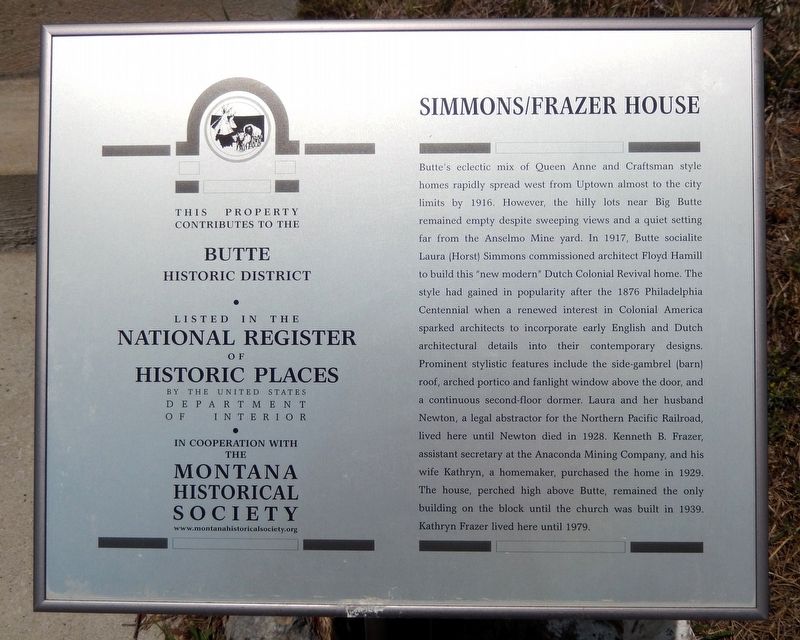
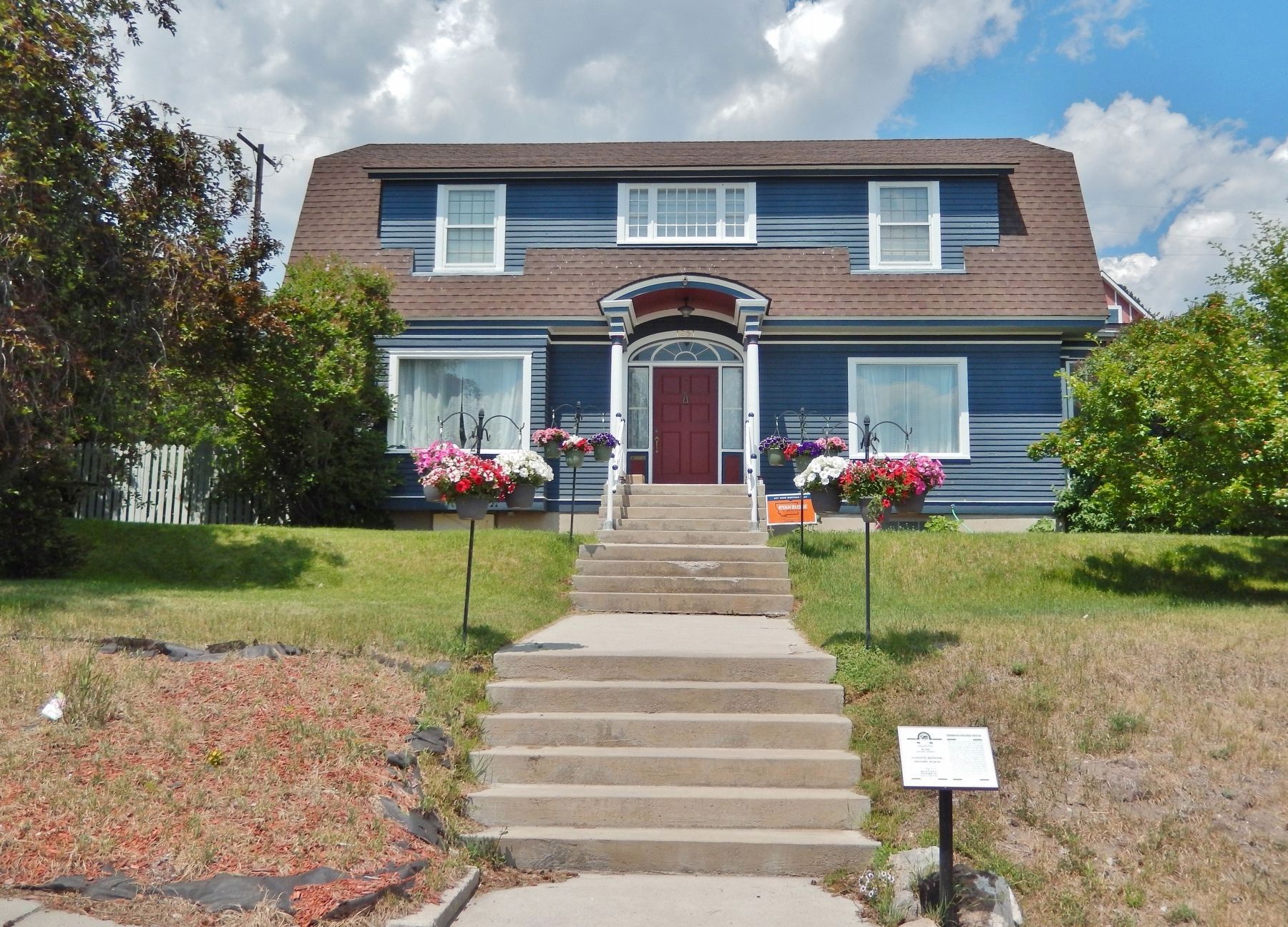
Butte's eclectic mix of Queen Anne and Craftsman style homes rapidly spread west from Uptown almost to the city limits by 1916. However, the hilly lots near Big Butte remained empty despite sweeping views and a quiet setting far from the Anselmo Mine yard. In 1917, Butte socialite Laura (Horst) Simmons commissioned architect Floyd Hamill to build this “new modern” Dutch Colonial Revival home. The style had gained in popularity after the 1876 Philadelphia Centennial when a renewed interest in Colonial America sparked architects to incorporate early English and Dutch architectural details into their contemporary designs. Prominent stylistic features include the side-gambrel (barn) roof, arched portico and fanlight window above the door, and a continuous second-floor dormer. Laura and her husband Newton, a legal abstractor for the Northern Pacific Railroad, lived here until Newton died in 1928. Kenneth B. Frazer, assistant secretary at the Anaconda Mining Company, and his wife Kathryn, a homemaker, purchased the home in 1929. The house, perched high above Butte, remained the only building on the block until the church was
this page online
Erected by Montana Historical Society.
Topics and series. This historical marker is listed in this topic list: Architecture. In addition, it is included in the Montana National Register Sign Program, and the National Register of Historic Places (NRHP) series lists. A significant historical year for this entry is 1917.
Location. 46° 0.975′ N, 112° 33.346′ W. Marker is in Butte, Montana, in Silver Bow County. It is on Caledonia Street just east of North Western Avenue, on the right when traveling east. The marker is beside the sidewalk, directly in front of the subject house. Touch for map. Marker is at or near this postal address: 1251 Caledonia Street, Butte MT 59701, United States of America. Touch for directions.

Regionally, this marker is in andspecifically outhwest Montana, in Gold West Country, in Mining Country. It is also in the American Mountain West and in the Lewis & Clark Corridor. Globally, it is in North America, the Rocky Mountains, the Western Hemisphere, the Western World, and the Anglosphere. Historically, it finds itself in what was once Rupert’s Land
Other nearby markers. At least 8 other markers are within walking distance of this marker: Immaculate Conception Church (within shouting distance of this marker); Montana Tech Campus Residence Halls (approx. ¼ mile away); Industry in the Middle (approx. ¼ mile away); Montana Tech Gateway Arch (approx. ¼ mile away); History of the ’M’ (approx. ¼ mile away); Montana Tech Campus President's Residence (approx. ¼ mile away); Montana Tech Campus (approx. ¼ mile away); Engineering Above and Below Ground (approx. 0.3 miles away). Touch for a list and map of all markers in Butte.
Regarding Simmons/Frazer House. The Simmons/Frazer House is a contributing property in Butte–Anaconda Historic District, National Register of Historic Places № 66000438.
From the National Register Nomination prepared by Derek Strahn, 1/2006:
The Newton W. Simmons home was designed by Butte architect Floyd A. Hamill in 1918. This side-gambrel Dutch Colonial house is enriched by a full-width shed dormer and a projecting barrel vaulted entry with fan and sidelights. Simmons was an abstractor with the Northern Pacific Railroad. Kenneth B. Frazier, assistant secretary for the Anaconda Mining Company, lived in the house from 1930 to 1954.Located just west of the Continental Divide, on the northern slope of the Summit Valley in southwestern Montana's Silver Bow County, the city of Butte is concentrated on a furrowed outcropping that once was appropriately nicknamed the “Richest Hill on Earth.” Both Butte and Walkerville owe their life to mining and a labyrinth of precious metals deposited deep beneath the earth's surface. These geologic patterns directed mining and milling operations to be concentrated mostly along the steeply sloping upper Butte Hill and on the ridge crests. It was mining, smelting, and railroading that shaped the built environment of the Butte-Anaconda Historic District throughout the period of significance from 1876-1934. Supported by complex technology, outside capital, and railroads, the mines on Butte Hill represented industrial mining on a colossal scale. In 1961, Butte's national prominence as a copper-producing center was recognized with its designation as a National Historic Landmark.
Also see . . .
1. Simmons/Frazer House (Montana Historical Society). (Submitted on August 14, 2026, by Cosmos Mariner of Cape Canaveral, Florida.)
2. Butte–Anaconda Historic District (Wikipedia).
Excerpt: The Butte–Anaconda Historic District is a National Historic Landmark that spans parts of Walkerville, Butte and Anaconda, Montana. It was declared an National Historic Landmark in 1961. The district's national significance relates to its long history of copper production as well as to its role in the development of the labor union movement in the United States. As the source of nearly one-third of all the world's copper in the early 1900s, Butte's mines provided one of the metals that were critical to American industrialization. Walkerville represents some of the earliest mines in the district and preserves the early mining camp flavor present in the 1890s to 1910s. Butte itself is an urban metropolis where industrial relics such as mine yards and head frames are juxtaposed with a wide variety of residential and business structures. Anaconda was created as a company town that contained the smelters for Butte's ore.(Submitted on August 14, 2026, by Cosmos Mariner of Cape Canaveral, Florida.)
Credits. This page was last revised on August 14, 2026. It was originally submitted on August 14, 2026, by Cosmos Mariner of Cape Canaveral, Florida. This page has been viewed 13 times since then. Photos: 1, 2. submitted on August 14, 2026, by Cosmos Mariner of Cape Canaveral, Florida.
