Immaculate Conception Church
Butte–Anaconda Historic District
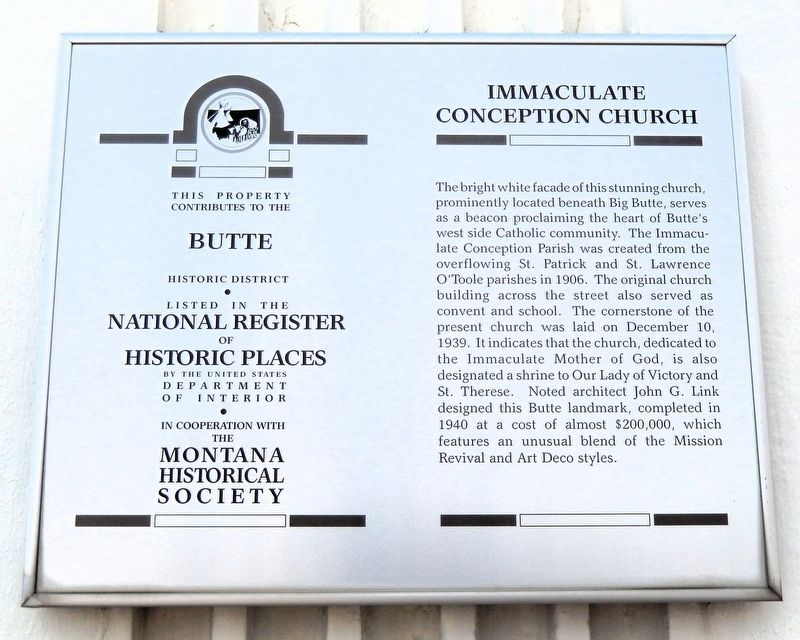
The bright white facade of this stunning church, prominently located beneath Big Butte, serves as a beacon proclaiming the heart of Butte's west side Catholic community. The Immaculate Conception Parish was created from the overflowing St. Patrick and St. Lawrence O’Toole parishes in 1906. The original church building across the street also served as convent and school. The cornerstone of the present church was laid on December 10, 1939. It indicates that the church, dedicated to the Immaculate Mother of God, is also designated a shrine to Our Lady of Victory and St. Therese. Noted architect John G. Link designed this Butte landmark, completed in 1940 at a cost of almost $200,000, which features an unusual blend of the Mission Revival and Art Deco styles.
Erected by Montana Historical Society.
Topics and series. This historical marker is listed in these topic lists: Architecture • Religion & Religious Structures. In addition, it is included in the Montana National Register Sign Program, and the National Register of Historic Places (NRHP) series lists. A significant historical date for this entry is December 10, 1939.
Location. 46° 0.981′ N, 112° 33.302′ W.
this page online

Regionally, this marker is in andspecifically outhwest Montana, in Gold West Country, in Mining Country. It is also in the American Mountain West and in the Lewis & Clark Corridor. Globally, it is in North America, the Rocky Mountains, the Western Hemisphere, the Western World, and the Anglosphere. Historically, it finds itself in what was once Rupert’s Land and also the Louisiana Purchase.
Other nearby markers. At least 8 other markers are within walking distance of this marker: Simmons/Frazer House (within shouting distance of this marker); Montana Tech Campus Residence Halls (approx. ¼ mile away); Switching & Hauling (approx. ¼ mile away); Industry in the Middle (approx. ¼ mile away); Montana Tech Gateway Arch
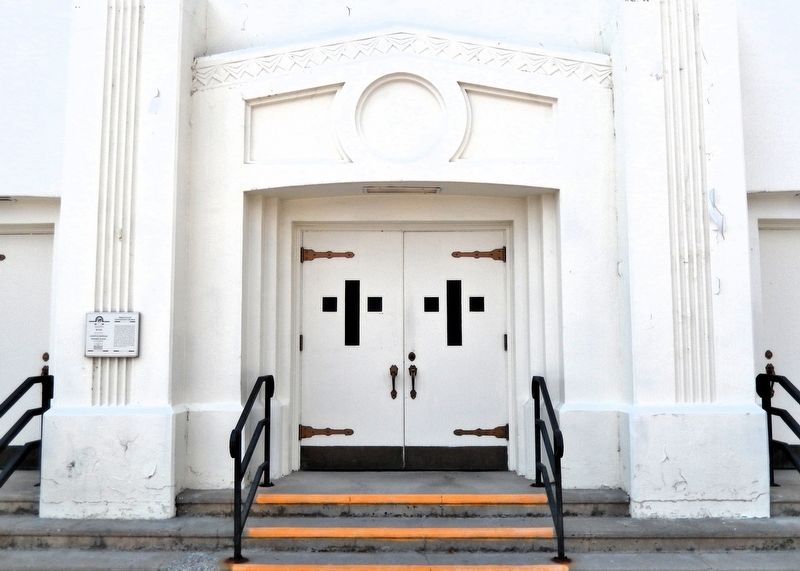
Regarding Immaculate Conception Church. Immaculate Conception Church is a contributing property in Butte–Anaconda Historic District, National Register of Historic Places № 66000438.
From the National Register Nomination prepared by Derek Strahn, 1/2006:
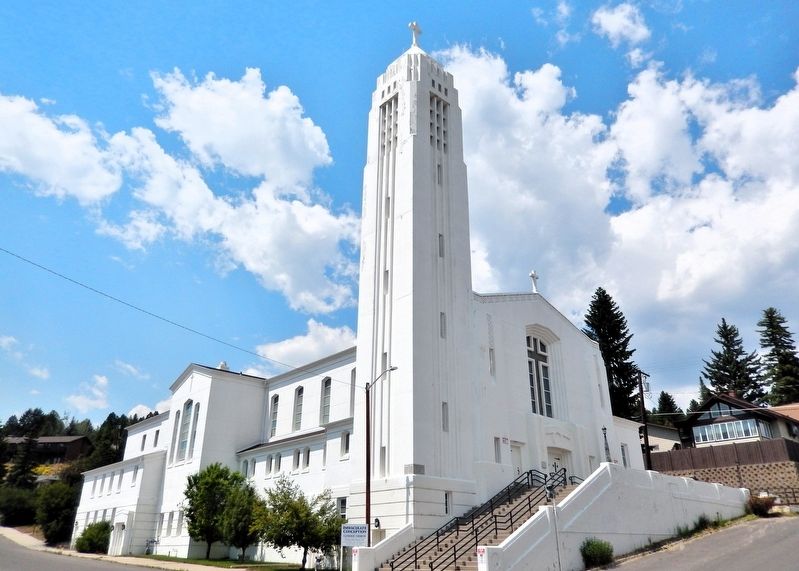
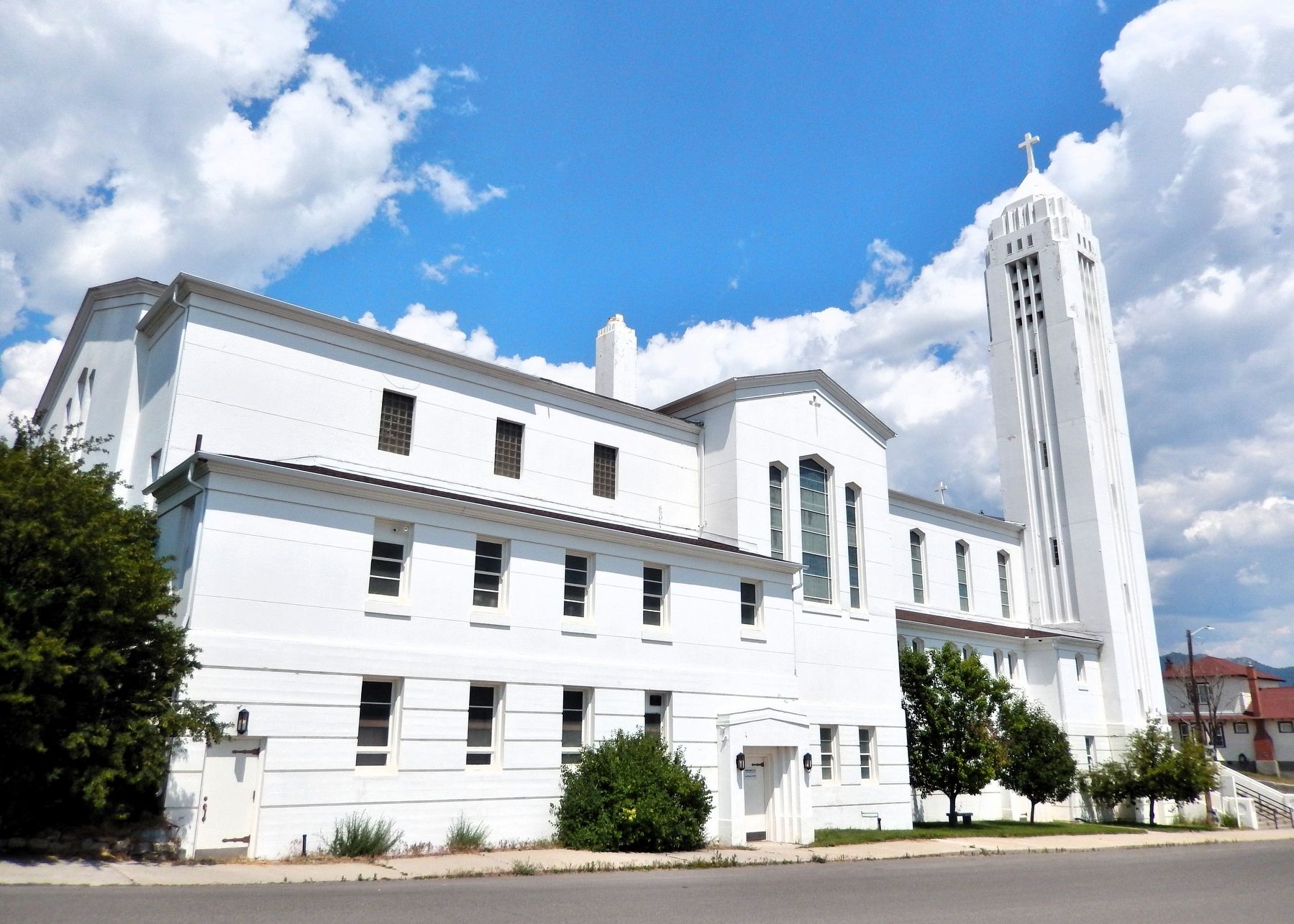
With the city expanding, the Roman Catholic Church created the parish of the Immaculate Conception in 1906 at the northwest corner of the Northwest-Big Butte neighborhood. Shortly thereafter, a large Craftsman rectory was also finished. In 1918, J. Wellington Smith, a local architect, designed a convent for the Sisters of Charity teachers at the school. Construction at the parish began again the 1930s, on a combination church-school for the parish. A concrete, Art Deco-style parish hall and gymnasium was completed in 1936, and in 1938 ground was broken for a new church that was to become a landmark on the Butte skyline. Prominent Montana architectJohn G. Link designed the Church of the Immaculate Conception. With its 170-foot-high bell tower and poured concrete construction, it combines the Gothic Revival and Art Deco styles.Photographed by Cosmos Mariner, July 6, 20243. Immaculate Conception Church (southeast elevation)Located just west of the Continental Divide, on the northern slope of the Summit Valley in southwestern Montana's Silver Bow County, the city of Butte is concentrated on a furrowed outcropping that once was appropriately nicknamed the “Richest Hill on Earth.” Both Butte and Walkerville owe their life to mining and a labyrinth of precious metals deposited deep beneath the earth's surface. These geologic patterns directed mining and milling operations to be concentrated mostly along the steeply sloping upper Butte Hill and on the ridge crests. It was mining, smelting, and railroading that shaped the built environment of the Butte-Anaconda Historic District throughout the period of significance from 1876-1934. Supported by complex technology, outside capital, and railroads, the mines on Butte Hill represented industrial mining on a colossal scale. In 1961, Butte's national prominence as a copper-producing center was recognized with its designation as a National
Historic Landmark.Photographed by Cosmos Mariner, July 6, 20244. Immaculate Conception Church (southwest elevation)
Also see . . .
1. Immaculate Conception Church (Montana Historical Society).
Excerpt: An article written for the parish history provides this description of the building’s stained-glass: “The beauty of the windows adorning the church truly defies description. They are entirely unique in the catalog of ecclesiastical art in the country.”(Submitted on August 14, 2026, by Cosmos Mariner of Cape Canaveral, Florida.)
• The façade (front) window shows the Cross Triumphant with side panels depicting the Tree of Life. The center cross was originally made of clear glass brick to provide a vivid contrast to the deep colors surrounding it. But the light from it could be blinding to the priest facing that direction in the morning sun, so the original glass was later replaced by colored glass done in a style called dalle de verre. In this technique, slabs of glass are broken or sawn into small pieces, then assembled to form the window.
• Saint Anne, the mother of Mary, was also the patron saint of miners. The emblem of the School of Mines in Butte (now called Montana Tech) is portrayed in her window.
• The Saint Bernadette Soubirous window includes a BVM emblem that represents the Sisters of Charity of the Blessed Virgin Mary, the religious order that established and taught at Immaculate Conception School.
• The Saint Kateri Tekakwitha window depicts the first Native American ever proposed for canonization. Of Mohawk and Algonquin descent, Kateri was venerated in 1943 and beatified in 1980.
• The coat of arms with the date 1884 represents the establishment of the Diocese of Helena. The seal of the State of Montana is depicted, as well as the first mission church in Montana, St. Mary Mission built in 1841 in present-day Stevensville, Montana.
• The smaller windows in the side aisles show the coats of arms of the recent popes, alternating with the emblems of the bishops of Montana.
• The triple panel windows in the two transepts (short aisles) are dedicated to the two special patrons of Immaculate Conception parish.
• The south window honors our Lady of Victory, and in one side panel can be seen the distinctive white tower of the church itself with the Big M in the background.
• The north transept window honors St. Therese of Lisieux. The triple panel window at the rear of the sanctuary portrays the Holy Spirit and the seven sacraments.
2. Butte–Anaconda Historic District (Wikipedia).
Excerpt: The Butte–Anaconda Historic District is a National Historic Landmark that spans parts of Walkerville, Butte and Anaconda, Montana. It was declared an National Historic Landmark in 1961. The district's national significance relates to its long history of copper production as well as to its role in the development of the labor union movement in the United States. As the source of nearly one-third of all the world's copper in the early 1900s, Butte's mines provided one of the metals that were critical to American industrialization. Walkerville represents some of the earliest mines in the district and preserves the early mining camp flavor present in the 1890s to 1910s. Butte itself is an urban metropolis where industrial relics such as mine yards and head frames are juxtaposed with a wide variety of residential and business structures. Anaconda was created as a company town that contained the smelters for Butte's ore.(Submitted on August 14, 2026, by Cosmos Mariner of Cape Canaveral, Florida.)
Credits. This page was last revised on August 14, 2026. It was originally submitted on August 14, 2026, by Cosmos Mariner of Cape Canaveral, Florida. This page has been viewed 14 times since then. Photos: 1, 2, 3, 4. submitted on August 14, 2026, by Cosmos Mariner of Cape Canaveral, Florida.
