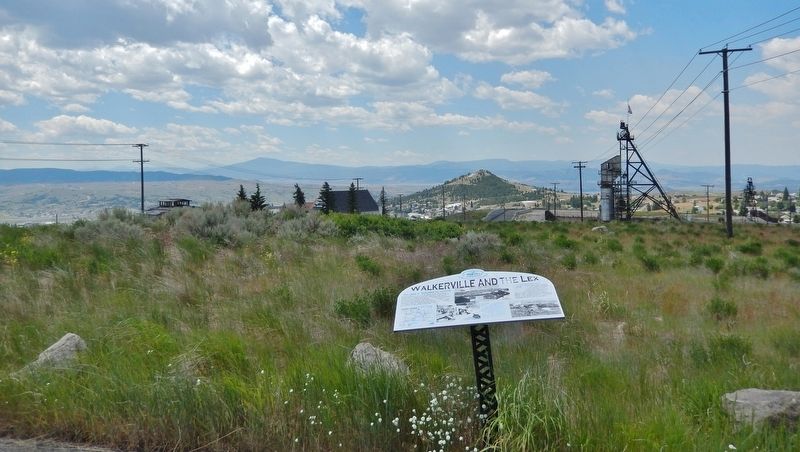
Walkerville and the Lex

Town’s Significance
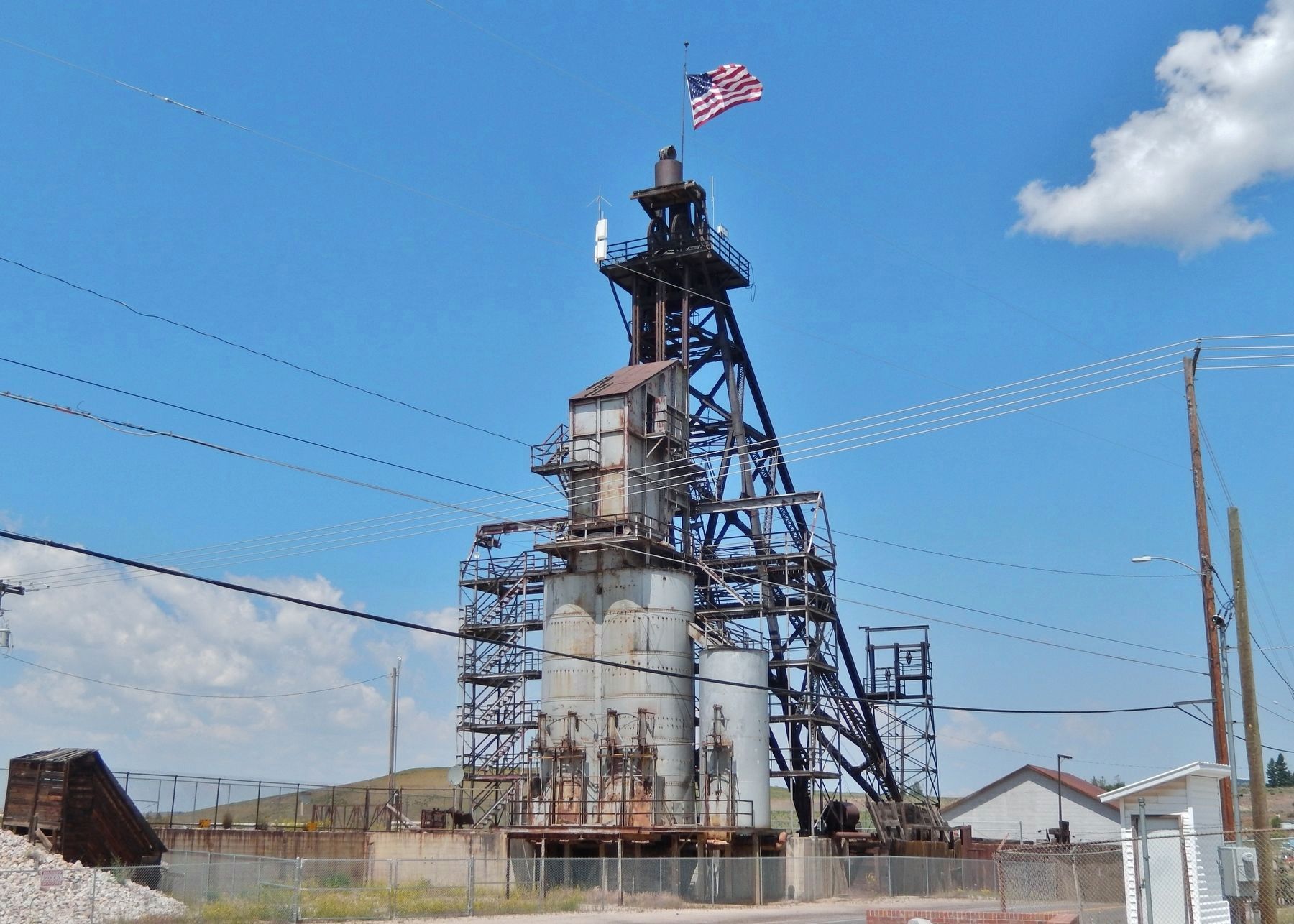
Walkerville is visible to the right of the Lexington headframe in front of you. The success of 40 or more mines in the 1880s and ‘90s, especially the silver producers Alice and Lexington, led to the construction of a hospital, schools, churches, markets, bakeries, laundries, boarding houses, and saloons. The population of Walkerville in 1890, the year of its incorporation, was 4,000. It has about 700 folks now.
Lexington Silver
The Lexington and Alice silver mines in the late 1870s and 1880s attracted some of the earliest outside investors to Butte and pioneered large-scale industrial mining in the district. The Lex operated until the mid-1950s. Walkerville’s significance began to fall in 1893 when Congress eliminated silver as an official form of U.S. currency, sending its price into a nosedive.
[photo captions]
• Top of the World Trail System [trail map]
• The Lexington mine yard is seen above in [date not legible] with Walkerville in the background.
• Manza’s grocery store, left, on Daly Street was a turn-of-the-century Walkerville business. The arrival of the cable car in 1889 may have hurt Walkerville
this page online
• Cable cars were replaced by electric cars in 1897 (one can be seen entering Walkerville at right), which made it even easier for residents to leave Walkerville.
Erected by Montana's Copperway.
Topics. This historical marker is listed in these topic lists: Industry & Commerce • Settlements & Settlers. A significant historical year for this entry is 1890.
Location. 46° 1.711′ N, 112° 31.942′ W. Marker is in Butte, Montana, in Silver Bow County. It can be reached from Bernie's Way 0.1 miles east of North Main Street, on the left when traveling east. The marker is on the west side of a pull-out and parking lot overlooking the historic Lexington Mine site. Touch for map. Marker is in this post office area: Butte MT 59701, United States of America. Touch for directions.

Regionally, this marker is in andspecifically outhwest Montana, in Gold West Country, in Mining Country. It is also in the American Mountain West and in the Lewis & Clark Corridor. Globally, it is in North America, the Rocky Mountains, the Western
Other nearby markers. At least 8 other markers are within walking distance of this marker: St. Lawrence O’Toole Church (about 800 feet away, measured in a direct line); 1600 North Main (approx. 0.2 miles away); Caplice & McCune Store (approx. 0.2 miles away); Butte-Anaconda Historic District (approx. ¼ mile away); Butte-Anaconda-Walkerville (approx. ¼ mile away); The Con Hoist House (approx. 0.3 miles away); The Con (approx. 0.3 miles away); Cornish of Centerville (approx. 0.3 miles away). Touch for a list and map of all markers in Butte.
Also see . . .
1. Walkerville, Montana (Wikipedia).
Excerpt: Walkerville is a suburb of Butte, Montana and is home to some of the earliest mining sites in the area. These sites attracted many investors to Walkerville in the late 1800s. Walkerville is named for four of those investors: brothers Joseph, Samuel, Matthew and David Walker of Salt Lake City; they had purchased the lucrative Alice mine upon recommendation by their agent(Submitted on August 16, 2026, by Cosmos Mariner of Cape Canaveral, Florida.)(and later Copper King) Marcus Daly.Photographed by Cosmos Mariner, July 6, 20243. Lexington Mine HeadframeClose-up view of the Lexington headframe from North Main Street, about 225 meters west of this historical marker.There were many different types of materials mined depending on the location of a given site. Copper and silver were two of the most commonly mined materials. In 1893, silver prices dropped, but the town's economy continued to thrive due to its copper production. The town incorporated in 1890, and by the early 1900s almost 2,500 people lived there, mostly Cornish and Irish immigrants who came to work in the mines. Walkerville's economic success continued until 1918 when the end of World War I caused copper prices to drop. By 2015, nearly all the town's many mines are abandoned.
2. Lexington Mine (Story of Butte).
(by Nancy Woodruff, Butte Historical Society, & Richard Gibson) Excerpt: Butte capitalist Andrew Davis invested in developing the Lexington first. Beginning in the mid-1870s, he used a horse-powered whim to raise silver. After encountering an exceedingly rich vein of silver, in 1881 Davis sold the Lexington to a group of French entrepreneurs for $1 million in cash and $2 million in stock. By the late 1880s, the Lexington had yielded nearly $8 million in silver and was the deepest mine in Montana at about 1500 feet. Rich ores were all but depleted by then, and operations further suffered when the price of silver plummeted in 1893. The mill closed for good, but small-scale mining continued until a fire destroyed the shaft house in early 1903.(Submitted on August 16, 2026, by Cosmos Mariner of Cape Canaveral, Florida.)In late 1904, Copper king F. Augustus Heinze leased the Lexington and ushered in the next major episode of development. Instead of silver, Heinze intended to exploit the mine for zinc. His crews equipped the shaft with one of the largest wood headframes ever in Butte, erected a wood-framed hoist house north of the shaft, and constructed a new mill east across Main St. The first reduction plant in Butte designed specifically for treating zinc ore, the mill failed to live up to expectations and created so much dust that nearby residents successfully secured a court injunction for its closure.
The Anaconda Mining Company (ACM) acquired the Lexington around 1916. Although only a minor producer, the Lexington contributed to the supply of Butte copper and zinc that aided the US and its allies in winning World War I. ACM did not operate the Lexington again until 1938, as a second world war loomed on the horizon. Mining continued until 1943 when operations ceased while the company rebuilt the surface plant, replacing the old wooden works with a steel headframe and a steel-frame hoist house and constructing two change houses for a large force of miners. After reopening in 1946, the Lexington became one of the top producers of zinc and copper in Butte. Mining and production continued strong until 1957 when ACM closed the Lexington for good.
Credits. This page was last revised on August 16, 2026. It was originally submitted on August 15, 2026, by Cosmos Mariner of Cape Canaveral, Florida. This page has been viewed 17 times since then. Photos: 1, 2, 3. submitted on August 16, 2026, by Cosmos Mariner of Cape Canaveral, Florida.
