Butte in Silver Bow County, Montana — The American West (Mountains)
Switching & Hauling
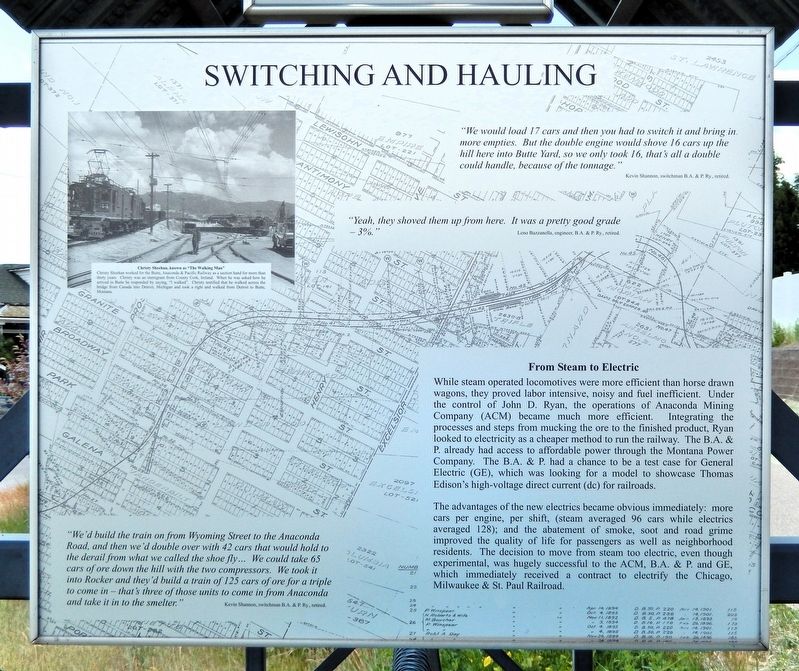
Photographed by Cosmos Mariner, July 6, 2024
1. Switching & Hauling Marker
From Steam to Electric
While steam operated locomotives were more efficient than horse drawn wagons, they proved labor intensive, noisy and fuel inefficient. Under the control of John D. Ryan, the operations of Anaconda Mining Company (ACM) became much more efficient. Integrating the processes and steps from mucking the ore to the finished product, Ryan looked to electricity as a cheaper method to run the railway. The B.A. & P. already had access to affordable power through the Montana Power Company. The B.A. & P. had a chance to be a test case for General Electric (GE), which was looking for a model to showcase Thomas Edison's high-voltage direct current (dc) for railroads.
The advantages of the new electrics became obvious immediately: more cars per engine, per shift, (steam averaged 96 cars while electrics averaged 128); and the abatement of smoke, soot and road grime improved the quality of life for passengers as well as neighborhood residents. The decision to move from steam to electric, even though experimental, was hugely successful to the ACM, B.A. & P. and GE, which immediately received a contract to electrify the
this page online
“We'd build the train on from Wyoming Street to the Anaconda Road, and then we'd double over with 42 cars that would hold to the derail from what we called the shoe fly... We could take 65 cars of ore down the hill with the two compressors. We took it into Rocker and they'd build a train of 125 cars of ore for a triple to come in — that's three of those units to come in from Anaconda and take it in to the smelter.”
—Kevin Shannon, switchman B.A. & P. Ry., retired.
“We would load 17 cars and then you had to switch it and bring in more empties. But the double engine would shove 16 cars up the hill here into Butte Yard, so we only took 16, that’s all a double could handle, because of the tonnage.”
—Kevin Shannon, switchman B.A. & P. Ry., retired.
“Yeah, they shoved them up from here. It was a pretty good grade — 3%.”
—Leno Bazzanella, engineer, B.A. & P. Ry., retired
Erected 2007 by Montana's Copperway.
Topics. This historical marker is listed in these topic lists: Industry & Commerce • Railroads & Streetcars.
Location. 46° 0.982′ N, 112° 32.982′ W.
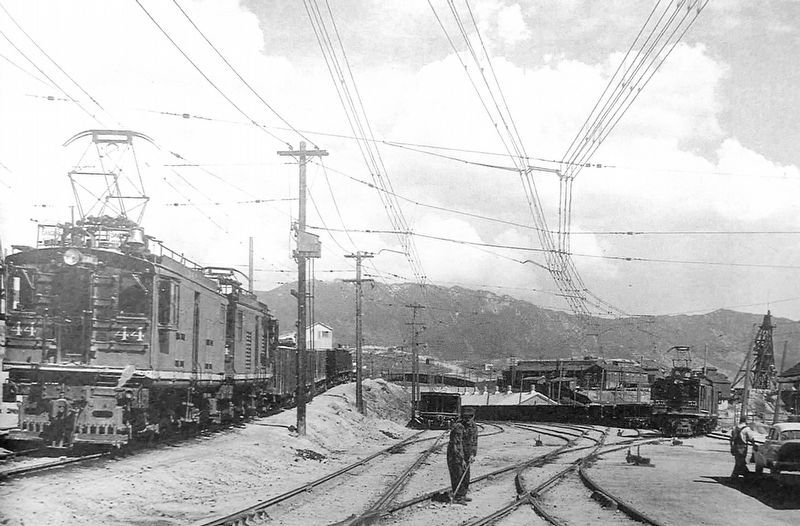
2. Marker detail: Christy Sheehan,
known as “The Walking Man”
known as “The Walking Man”
Christy Sheehan worked for the Butte, Anaconda & Pacific Railway as a section hand for more than thirty years. Christy was an immigrant from County Cork, Ireland. When he was asked how he arrived in Butte he responded by saying, “I walked.” Christy testified that he walked across the bridge from Canada into Detroit, Michigan and took a right and walked from Detroit to Butte, Montana.

Regionally, this marker is in andspecifically outhwest Montana, in Gold West Country, in Mining Country. It is also in the American Mountain West and in the Lewis & Clark Corridor. Globally, it is in North America, the Rocky Mountains, the Western Hemisphere, the Western World, and the Anglosphere. Historically, it finds itself in what was once Rupert’s Land and also the Louisiana Purchase.
Other nearby markers. At least 8 other markers are within walking distance of this marker: The Anselmo (within shouting distance of this marker); The Cow and The Calf (about 400 feet away, measured in a direct line); a different marker also named The Anselmo (about 600 feet away); 833 West Quartz (about 700 feet away);

Photographed by Cosmos Mariner, July 6, 2024
3. Switching & Hauling Marker
Looking southwest along the Butte, Anaconda & Pacific (BA&P) Hill Trail. Caledonia Street crosses in the background. The marker is mounted on the side frame of a shaded park bench.
Also see . . . Butte, Anaconda and Pacific Railway (Wikipedia).
Excerpt: The Butte, Anaconda and Pacific Railway (reporting mark BAP) is a shortline railroad in the U.S. state of Montana. Founded in 1891, it was the main conduit for ore transport between Butte and Anaconda. In 1890, a dispute between the Montana Union Railway and the Anaconda Copper Company arose over the cost to transport copper ore from the Butte mines to the Anaconda, Montana, smelters. Marcus Daly, the interest behind the Anaconda Copper Mining Company, financed the incorporation of the Butte, Anaconda and Pacific in 1891, and operation began just two years later, in 1893. While transport of ore from Butte to Anaconda was central to the line's founding, the BA&P was chartered as a common carrier and carried passengers and general freight.(Submitted on August 16, 2026, by Cosmos Mariner of Cape Canaveral, Florida.)When it first opened, the BA&P used steam locomotives to haul the ore, freight, and passenger trains,
however the heavy daily use took its toll on the engines, and by 1910 alternative power sources were being sought. The BA&P was an electrification pioneer, electrifying 75 mi out of 114 mi between 1912 and 1913. The work was performed by General Electric and the railroad's own staff. Power was delivered from Great Falls, 125 mi (201 km) to the northeast, and converted from AC to DC via several substations along the railway. While the common voltages used were 600 or 1200 volts DC, BA&P electrification was the highest available at that time, being 2,400 volts DC.
Credits. This page was last revised on August 16, 2026. It was originally submitted on August 15, 2026, by Cosmos Mariner of Cape Canaveral, Florida. This page has been viewed 9 times since then. Photos: 1, 2, 3. submitted on August 16, 2026, by Cosmos Mariner of Cape Canaveral, Florida.
