Montana Tech Campus Library/Museum
Butte–Anaconda Historic District
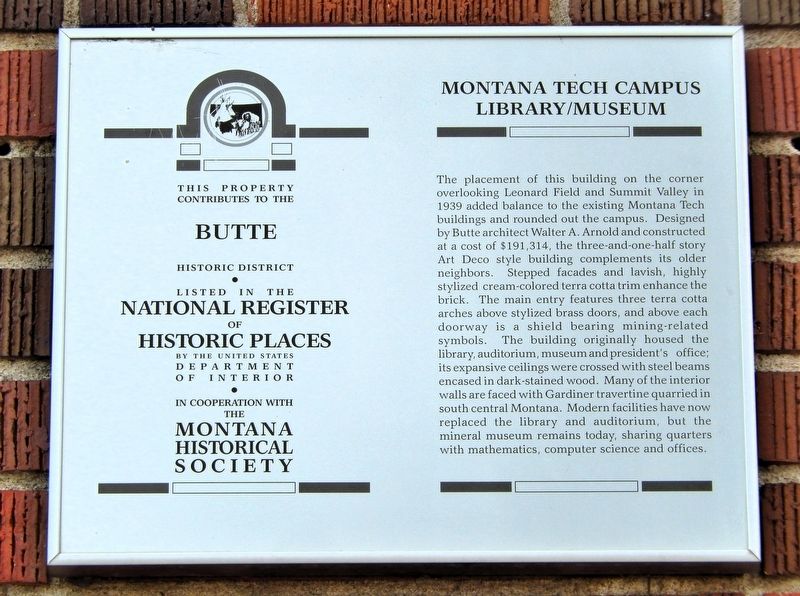
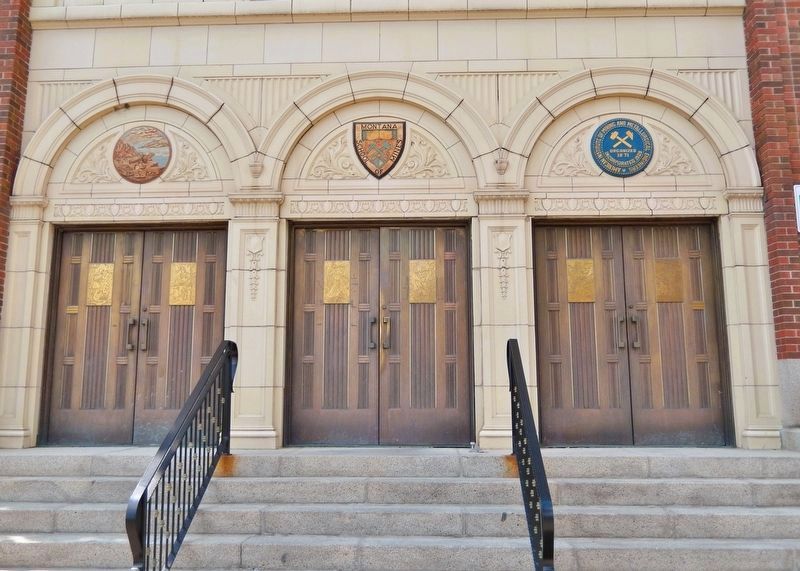
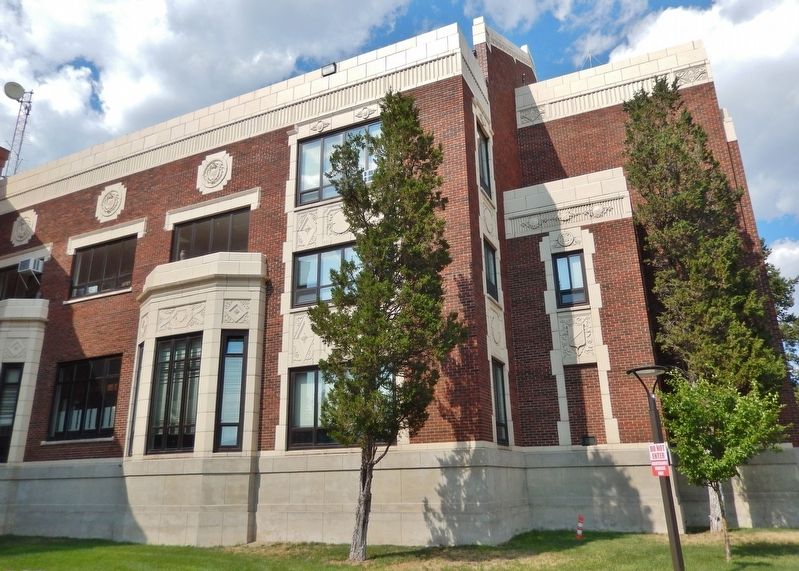
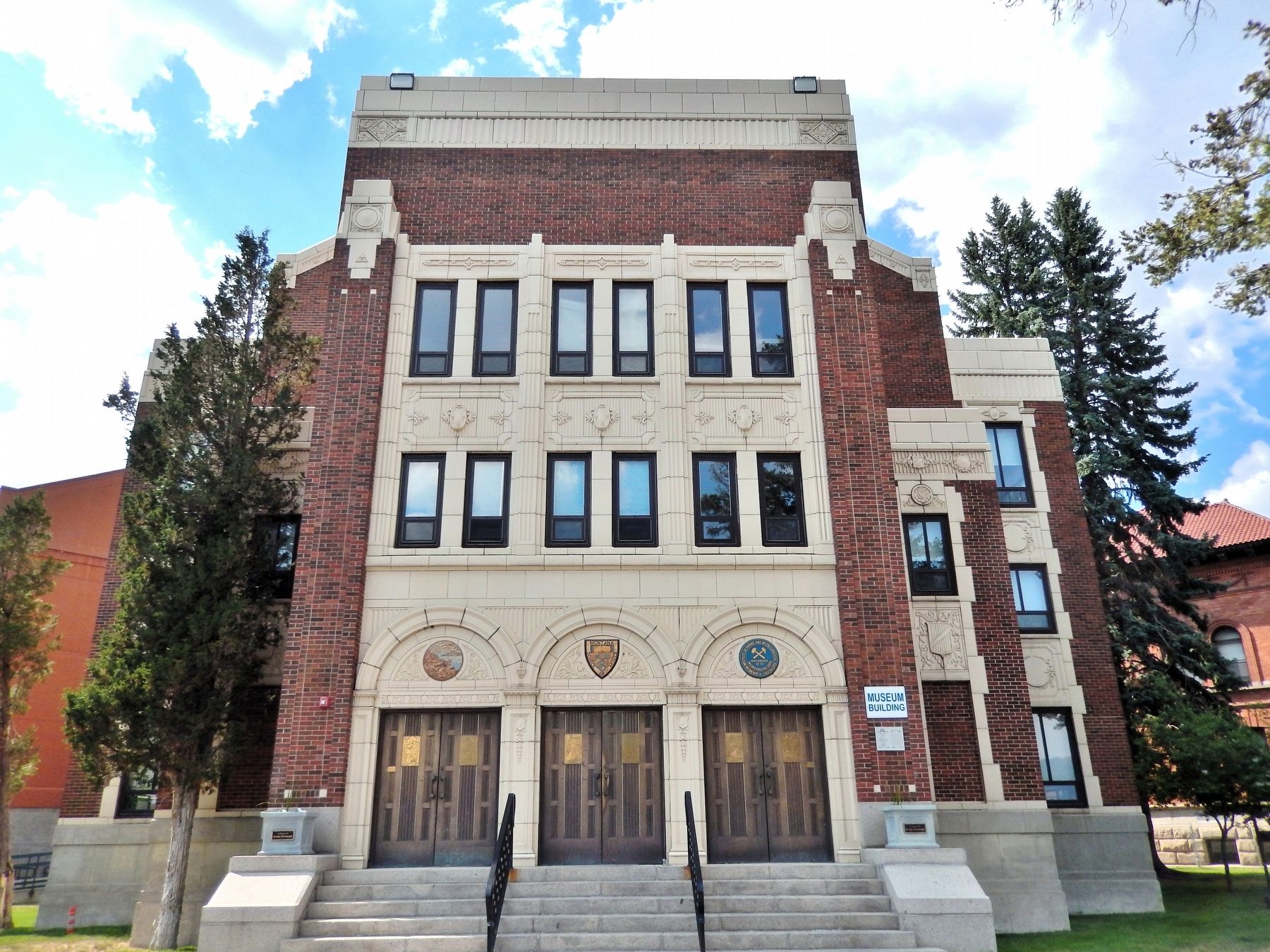
The placement of this building on the corner overlooking Leonard Field and Summit Valley in 1939 added balance to the existing Montana Tech buildings and rounded out the campus. Designed by Butte architect Walter A. Arnold and constructed at a cost of $191,314, the three-and-one-half-story Art Deco style building complements its older neighbors. Stepped façades and lavish, highly stylized cream-colored terra cotta trim enhance the brick. The main entry features three terra cotta arches above stylized brass doors, and above each doorway is a shield bearing mining-related symbols. The building originally housed the library, auditorium, museum, and president’s office; its expansive ceilings were crossed with steel beams encased in dark-stained wood. Many of the interior walls are faced with Gardiner travertine quarried in south central Montana. Modern facilities have now replaced the library and auditorium, but the mineral museum remains today, sharing quarters with mathematics, computer science, and offices.
Erected by Montana Historical Society.
Topics and series. This historical marker is listed in these topic
this page online
Location. 46° 0.646′ N, 112° 33.412′ W. Marker is in Butte, Montana, in Silver Bow County. It is on Montrose Avenue 0.1 miles south of West Park Street, on the right when traveling south. The marker is on the southeast/front facade of the subject building, on the right side of the entrance. Touch for map. Marker is at or near this postal address: 1300 West Park Street, Butte MT 59701, United States of America. Touch for directions.

Regionally, this marker is in andspecifically outhwest Montana, in Gold West Country, in Mining Country. It is also in the American Mountain West and in the Lewis & Clark Corridor. Globally, it is in North America, the Rocky Mountains, the Western Hemisphere, the Western World, and the Anglosphere. Historically, it finds itself in what was once Rupert’s Land and also the Louisiana Purchase.
Other nearby markers. At
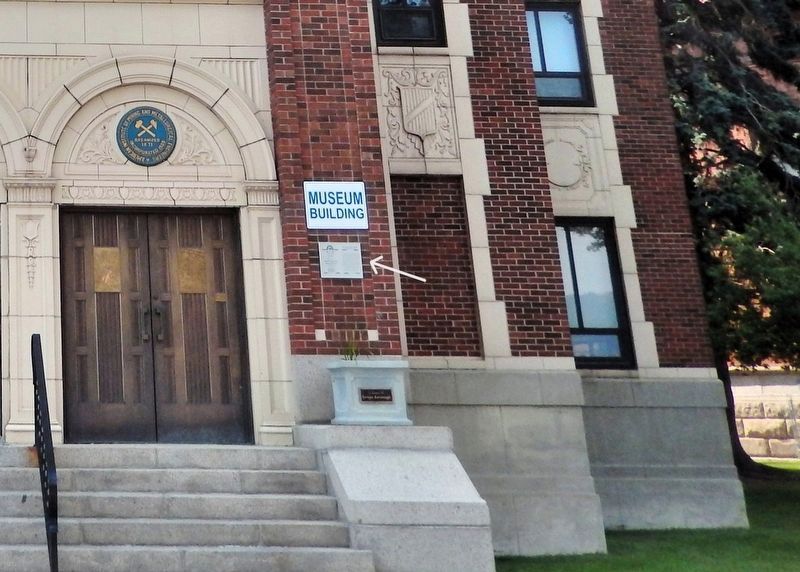
Regarding Montana Tech Campus Library/Museum. The Montana Tech Library/Museum is a contributing property in Butte–Anaconda Historic District, National Register of Historic Places № 66000438.
From the National Register Nomination prepared by Derek Strahn, 1/2006:
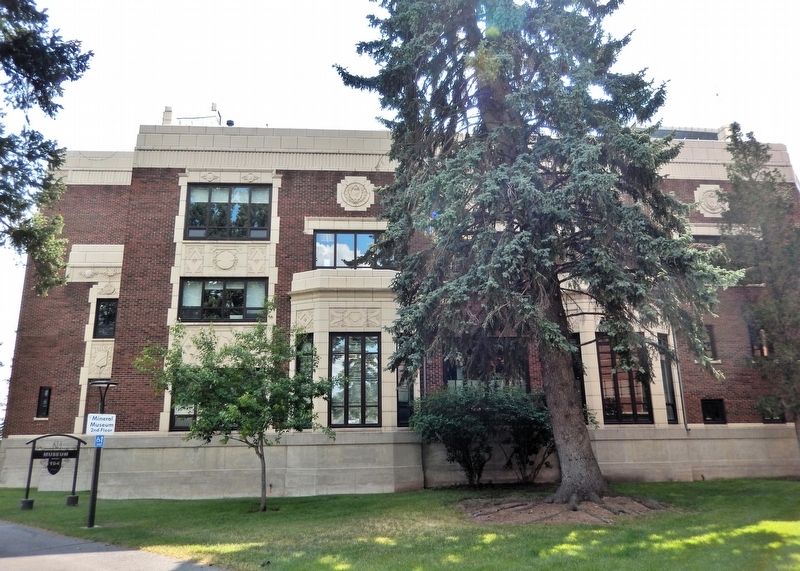
The Library-Museum building [1939] is one of only nine Public Works Administration-funded buildings built in Montana during the 1930s. One of the best Art Deco buildings in the state, it was designed by W. A. Arnold and features stepped facades, stylized terra cotta, verticallinear elements and bronze doors.Photographed by Cosmos Mariner, July 6, 20243. Montana Tech Library/Museum EntranceThe Montana College of Mineral Science and Technology is a formal ca. 1900 campus, located on the edge of Butte's west side. It overlooks the city of Butte from its perch on the ridge sloping down from Big Butte. The historic design of the campus is highly intact and is centered around substantial nineteenth-century brick buildings that date to the founding of the school. The campus with its stately buildings and mature trees can be seen from much of the city. Montana Tech, reflecting the primary role of industrial education in the NHL district, retains a high level of integrity within its historic core. A mature campus setting is well preserved, where courtyards, conifers and brick buildings create a contemplative atmosphere for study. The historic campus design and buildings form the center of and dominate the complex. They are a strong symbol of the abiding ties of this college to the advancement of deep mining, and its importance to the Butte-Anaconda Historic District.
Montana Tech had its origins in the Enabling Act of 1889, and its provision of federal land grants to new states, for the purposes
of establishing mining schools. Montana's legislature located the state's School of Mines in Butte, and the mining city enthusiastically supported the institution, donating land for the campus and coming to the school's aid financially during its early history. The first class graduated in 1903, launching its long tradition as one of the country's leading programs in mining engineering, with emphasis on mineral sciences and deep mining.Photographed by Cosmos Mariner, July 6, 20244. Montana Tech Library/Museum (northeast elevation)
Related markers. Click here for a list of markers that are related to this marker.
Also see . . .
1. Museum Building: Brass Doors Depict the Evolution of Mining (Story of Butte).
(by Lindsay Mulcahy & Montana Historical Society) Excerpt: The notable main entrance to the building has three sets of doors that were donated by the Anaconda Copper Mining Company. The doors are made of brass and have bas-relief panes depicting the evolution of mining. The Mineral Museum began in 1901 and is the oldest museum in Butte. It has an impressive collection, including a donation of 2,000 minerals from the Charles Gallagher family and another collection of 1,000 specimens willed to the(Submitted on August 17, 2026, by Cosmos Mariner of Cape Canaveral, Florida.)Museum by William A. Clark III. Today the Mineral Museum has approximately 13,000 specimens. When visiting, notice the stage at the north end of the museum. The space in which the museum is held was once an auditorium.Photographed by Cosmos Mariner, July 6, 20245. Montana Tech Library/Museum (southwest elevation)
2. Butte–Anaconda Historic District (Wikipedia).
Excerpt: The Butte–Anaconda Historic District is a National Historic Landmark that spans parts of Walkerville, Butte and Anaconda, Montana. It was declared an National Historic Landmark in 1961. The district's national significance relates to its long history of copper production as well as to its role in the development of the labor union movement in the United States. As the source of nearly one-third of all the world's copper in the early 1900s, Butte's mines provided one of the metals that were critical to American industrialization. Walkerville represents some of the earliest mines in the district and preserves the early mining camp flavor present in the 1890s to 1910s. Butte itself is an urban metropolis where industrial relics such as mine yards and head frames are juxtaposed(Submitted on August 17, 2026, by Cosmos Mariner of Cape Canaveral, Florida.)with a wide variety of residential and business structures. Anaconda was created as a company town that contained the smelters for Butte's ore.Photographed by Cosmos Mariner, July 6, 20246. Montana Tech Library/Museum (southeast/front elevation)
Credits. This page was last revised on August 17, 2026. It was originally submitted on August 15, 2026, by Cosmos Mariner of Cape Canaveral, Florida. This page has been viewed 23 times since then. Photos: 1, 2, 3, 4, 5, 6. submitted on August 17, 2026, by Cosmos Mariner of Cape Canaveral, Florida.
