Blijdorp in Rotterdam, South Holland, Netherlands — Northwestern Europe
Noodwinkels Betinckplein
⎯⎯⎯
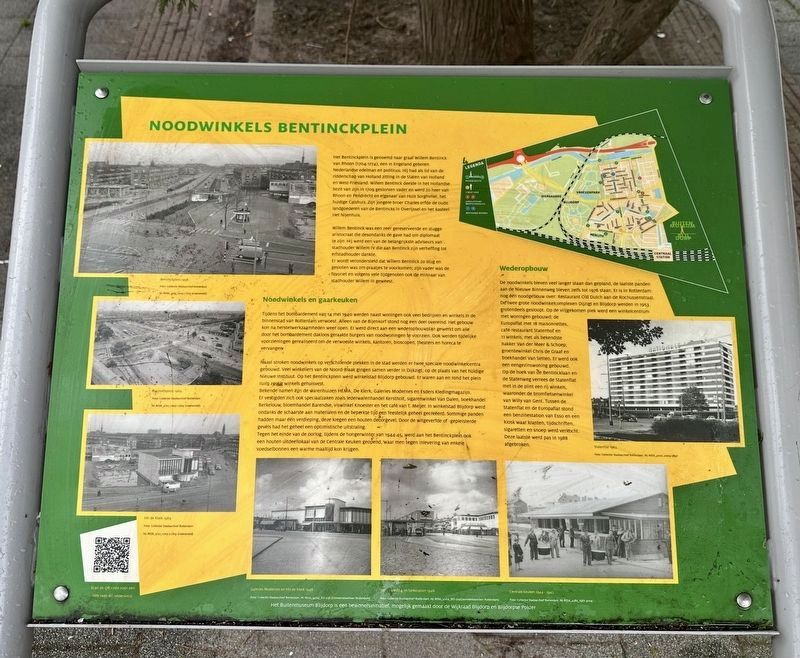
Betinckplein Temporary Shops
Photographed by Andrew Ruppenstein, March 22, 2024
1. Noodwinkels Betinckplein / Betinckplein Temporary Shops Marker

Het Bentinckplein is genoemd naar graaf Willem Bentinck van Rhoon (1704-1774), een in Engeland geboren Nederlandse edelman en politicus. Hij had als lid van de ridderschap van Holland zitting in de Staten van Holland en West-Friesland. Willem Bentinck deelde in het Hollandse bezit van zijn in 1709 gestorven vader en werd zo heer van Rhoon en Pendrecht en eigenaar van Huis Sorghvliet, het huidige Catshuis. Zijn jongere broer Charles erfde de oude landgoederen van de Bentincks in Overijssel en het kasteel Het Nijenhuis.
Willem Bentinck was een zeer gereserveerde en stugge aristocraat die desondanks de gave had om diplomaat te zijn. Hij werd een van de belangrijkste adviseurs van stadhouder Willem IV die aan Bentinck zijn verheffing tot erfstadhouder dankte.
Er wordt verondersteld dat willem Bentinck zo stug en gesloten was om praatjes te voorkomen; zijn vader was de favoriet en volgens vele tijdgenoten ook de minnaar van stadhouder Willem III geweest.
Noodwinkels en gaarkeuken
Tijdens het bombardement van 14 mei 1940 werden naast woningen ook veel bedrijven en
this page online
Naast stroken noodwinkels op verschillende plekken in de stad werden er twee speciale noodwinkelcentra gebouwd. Veel winkeliers van de Noord-Blaak gingen samen verder in Dijkzigt, op de plaats van het huidige Nieuwe Instituut. Op het Bentinckplein werd winkelstad Blijdorp gebouwd. Er waren aan en rond het plein ruim zestig winkels gehuisvest.
Bekende namen zijn de warenhuizen HEMA, De Klerk, Galeries Modernes en Esders Kledingmagazijn. Er vestigden zich ook speciaalzaken zoals lederwaren handel Kerstholt, sigarenwinkel Van Dalen, boekhandel Berkelouw, bloemhandel Barendse, viswinkel Knoester en het café van T. Meijer. In winkelstad Blijdorp werd ondanks de schaarste aan materialen en de beperkte tijd een feestelijk geheel
Photographed by Andrew Ruppenstein, March 22, 2024
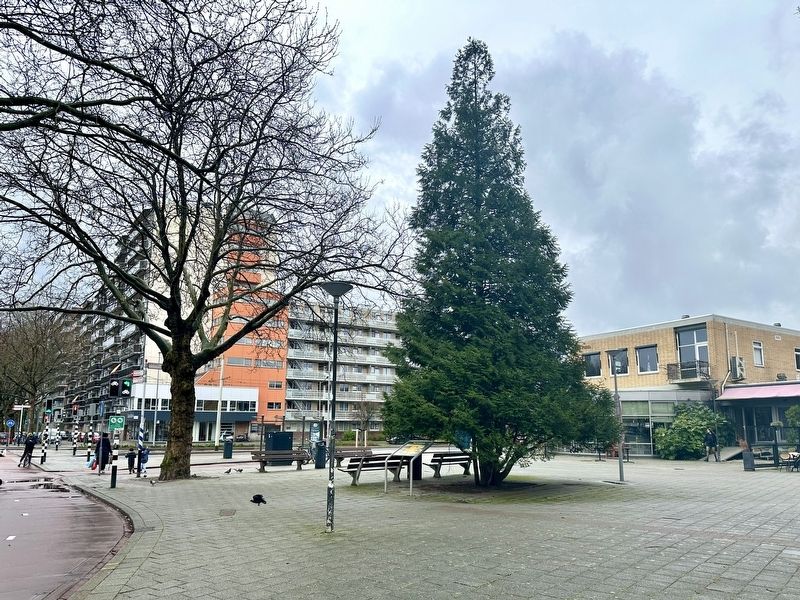
2. Noodwinkels Betinckplein / Betinckplein Temporary Shops Marker - wide view
The marker is visible here next to the fir tree.
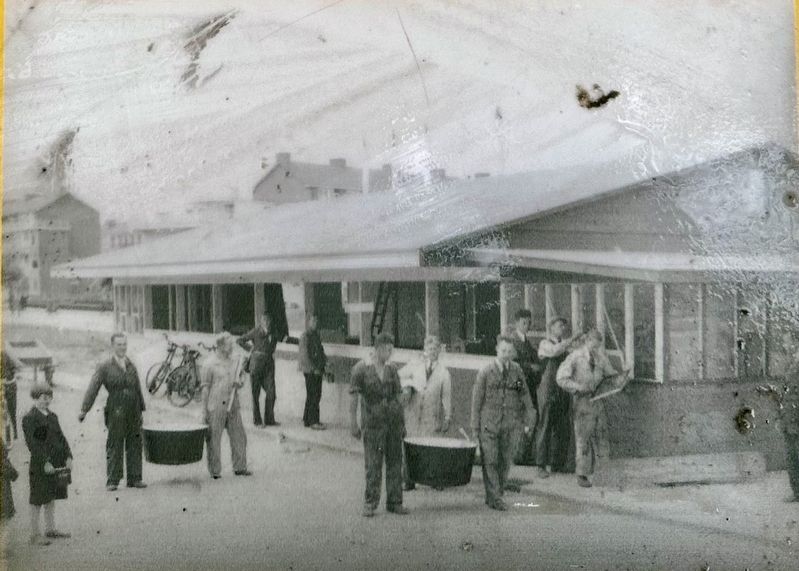
Tegen het einde van de oorlog, tijdens de hongerwinter van 1944-45, werd aan het Bentinckplein ook een houten uitdeellokaal van de Centrale Keuken geopend, waar men tegen inlevering van enkele voedselbonnen een warme maaltijd kon krijgen.
Wederopbouw
De noodwinkels bleven veel langer staan dan gepland, de laatste panden aan de Nieuwe Binnenweg bleven zelfs tot 1976 staan. Er is in Rotterdam nog één noodgebouw over: Restaurant Old Dutch aan de Rochussenstraat. De twee grote noodwinkelcomplexen Dijzigt en Blijdorp werden in 1953 grotendeels gesloopt. Op de vrijgekomen plek werd een winkelcentrum met woningen gebouwd; de Europaflat met 18 maisonnettes, café-restaurant Statenhof en 11 winkels, met als bekendste bakker Van der Meer & Schoep, groentewinkel Chris de Graaf en boekhandel Van Setten. Er werd ook een eengezinswoning gebouwd. Op de hoek van de Bentincklaan en de Statenweg verrees de Statenflat met in de plint een rij winkels, waaronder de
courtesy Stadsarchief Rotterdam, circa 1944/45
3. Temporary Kitchen on Betinckplein
Bentinckplein Temporary Shops
Bentinckplein is named after Count Willem Bentinck van Rhoon (1704–1774), an English-born Dutch nobleman and politician. As a member of the Knighthood of Holland, he held a seat in the States of Holland and West Friesland. Willem Bentinck inherited a share of the Dutch estates belonging to his father—who had died in 1709—thereby becoming the Lord of Rhoon and Pendrecht and the owner of Huis Sorghvliet (now known as the Catshuis). His younger brother, Charles, inherited the family's ancestral estates in Overijssel and the castle Het Nijenhuis.
Willem Bentinck was a highly reserved and aloof aristocrat who nonetheless possessed a gift for diplomacy. He became one of the key advisors to Stadtholder William IV, who owed his elevation to the position of hereditary stadtholder to Bentinck.
It is believed that Willem Bentinck was so aloof and guarded in order to avoid gossip; his father had been the favorite—and, according to many contemporaries, the lover—of Stadtholder William III.
Emergency shops and soup kitchen
During the bombing of May 14, 1940, many businesses and shops in Rotterdam's city center were destroyed alongside homes. Only a section of the Bijenkorf department store remained standing; the building was able to reopen following repairs. Work began immediately on a reconstruction plan to provide emergency housing for all the citizens left homeless by the bombing. Temporary facilities were also established to replace the destroyed shops, offices, cinemas, theaters, and hospitality venues.
In addition to rows of emergency shops at various locations across the city, two dedicated emergency shopping centers were built. Many shopkeepers from the Noord-Blaak area relocated together to Dijkzigt, on the site of the current Nieuwe Instituut. The "Blijdorp shopping complex" was built at Bentinckplein, housing over sixty shops in and around the square. Well-known names included department stores such as HEMA, De Klerk, Galeries Modernes, and Esders Kledingmagazijn. Specialty shops also set up business there, including Kerstholt (leather goods), Van Dalen (cigars), Berkelouw (books), Barendse (flowers), Knoester (fish), and T. Meijer’s café. Despite material shortages and time constraints, the Blijdorp shopping complex was designed to have a festive atmosphere. Some buildings consisted of only a single story and were fitted with decorative wooden facades; the white-painted or white-plastered facades gave the entire complex an optimistic look. Towards the end of the war, during the "Hunger Winter" of 1944–45, a wooden distribution center for the Central Kitchen was also opened at Bentinckplein, where people could obtain a hot meal in exchange for food coupons.
Reconstruction
The temporary shops remained in place much longer than planned; the last structures on Nieuwe Binnenweg actually stood until 1976. Only one temporary building remains in Rotterdam: Restaurant Old Dutch on Rochussenstraat. The two large temporary retail complexes, Dijzigt and Blijdorp, were largely demolished in 1953. A shopping center with residential units was built on the cleared site; this included the Europaflat—featuring 18 maisonettes, the Statenhof café-restaurant, and 11 shops—with the best-known tenants being the Van der Meer & Schoep bakery, the Chris de Graaf greengrocer, and the Van Setten bookstore. A single-family home was also built there. The Statenflat rose on the corner of Bentincklaan and Statenweg, featuring a row of shops at street level, including Willy van Gent’s moped shop. An Esso gas station and a kiosk selling newspapers, magazines, cigarettes, and candy stood between the Statenflat and the Europaflat. The latter was not demolished until 1988.
Erected by Buitenmuseum Blijdorp. (Marker Number 4.)
Topics. This historical marker is listed in these topic lists: Industry & Commerce • War, World II. A significant historical year for this entry is 1709.
Location. 51° 55.593′ N, 4° 27.659′ E. Marker is in Rotterdam, Zuid-Holland (South Holland). It is in Blijdorp. It is at the intersection of Bentincklaan and Statenweg, on the left when traveling east on Bentincklaan. Touch for map. Marker is at or near this postal address: Bentincklaan 21-A, Rotterdam, Zuid-Holland 3039 XL, Netherlands. Touch for directions.

Regionally, it is in Europe, the European Union, Atlantic Europe, the Benelux Low Countries, the Schengen Area, Western Europe, and the Western World. Historically, it finds itself in what was once the Roman Empire and specifically also the Holy Roman Empire.
Other nearby markers. At least 8 other markers are within walking distance of this marker: Bloemstraat (approx. half a kilometer away); Stadhoudersplein / “Governors Square” (approx. 0.6 kilometers away); Van Maanenbad (approx. 0.7 kilometers away); Zijdewindeplein (approx. 0.8 kilometers away); Palmdwarsstraat (approx. 0.8 kilometers away); Salomon Cohen (approx. 0.8 kilometers away); Bertha Cohen-Hartog (approx. 0.8 kilometers away); V-2 Rocket Attack Memorial (approx. 0.8 kilometers away). Touch for a list and map of all markers in Rotterdam.
Also see . . . Betinckplein (Youtube, 2:08). The QR code on the marker leads to this clip on Youtube, which is a 2-minute long collection of silent film clips taken after the War around Betinckplein. Provided by Buitenmuseum Blijdorp and Stadsarchief Rotterdam. (Submitted on August 16, 2026.)
Credits. This page was last revised on August 16, 2026. It was originally submitted on August 16, 2026, by Andrew Ruppenstein of Lamorinda, California. This page has been viewed 8 times since then. Photos: 1, 2, 3. submitted on August 16, 2026, by Andrew Ruppenstein of Lamorinda, California.
