Butte in Silver Bow County, Montana — The American West (Mountains)
Montana Tech Campus Residence Halls
Butte–Anaconda Historic District
Photographed by Cosmos Mariner, July 6, 2024
1. Montana Tech Campus Residence Halls Marker
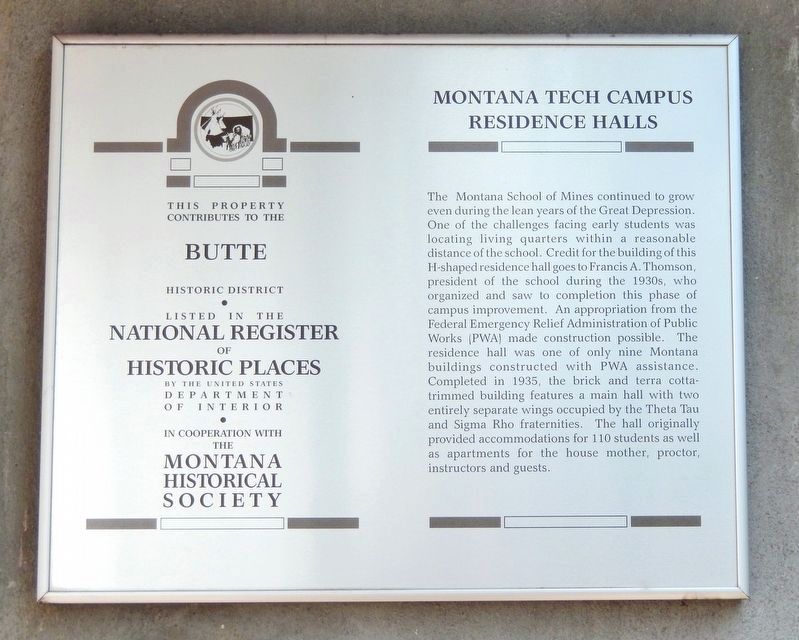
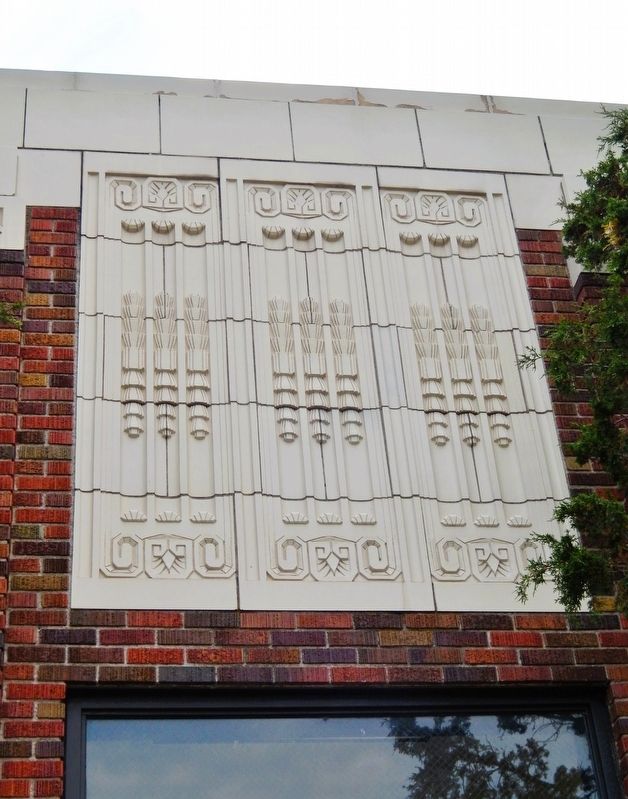
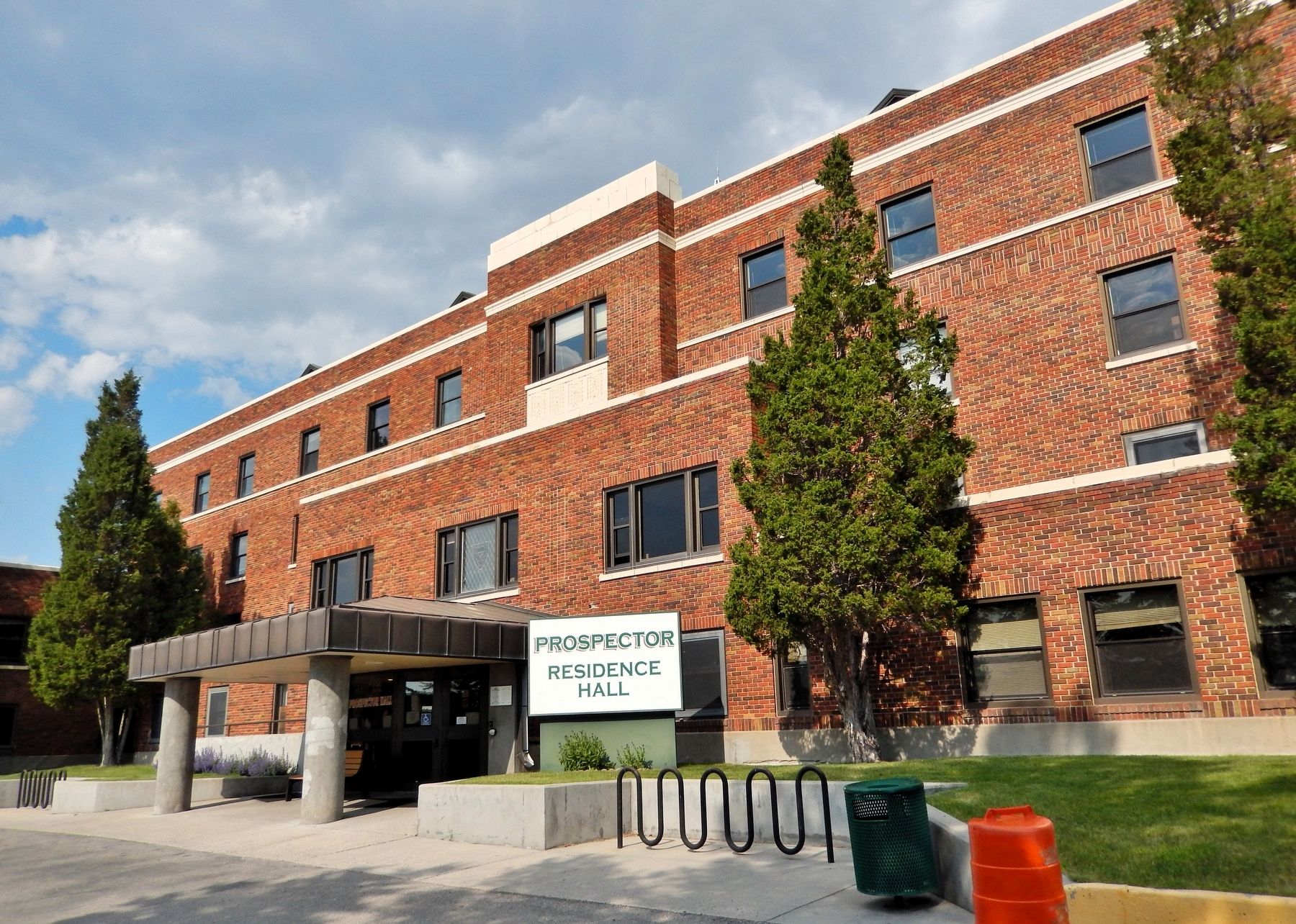
The Montana School of Mines continued to grow even during the lean years of the Great Depression. One of the challenges facing early students was locating living quarters within a reasonable distance of the school. Credit for the building of this H-shaped residence hall goes to Francis A. Thomson, president of the school during the 1930s, who organized and saw to completion this phase of campus improvement. An appropriation from the Federal Emergency Relief Administration of Public Works (PWA) made construction possible. The residence hall was one of only nine Montana buildings constructed with PWA assistance. Completed in 1935, the brick and terra cotta-trimmed building features a main hall with two entirely separate wings occupied by the Theta Tau and Sigma Rho fraternities. The hall originally provided accommodations for 110 students as well as apartments for the house mother, proctor, instructors, and guests.
Erected by Montana Historical Society.
Topics and series. This historical marker is listed in these topic lists: Architecture • Charity & Public Work • Education • Notable Buildings.
this page online
Location. 46° 0.786′ N, 112° 33.41′ W. Marker is in Butte, Montana, in Silver Bow County. It is on North Prospect Avenue just north of West Park Street, on the right when traveling north. The marker is on the right side of the Prospector Hall west/front entrance. Touch for map. Marker is at or near this postal address: 1301 West Park Street, Butte MT 59701, United States of America. Touch for directions.

Regionally, this marker is in andspecifically outhwest Montana, in Gold West Country, in Mining Country. It is also in the American Mountain West and in the Lewis & Clark Corridor. Globally, it is in North America, the Rocky Mountains, the Western Hemisphere, the Western World, and the Anglosphere. Historically, it finds itself in what was once Rupert’s Land and also the Louisiana Purchase.
Other nearby markers. At least 8 other markers are within walking distance of this marker: Montana Tech Campus President's Residence
Photographed by Cosmos Mariner, July 6, 2024
2. Montana Tech Campus Residence Halls Marker
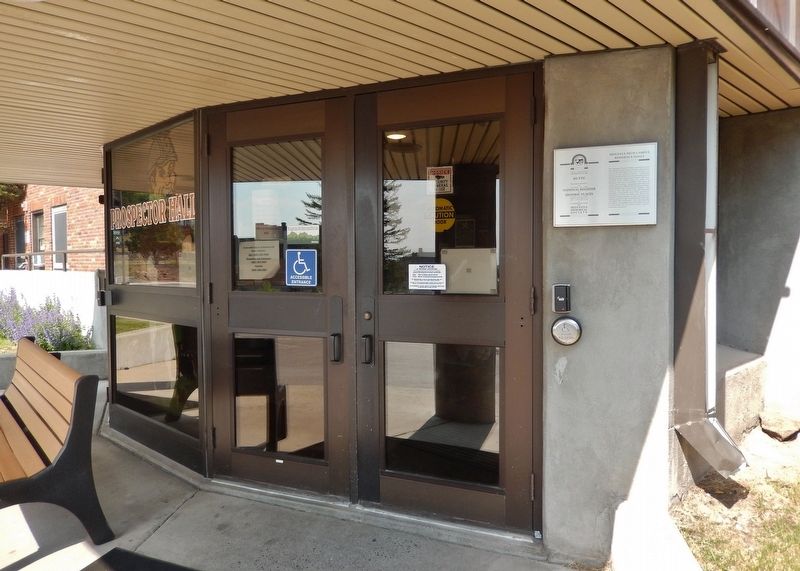
The marker is on the right side of the Prospector Hall west/front entrance.
Regarding Montana Tech Campus Residence Halls. Prospector Hall is a contributing property in Butte–Anaconda Historic District, National Register of Historic Places № 66000438.
From the National Register Nomination prepared by Derek Strahn, 1/2006:
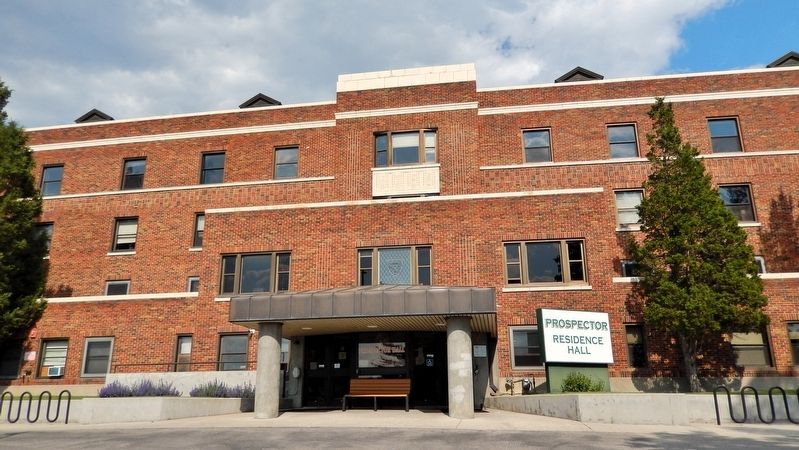
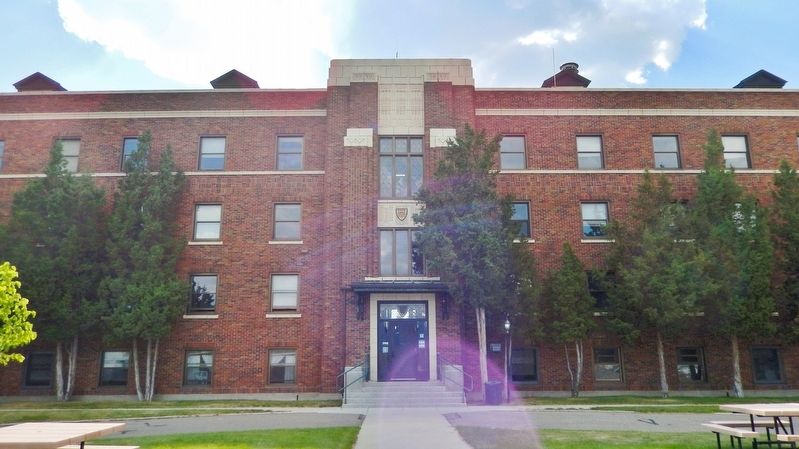
Buildings of the 1920s and 1930s took on the influence of early twentieth-century Modernism. These include the brick residence hall (1935), the President's House, and the Library-Museum building.The Montana College of Mineral Science and Technology is a formal circa 1900 campus, located on the edge of Butte's west side. It overlooks the city of Butte from its perch on the ridge sloping down from Big Butte. The historic
design of the campus is highly intact and is centered around substantial nineteenth-century brick buildings that date to the founding of the school. The campus with its stately buildings and mature trees can be seen from much of the city. Montana Tech, reflecting the primary role of industrial education in the NHL district, retains a high level of integrity within its historic core. A mature campus setting is well preserved, where courtyards, conifers and brick buildings create a contemplative atmosphere for study. The historic campus design and buildings form the center of and dominate the complex. They are a strong symbol of the abiding ties of this college to the advancement of deep mining, and its importance to the Butte-Anaconda Historic District.Photographed by Cosmos Mariner, July 6, 20243. Prospector Hall (west/front elevation)Montana Tech had its origins in the Enabling Act of 1889, and its provision of federal land grants to new states, for the purposes of establishing mining schools. Montana's legislature located the state's School of Mines in Butte, and the mining city enthusiastically supported the institution, donating land for the campus and coming to the school's aid financially during its early history.
The first class graduated in 1903, launching its long tradition as one of the country's leading programs in mining engineering, with emphasis on mineral sciences and deep mining.Photographed by Cosmos Mariner, July 6, 20244. Prospector Hall (east elevation)
Also see . . .
1. Prospector Hall, Montana Tech University (Living New Deal).
Excerpt: The PWA granted $320,000 for the construction of a new dormitory at the Montana School of Mines, now known as the Montana Technical campus of the University of Montana. The residence is now known as Prospector Hall. The school's website explains: “Construction of the Residence Hall began in 1935 with an appropriation grant from the Federal Emergency Relief Administration of Public Works. It was open for use during the 1935-1936 academic year.”(Submitted on August 18, 2026, by Cosmos Mariner of Cape Canaveral, Florida.)
2. Prospector Hall (Montana Technological University).
Excerpt: Prospector Hall was the first campus residence hall and opened when the institution was known as the Montana School of Mines. Completed in 1935 during the presidency of Francis A Thomson, it originally housed 110 students, as well as a house mother, proctors, instructors,(Submitted on August 18, 2026, by Cosmos Mariner of Cape Canaveral, Florida.)and guests. As the needs of the University evolved over the years, so did Prospector Hall. Prospector now houses approximately 200 first-year students and is the home of the Office of Residence Life.Photographed by Cosmos Mariner, July 6, 20245. Prospector Hall (terra cotta detail )Close-up view of the terra cotta tile panels above the east entrance.
3. Montana Tech Campus Residence Halls (Story of Butte). (Submitted on August 18, 2026, by Cosmos Mariner of Cape Canaveral, Florida.)
Photographed by Cosmos Mariner, July 6, 2024
6. Prospector Hall (southwest elevation)
Credits. This page was last revised on August 18, 2026. It was originally submitted on August 16, 2026, by Cosmos Mariner of Cape Canaveral, Florida. This page has been viewed 12 times since then. Photos: 1, 2, 3, 4, 5, 6. submitted on August 18, 2026, by Cosmos Mariner of Cape Canaveral, Florida.
