Douglas in Chicago in Cook County, Illinois — The American Midwest (Great Lakes)
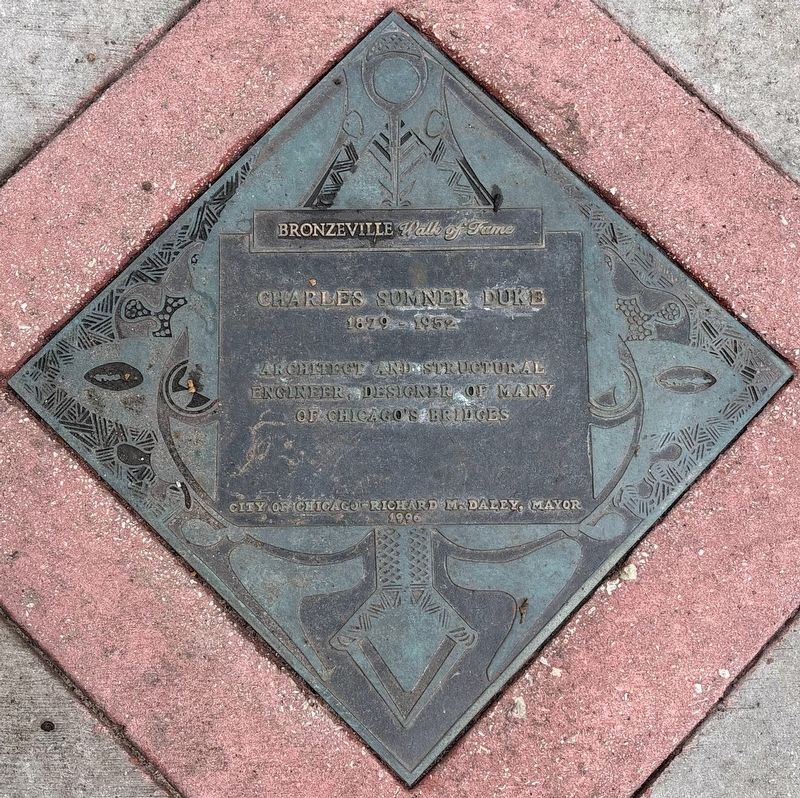
Charles Sumner Duke
1879-1952
| — | Bronzeville Walk of Fame | — |
Photographed by Sean P. Flynn, August 14, 2026
1. Charles Sumner Duke Marker
Architect and structural engineer, designer of many of Chicago's bridges
Topics and series. This historical marker is listed in these topic lists: African Americans • Architecture • Bridges & Viaducts. In addition, it is included in the Bronzeville Walk of Fame series list. A significant historical year for this entry is 1879.
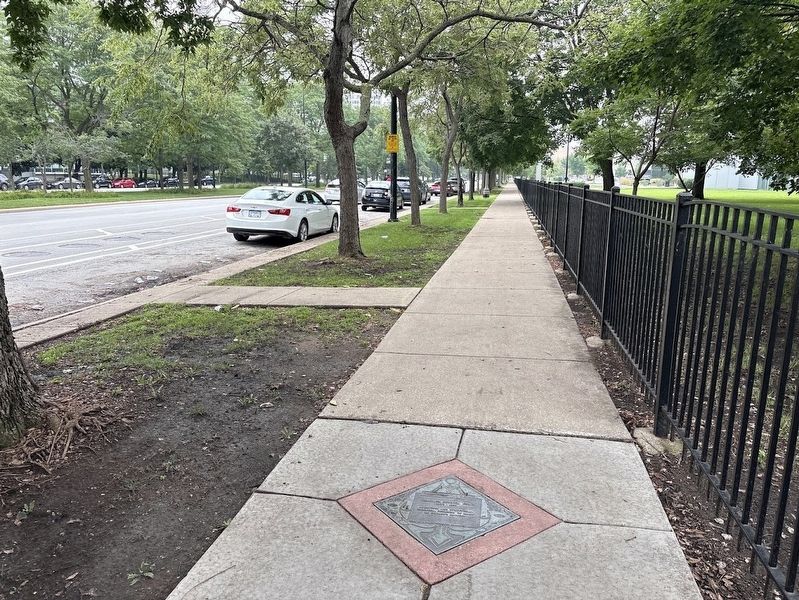
Location. 41° 50.667′ N, 87° 37.068′ W. Marker is in Chicago, Illinois, in Cook County. It is in Douglas. It is on South Martin Luther King Drive 0.1 miles south of East 26th Street, on the right when traveling south. Touch for map. Marker is in this post office area: Chicago IL 60616, United States of America. Touch for directions.

Regionally, this marker is on Chicago’s South Side and in Chicago’s Bronzeville. It is also in the American Midwest. Globally, it is in North America, on the Great Lakes, in the Western Hemisphere, in the Western World, and in the Anglosphere. Historically, it finds itself in what was once the Viceroyalty of New France, the territory of the Mississippian Culture, and the Northwest Territory.
Other nearby markers. At least 8 other markers are within
this page online
More about this marker. Roughly 100 Bronzeville Walk of Fame markers are found around the neighborhood along Martin Luther King Drive between 25th and 35th Streets.
Also see . . . Charles Sumner Duke. From the Encyclopedia of Arkansas.
Excerpt: "Duke started an architectural engineering consulting firm in 1922. This gave rise to several projects, including three churches, a nursing home, hotels, and several houses in Chicago. Duke’s most prominent project may have been his work as a project engineer for the eight-story Knights of Pythias building designed by Walter Thomas Bailey. The building, according(Submitted on August 17, 2026, by Sean P. Flynn of Oak Park, Illinois.)to some sources, was the tallest building at the time to have been built by African Americans and cost about $1 million. It used Egyptian motifs detailing the building’s exterior, boasted a 1,500-seat theater and a rooftop garden, and served as a source of pride for Chicago’s Black community. By the late 1920s, Duke was also pursuing housing opportunities for African Americans to lift them out of poverty. He was appointed in 1926 by the mayor of Chicago, Bill Thompson, as the only Black member of the Chicago Zoning Commission. Two years later, he was appointed to President Herbert Hoover’s Commission on Public Housing, later securing funding to build the first housing project in Chicago, the Ida B. Wells Homes."Photographed by Sean P. Flynn, August 14, 20262. Charles Sumner Duke Marker on the west side of King Drive
Credits. This page was last revised on September 29, 2026. It was originally submitted on August 17, 2026, by Sean P. Flynn of Oak Park, Illinois. This page has been viewed 13 times since then. Photos: 1, 2. submitted on August 17, 2026, by Sean P. Flynn of Oak Park, Illinois.
