South Loop in Chicago in Cook County, Illinois — The American Midwest (Great Lakes)
Lost Houses of Prairie Avenue: 2000-2100 Blocks

Photographed by Sean P. Flynn, August 14, 2026
1. Lost Houses of Prairie Avenue: 2000-2100 Blocks Marker
2009 S. Prairie Avenue
Max A Meyer Residence. Built 1888; Burnham & Root, architects
This picturesque row house was among the more distinctive on the street, being executed in the French Gothic style. Mayer was an officer with a successful boot and shoe firm, and died just as the house was being completed. Razed 1955.
2100 S. Prairie Avenue
John B. Sherman Residence. Built 1874; Burnham & Root, architects
Sherman was manager of the Union Stock Yards, and his daughter Margaret married the architect Daniel Burnham during construction. Sherman often recommended the firm to his neighbors, making them the most prolific architects represented on the street. Razed 1936.
2115 S. Prairie Avenue
David Kelley-Philip D. Armour Residence. Built 1871; architect unknown
Originally built for lumberman David Kelley, this stately Second Empire residence was for nearly 50 years the home
this page online
2126 S. Prairie Avenue
Edward F. Robbins Residence. Built 1904; Mann, MacNeill & Lindeberg, architects
This was the last house built on Prairie Avenue for 95 years, and was designed in the Federal style of dark red brick with white marble trim. In less than 20 years, it was converted to publishing offices, eventually being occupied by the World Book Company. Razed 2002.
2140 S. Prairie Avenue
William F. Tucker-Byron L. Smith Residence. Built 1876; John M. Van Osdel, architect
This imposing brick residence was acquired in 1881 by Byron L. Smith, founder and first president of the Northern Trust Company. Prior to demolition in 1936, the dining room was dismantled and reassembled as a private dining room at Northern Trust.
Topics. This historical marker is listed in these topic lists: Architecture • Industry & Commerce. A significant historical year for this entry is 1874.
Location. 41° 51.42′ N, 87° 37.253′ W. Marker is in Chicago, Illinois, in Cook
Photographed by Sean P. Flynn, August 14, 2026
2. The marker near the Chicago Women's Park entrance on Prairie Avenue

Regionally, this marker is on Chicago’s South Side. It is also in the American Midwest. Globally, it is in North America, on the Great Lakes, in the Western Hemisphere, in the Western World, and in the Anglosphere. Historically, it finds itself in what was once the Viceroyalty of New France, the territory of the Mississippian Culture, and the Northwest Territory.
Other nearby markers. At least 8 other markers are within walking distance of this marker: Rebirth 1966-2004 (here, next to this marker); Upstairs Downstairs (a few steps from this marker); In Chicago Palaces (a few steps from this marker); Decline 1905-1965 (a few steps from this marker); Lost Houses of Prairie Avenue: 1800-1900 Blocks (West Side) (a few steps from this marker); Glory Days 1872-1904

Courtesy of Chicago History Museum (ICHi-001299), circa 1890
3. Sherman house at 2100 S. Prairie
Regarding Lost Houses of Prairie Avenue: 2000-2100 Blocks. An estimated 90% of the homes that, during the 1870s and 1880s, made Prairie Avenue the city's most sought-after residential location have been razed, many as the neighborhood shifted to commercial and industrial uses starting in the 1910s. Restoration efforts coupled with rezoning and new building have returned this neighborhood to its residential roots.

Photographed by Sean P. Flynn, August 14, 2026
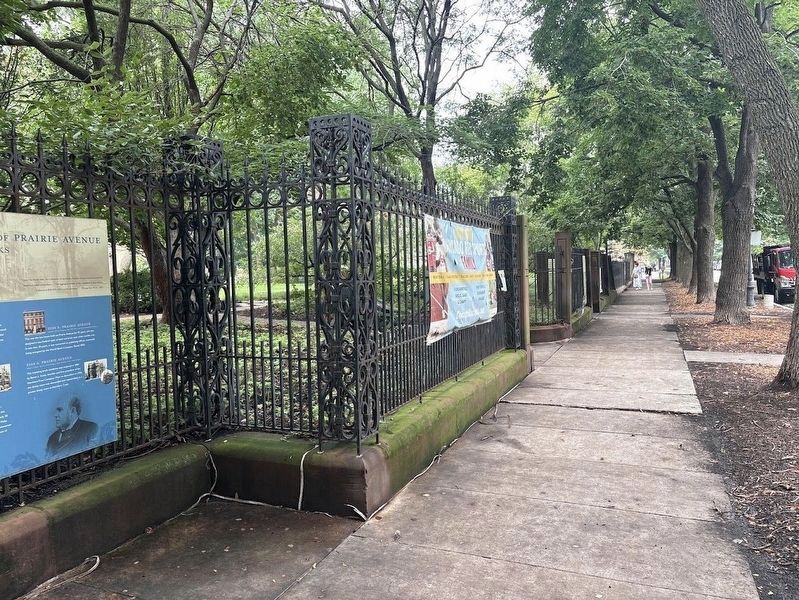
4. Fence around Chicago Women's Park
This Lost Houses marker is obscured by the fence but is just to the right of the blue marker seen in the distance on the fence.
Credits. This page was last revised on August 25, 2026. It was originally submitted on August 19, 2026, by Sean P. Flynn of Oak Park, Illinois. This page has been viewed 15 times since then. Photos: 1, 2, 3, 4. submitted on August 19, 2026, by Sean P. Flynn of Oak Park, Illinois.
