South Loop in Chicago in Cook County, Illinois — The American Midwest (Great Lakes)
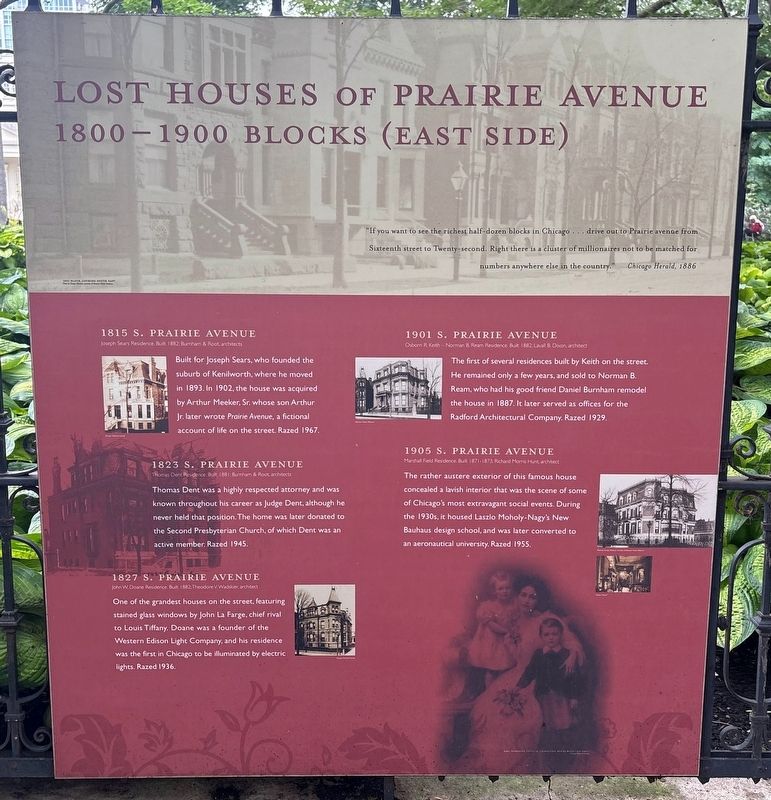
Lost Houses of Prairie Avenue: 1800-1900 Blocks (East Side)
Photographed by Sean P. Flynn, August 14, 2026
1. Lost Houses of Prairie Avenue: 1800-1900 Blocks (East Side) Marker
1815 S. Prairie Avenue
Joseph Sears Residence, Built 1882; Burnham & Root, architects
Built for Joseph Sears, who founded the suburb of Kenilworth, where he moved in 1893. In 1902, the house was acquired by Arthur Meeker, Sr. whose son Arthur Jr. later wrote Prairie Avenue, a fictional account of life on the street. Razed 1967.
1823 S. Prairie Avenue
Thomas Dent Residence. Built 1881; Burnham & Root, architects
Thomas Dent was a highly respected attorney and was known throughout his career as Judge Dent, although he never held that position. The home was later donated to the Second Presbyterian Church, of which Dent was an active member. Razed 1945.
1827 S. Prairie Avenue
John W. Doane Residence. Built 1882; Theodore V. Wadskier, architect
One of the grandest houses on the street, featuring stained glass windows by John La Farge, chief rival to Louis Tiffany.
this page online
1901 S. Prairie Avenue
Osborn R. Keith-Norman B. Ream Residence. Built 1882; Lavall B. Dixon, architect
The first of several residences built by Keith on the street. He remained only a few years, and sold to Norman B. Ream, who had his good friend Daniel Burnham remodel the house in 1887. It later served as offices for the Radford Architectural Company. Razed 1929.
1905 S. Prairie Avenue
Marshall Field Residence Bult 1871-1873. Richard Moms Hunt, architect
The rather austere exterior of this famous house concealed a lavish interior that was the scene of some of Chicago's most extravagant social events. During the 1930s, it housed Laszlo Moholy-Nagy's New Bauhaus design school, and was later converted to an aeronautical university. Razed 1955.
Topics. This historical marker is listed in these topic lists: Architecture • Arts, Letters, Music • Religion & Religious Structures. A significant historical year for this entry is 1886.
Location. 41° 51.444′ N, 87° 37.254′ W. Marker

Photographed by Sean P. Flynn, August 14, 2026
2. Lost Houses of Prairie Avenue: 1800-1900 Blocks (East Side) Marker
The marker is in the distance but obscured by its placement in an alcove of the metal fence around Chicago Women's Park.

Regionally, this marker is on Chicago’s South Side. It is also in the American Midwest. Globally, it is in North America, on the Great Lakes, in the Western Hemisphere, in the Western World, and in the Anglosphere. Historically, it finds itself in what was once the Viceroyalty of New France, the territory of the Mississippian Culture, and the Northwest Territory.
Other nearby markers. At least 8 other markers are within walking distance of this marker: Glory Days 1872-1904 (here, next to this marker); Beginnings 1812-1871 (a few steps from this marker); Lost Houses of Prairie Avenue: 1600-1700 Blocks (a few steps from this marker); A Heritage Preserved (a few steps from this marker); Outside the District (a few steps from this

Chicago Daily News Collection, Chicago History Museum, 1905
3. Marshall Field Sr. residence at 1905 S. Prairie

Hugh W. Celander, Camera Club; Courtesy of Chicago History Museum (ICHi-038250), 1959
4. 1815 S. Prairie Ave.
The home was built by Joseph Sears, the founder of the Chicago suburb of Kenilworth. Sears served in the Civil War with the 134th Illinois Infantry. After the war he was a successful executive with a manufacturing company.
Credits. This page was last revised on August 19, 2026. It was originally submitted on August 19, 2026, by Sean P. Flynn of Oak Park, Illinois. This page has been viewed 16 times since then. Photos: 1, 2, 3, 4. submitted on August 19, 2026, by Sean P. Flynn of Oak Park, Illinois.
