South Loop in Chicago in Cook County, Illinois — The American Midwest (Great Lakes)
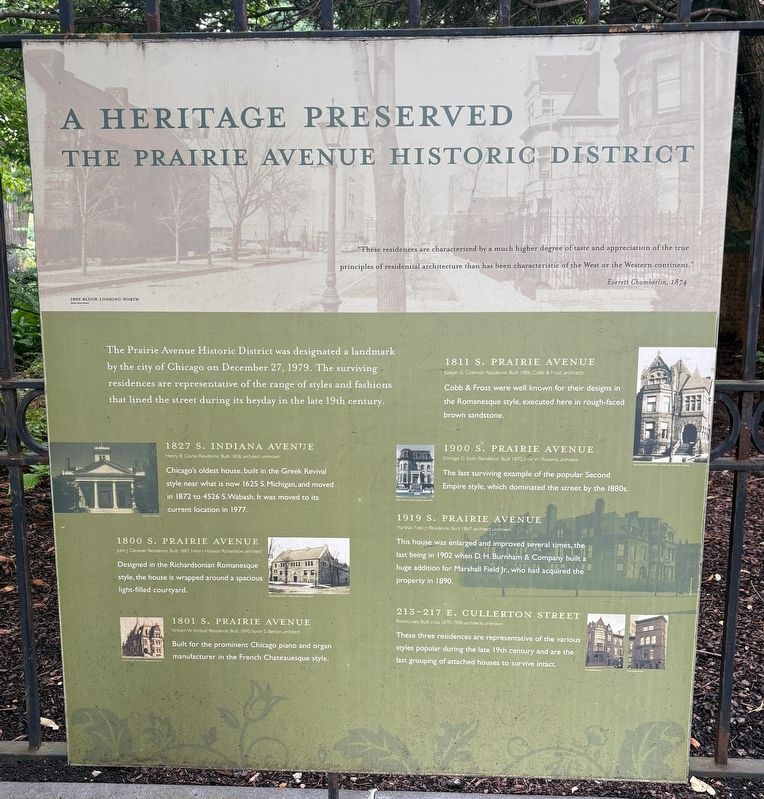
A Heritage Preserved
Photographed by Sean P. Flynn, August 14, 2026
1. A Heritage Preserved Marker
Everett Chamberlin, 1874
The Prairie Avenue Historic District was designated a landmark by the city of Chicago on December 27, 1979. The surviving residences are representative of the range of styles and fashions that lined the street during its heyday in the late 19th century.
1827 S. Indiana Avenue
Henry B. Clarke Residence. Built 1836; architect, unknown
Chicago's oldest house, built in the Greek Revival style near what is now 1625 S. Michigan, and moved in 1872 to 4526 S. Wabash. It was moved to its current location in 1977.
1800 S. Prairie Avenue
John Glessner Residence. Built 1887; Henry Hobson Richardson, architect
Designed in the Richardsonian Romanesque style, the house is wrapped around a spacious light-filled courtyard.
1801 S. Prairie Avenue
William W. Kimball Residence. Built 1890; Solon S. Beman, architect
Built for the prominent Chicago piano and organ manufacturer in the French Chateauesque
this page online
1811 S. Prairie Avenue
Joseph G. Coleman Residence. Built 1886; Cobb & Frost, architects
Cobb & Frost were well known for their designs in the Romanesque style, executed here in rough-faced brown sandstone.
1900 S. Prairie Avenue
Elbridge G. Keith Residence. Built 1870; John W. Roberts, architect
The last surviving example of the popular Second Empire style, which dominated the street by the 1880s.
1919 S. Prairie Avenue
Marshall Field Jr. Residence. Built 1867; architect unknown
This house was enlarged and improved several times, the last being in 1902 when D. H. Burnham & Company built a huge addition for Marshall Field Jr., who had acquired the property in 1890.
213-217 E. Cullerton Street
Rowhouses. Built circa 1870-1900; architects unknown These three residences are representative of the various styles popular during the late 19th century and are the last grouping of attached houses to survive intact.
Topics and series. This historical marker is listed in this topic list: Architecture. In addition, it is included in the Chicago's Surviving Pre-Fire Structures series list. A significant historical date for this entry is December 27, 1979.
Location. 41° 51.455′ N,
Photographed by Sean P. Flynn, August 14, 2026
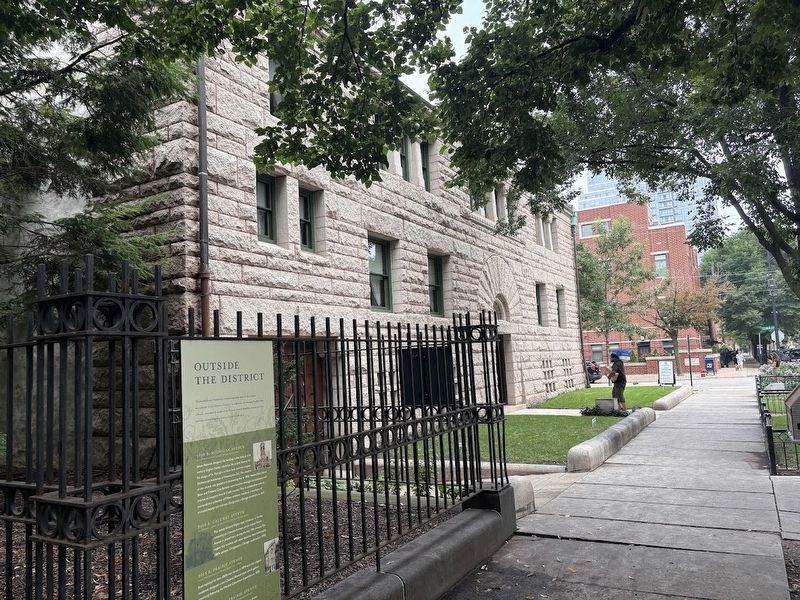
2. Markers near the Glessner House
The marker is just off camera to the left.

Regionally, this marker is on Chicago’s South Side. It is also in the American Midwest. Globally, it is in North America, on the Great Lakes, in the Western Hemisphere, in the Western World, and in the Anglosphere. Historically, it finds itself in what was once the Viceroyalty of New France, the territory of the Mississippian Culture, and the Northwest Territory.
Other nearby markers. At least 8 other markers are within walking distance of this marker: Outside the District (here, next to this marker); Lost Houses of Prairie Avenue: 1600-1700 Blocks (here, next to this marker); Beginnings 1812-1871 (a few steps from this marker); John J. and Frances M. Glessner House (a few steps from this

Photographed by Sean P. Flynn, August 14, 2026
3. Prairie Avenue Historic District
Chicago Women's Park and Gardens is in the distance, with several markers affixed to its Prairie Avenue fence.
Another marker is no longer nearby. John J. Glessner House (was a few steps from this marker but has been replaced with another marker now near it).
Credits. This page was last revised on August 20, 2026. It was originally submitted on August 19, 2026, by Sean P. Flynn of Oak Park, Illinois. This page has been viewed 18 times since then. Photos: 1, 2, 3. submitted on August 19, 2026, by Sean P. Flynn of Oak Park, Illinois.
