Fort Sam Houston in San Antonio in Bexar County, Texas — The American South (West South Central)
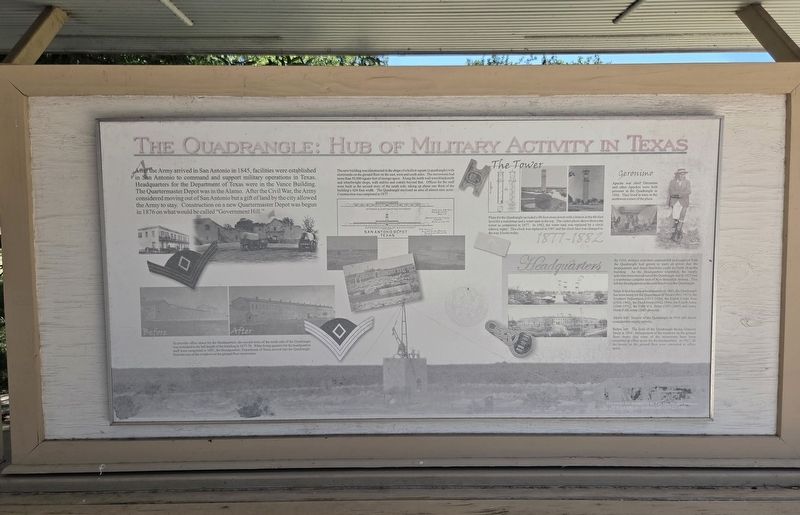
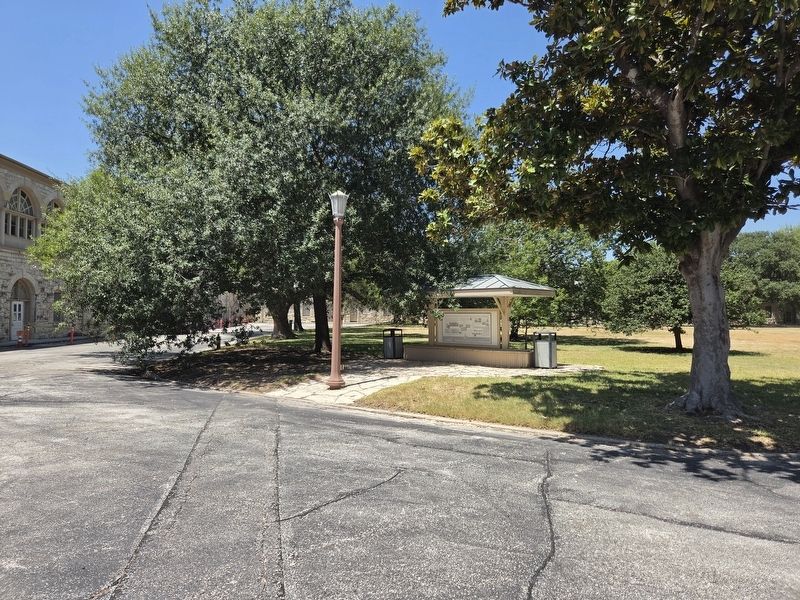
The Quadrangle: Hub of Military Activity in Texas
Photographed by James Hulse, August 18, 2026
1. The Quadrangle: Hub of Military Activity in Texas Marker
After the Army arrived in San Antonio in 1845, facilities were established in San Antonio to command and support military operations in Texas. Headquarters for the Department of Texas was in the Vance Building. The Quartermaster Depot was in the Alamo. After the Civil War, the Army considered moving out of San Antonio but a gift of land by the city allowed the Army to stay. Construction on a new Quartermaster Depot was begun in 1876 on what would be called “Government Hill.”
To provide office space for the Headquarters, the second story of the south side of the Quadrangle was extended to the full length of the building in 1877–78. When living quarters for the headquarters staff were completed in 1881, the Headquarters, Department of Texas moved into the Quadrangle. Note the size of the windows on the ground-floor storerooms.
The new building was constructed in the shape of a hollow square (a quadrangle) with storerooms on the ground floor on the east, west and south sides. The storerooms had more than 50,000 square feet of storage space. Along the north wall were blacksmith and wheelwright shops, with stables and corrals beyond that. Offices for the staff were built in the second story of the south side, taking up about one third of the building’s 624-foot width. The Quadrangle enclosed an area of almost nine acres. Construction was completed in 1877.
The Tower
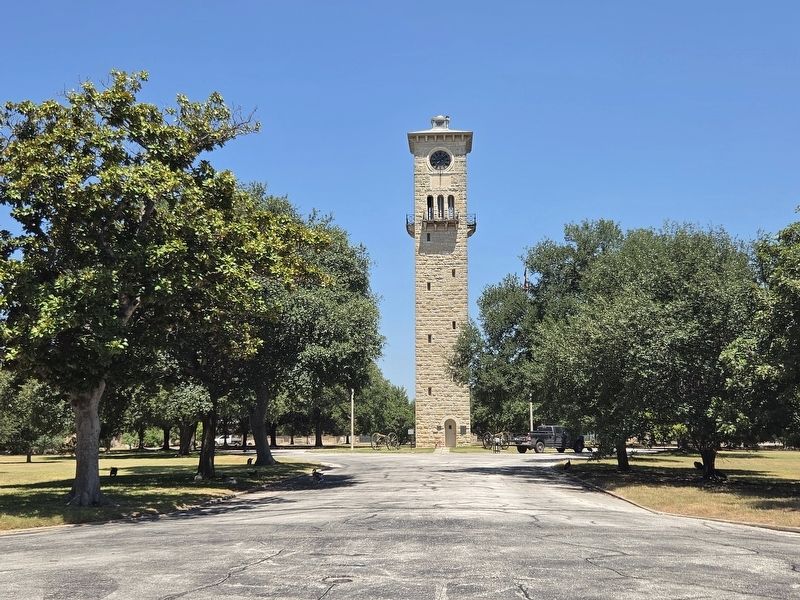
Plans for the Quadrangle included a 90-foot stone tower with a staircase at the 60-foot level for a watchtower and water tank in the top. The center photo shows the tower as completed in 1877. In 1882, the water tank was replaced by a clock (above, right). This clock was replaced in 1907 and the clock face was changed to the way it looks today.
Geronimo
Apache war chief Geronimo and other Apaches were held prisoner in the Quadrangle in 1886. They lived in tents in the northwest corner of the plaza.
Headquarters
By 1916, military activities commanded and supplied from the Quadrangle had grown to such an extent that the headquarters and depot functions could no longer fit in the building. As the Headquarters expanded, the supply activities were moved out of the Quadrangle and in 1922 into a warehouse complex east of New Braunfels Avenue. The latter facility is today the home of the Quartermaster Museum.
Since it first became headquarters in 1881, the Quadrangle has been home for the Department of Texas (1881–1913), the Southern Department (1913–1920), the Eighth Corps Area (1920–1942), the Third Army (1942–1946), the Fourth Army (1946–1971), the Fifth U.S. Army (1971–2003) and Army North/Fifth Army (2006–present).
Above left: A view of the Quadrangle in 1916 still shows considerable supply activity.
Below left: The front of the Quadrangle facing Grayson Street in 1916. Enlargement of the windows on the second floor shows that some of the storerooms have been converted to office space for the headquarters. In 1917, all the rooms on the ground floor were converted to office space.
Reverse Side
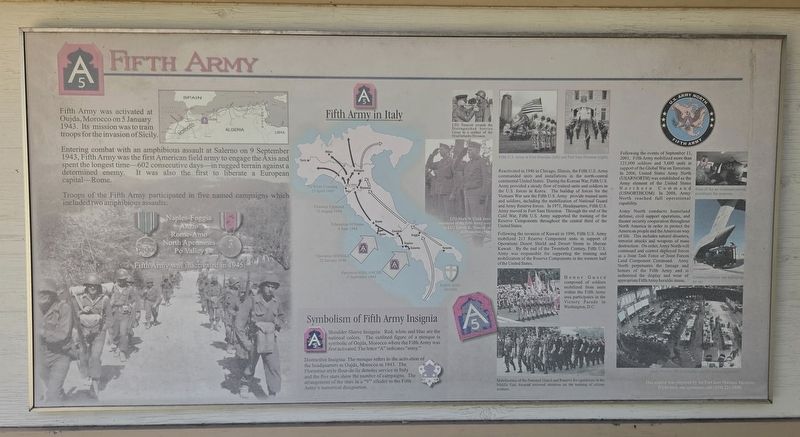
Fifth Army
Fifth
this page online
Entering combat with an amphibious assault at Salerno on 9 September 1943, Fifth Army was the first American field army to engage the Axis and spent the longest time—602 consecutive days—in rugged terrain against a determined enemy. It was also the first to liberate a European capital—Rome.
Troops of the Fifth Army participated in five named campaigns which included two amphibious assaults:
Naples-Foggia • Anzio • Rome-Arno • North Apennines • Po Valley
Fifth Army in Italy
Symbolism of Fifth Army Insignia
Shoulder Sleeve Insignia: Red, white and blue are the national colors. The outlined figure of a mosque is symbolic of Oujda, Morocco where the Fifth Army was first activated. The letter “A” indicates “army.”
Distinctive Insignia: The mosque refers to the activation of the headquarters in Oujda, Morocco in 1943. The Florentine-style fleur-de-lis denotes service in Italy and the five stars show the number of campaigns. The arrangement of the stars in a “V” alludes to the Fifth Army’s numerical designation.
Reactivated
Photographed by James Hulse, August 18, 2026
2. The Quadrangle: Hub of Military Activity in Texas Marker - Reverse Side
Following the invasion of Kuwait in 1990, Fifth U.S. Army mobilized 213 Reserve Component units in support of Operations Desert Shield and Desert Storm. Following Kuwait, by the end of the Twentieth Century, Fifth U.S. Army was responsible for supporting the training and mobilization of the Reserve Components in the western half of the United States.
Following the events of September 11, 2001, Fifth Army mobilized more than 125,000 soldiers and 3,600 units in support of the Global War on Terrorism.
Photographed by James Hulse, August 18, 2026
3. The Quadrangle: Hub of Military Activity in Texas Marker
Army North conducts homeland defense, civil support operations, and theater security cooperation throughout North America in order to protect the American people and the American way of life. This includes natural disasters, terrorist attacks and weapons of mass destruction. On order, Army North will command and control deployed forces as a Joint Task Force or Joint Forces Land Component Command. Army North perpetuates the lineage and honors of the Fifth Army and is authorized the display and wear of appropriate Fifth Army heraldic items.
LTG Truscott awards the Distinguished Service Cross to a soldier of the 92nd Infantry Division.
LTG Mark W. Clark turns command of the Fifth Army over to LTG Lucian K. Truscott on 16 December 1944.
Fifth U.S. Army at Fort Sheridan (left) and Fort Sam Houston (right).
Honor Guard composed of soldiers mobilized from units within the Fifth Army area participates in the Victory Parade in Washington, D.C.
Mobilization of the National Guard and Reserve for operations in the Middle East focused renewed attention on the training of citizen soldiers.
State of the art communications coordinate the response.
Communications van deploying by air.
Army North’s JTF Falcon deployed on a training exercise.
Erected by Fort
Photographed by James Hulse, August 18, 2026
4. The Quadrangle: Hub of Military Activity in Texas Marker
The view of the tower inside the center of the Quad.
Topics. This historical marker is listed in this topic list: Forts and Castles. A significant historical year for this entry is 1845.
Location. 29° 26.637′ N, 98° 27.751′ W. Marker is in San Antonio, Texas, in Bexar County. It is in Fort Sam Houston. It is at the intersection of Liscum Road and Staff Post Road on Liscum Road. Touch for map. Marker is at or near this postal address: 1405 E Grayson St, Jbsa Ft Sam Houston TX 78234, United States of America. Touch for directions.

Regionally, this marker is in South Texas. It is also in the American South. Globally, it is in North America, a Gulf of Mexico state, the Western Hemisphere, the Western World, and the Anglosphere. Historically, it finds itself in what was once New Spain, the Republic of Texas, and one of the Confederate States of America.
Other nearby markers. At least 8 other markers are within walking distance of this marker: The Sally Port (within shouting distance of this marker); Cannon and the Tower (within shouting distance of this marker); Water Features (within shouting distance of this marker); The Quadrangle: Quartermaster Depot (within

Photographed by James Hulse, August 18, 2026
5. The Quadrangle: Hub of Military Activity in Texas Marker
Cannon out front of the Quadrangle.
Other markers no longer nearby. M-1905 Field Gun (was about 400 feet away but has been permanently removed); Ft. Sam Houston Quadrangle and Staff Post (was about 400 feet away but has been replaced with another marker now near it).
More about this marker. Fort Sam Houston is an active military installation. Appropriate identification is required for access.
Credits. This page was last revised on August 21, 2026. It was originally submitted on August 21, 2026, by James Hulse of Medina, Texas. This page has been viewed 15 times since then. Photos: 1, 2, 3, 4, 5. submitted on August 21, 2026, by James Hulse of Medina, Texas.
