South Side in Billings in Yellowstone County, Montana — The American West (Mountains)
The Railroad Arrives
Photographed by Cosmos Mariner, July 4, 2024
1. The Railroad Arrives Marker
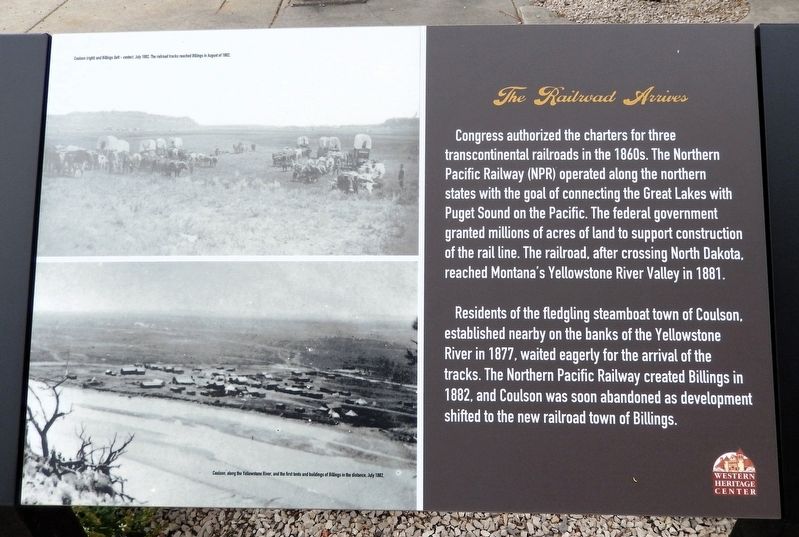
Congress authorized the charters for three transcontinental railroads in the 1860s. The Northern Pacific Railway (NPR) operated along the northern states with the goal of connecting the Great Lakes with Puget Sound on the Pacific. The federal government granted millions of acres of land to support construction of the rail line. The railroad, after crossing North Dakota, reached Montana's Yellowstone River Valley in 1881.
Residents of the fledgling steamboat town of Coulson, established nearby on the banks of the Yellowstone River in 1877, waited eagerly for the arrival of the tracks. The Northern Pacific Railway created Billings in 1882, and Coulson was soon abandoned as development shifted to the new railroad town of Billings.
Erected by Western Heritage Center.
Topics. This historical marker is listed in these topic lists: Railroads & Streetcars • Settlements & Settlers. A significant historical year for this entry is 1882.
Location. 45° 46.828′ N, 108° 30.345′ W. Marker is in Billings, Montana, in Yellowstone County. It is in the South Side. It is on North 29th Street just south of Montana Avenue (Business Interstate
this page online

Regionally, this marker is in Yellowstone Country. It is also in the American Mountain West and in the Lewis & Clark Corridor. Globally, it is in North America, the Western Hemisphere, the Western World, and the Anglosphere. Historically, it finds itself in what was once Rupert’s Land and also the Louisiana Purchase.
Other nearby markers. At least 8 other markers are within walking distance of this marker: Billings — A Tale of Two Cities (here, next to this marker); The Western Heritage Center (here, next to this marker); Indigenous Homeland (here, next to this marker); The Parmly Billings Library Building (a few steps from this marker); Frederick Billings (a few steps from this marker); J.K. Ralston Cabin-Studio (within shouting distance of this marker); The Clark Hotel - 1928 (within shouting distance of this marker); The Parmly Billings Library - 1901 (within

2. Marker detail: Coulson and Billings, July 1882
Coulson (right) and Billings (left-center), July 1882. The railroad tracks reached Billings in August of 1882.
Also see . . . Billings, Montana (Wikipedia).
Excerpt: In 1877, settlers from the Gallatin Valley area of the Montana Territory formed Coulson, the first town of the Yellowstone Valley. At this time before the coming of the railroad, most goods coming to and going from the Montana Territory were carried on paddle riverboats.(Submitted on August 24, 2026, by Cosmos Mariner of Cape Canaveral, Florida.)When the railroad came to the area, Coulson residents were sure the town would become the railroads hub and Coulson would soon be the territory's largest city. The railroad only had claim to odd sections and it had two sections side-by-side about two miles west of Coulson. Being able to make far more money by creating a new town on these two sections the railroad decided to create the new town of Billings. Named after the Northern Pacific Railway president Frederick H. Billings, the city was founded in 1882. The Railroad formed the city as a western railhead for its further westward expansion. At first the new town had only three buildings but within just a few months it had grown to over 2,000.
Coulson and
Billings existed side by side for a short time with a trolley even running between them. However, most of Coulson's residents moved to the new booming town of Billings. In the end, Coulson faded away, with the last remains of the town disappearing in the 1930s.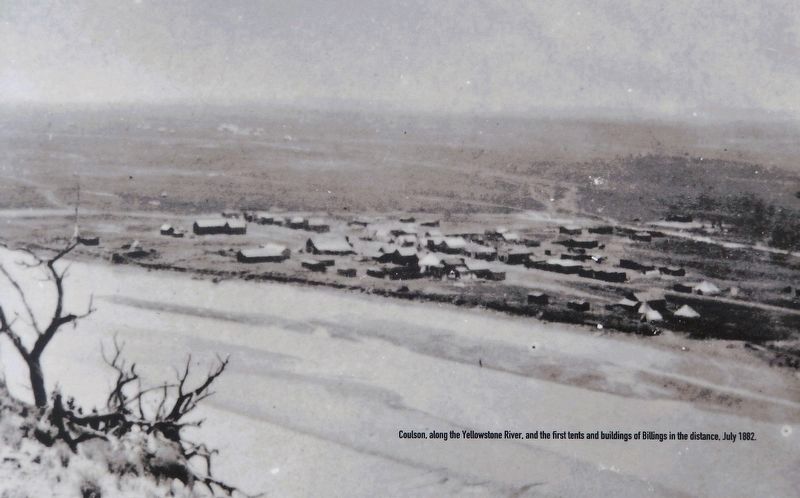 3. Marker detail: Coulson, along the Yellowstone RiverThe first tents and buildings of Billings in the distance, July 1882.

Photographed by Cosmos Mariner, July 4, 2024
4. The Railroad Arrives Marker
Looking southwest across North 29th Street. There is a locomotive on the active railroad tracks.
Credits. This page was last revised on August 24, 2026. It was originally submitted on August 22, 2026, by Cosmos Mariner of Cape Canaveral, Florida. This page has been viewed 15 times since then. Photos: 1, 2, 3, 4. submitted on August 24, 2026, by Cosmos Mariner of Cape Canaveral, Florida.
