Northwest Portland in Multnomah County, Oregon — The American West (Northwest)
The Golden West Hotel
1906–1931
Photographed by Ian Lefkowitz, June 25, 2026
1. The Golden West Hotel Marker
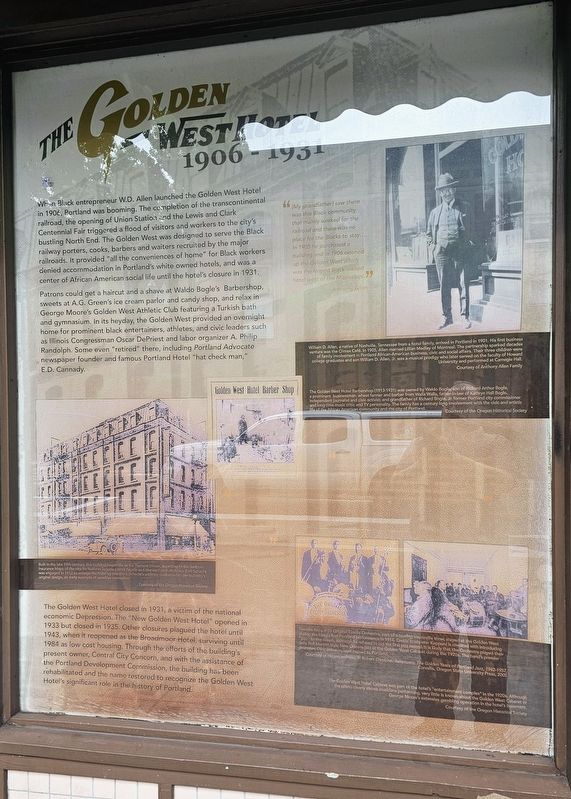
When Black entrepreneur W.D. Allen launched the Golden West Hotel in 1906, Portland was booming. The completion of the transcontinental railroad, the opening of Union Station, and the Lewis and Clark Centennial Fair triggered a flood of visitors and workers to the city’s bustling North End. The Golden West was designed to serve the Black railway porters, cooks, barbers and waiters recruited by the major railroads. It provided “all the conveniences of home” for Black workers denied accommodation in Portland’s white owned hotels, and was a center of African American social life until the hotel’s closure in 1931.
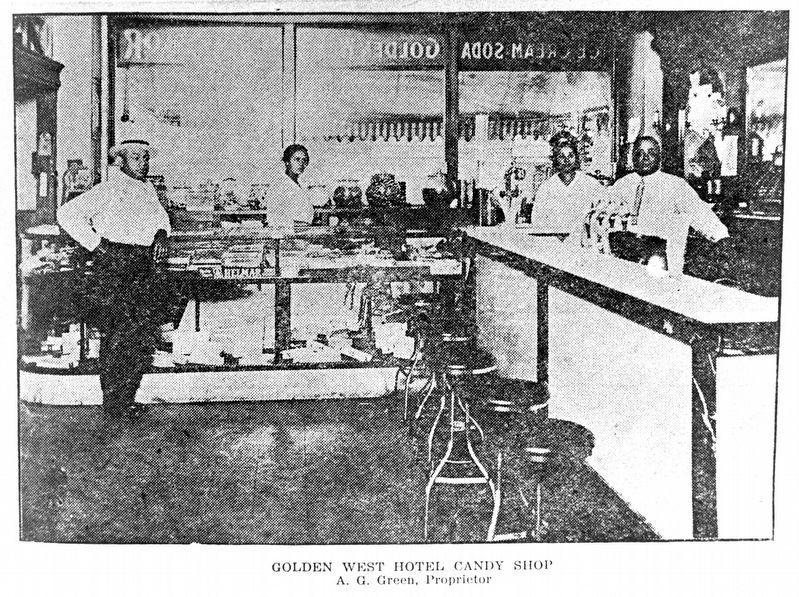
Patrons could get a haircut and a shave at Waldo Bogle’s Barbershop, sweets at A.G. Green’s ice cream parlor and candy shop, and relax in George Moore’s Golden West Athletic Club featuring a Turkish bath and gymnasium. In its heyday, the Golden West provided an overnight home for prominent black entertainers, athletes, and civic leaders such as Illinois Congressman Oscar DePriest and labor organizer A. Philip Randolph. Some even “retired” there, including Portland Advocate newspaper founder and famous Portland
this page online
The Golden West Hotel closed in 1931, a victim of the national economic Depression. The “New Golden West Hotel” opened in 1933 but closed in 1935. Other closures plagued the hotel until 1943, when it reopened as the Broadmoor Hotel, surviving until 1984 as low cost housing. Through the efforts of the building’s present owner, Central City Concern, and with the assistance of the Portland Development Commission, the building has been rehabilitated and the name restored to recognize the Golden West Hotel’s significant role in the history of Portland.
“[My grandfather] saw there was this Black community that mainly worked for the railroad and there was no place for the Blacks to stay… In 1905 he purchased a building and in 1906 opened up the Golden West which was the largest Black-owned hotel west of the Mississippi.”
Anthony Allen
[Captions:]
William D. Allen, a native of Nashville, Tennessee from a hotel family, arrived in Portland in 1901. His first business venture was the Climax Café. In 1905, Allen married Lillian Medley of Montreal. The partnership sparked decades of family involvement in Portland African-American business, civic and social affairs. Their three children were college graduates and son William D. Allen, Jr. was a musical prodigy who later served on the faculty of Howard University and performed at Carnegie Hall. Courtesy of Anthony Allen Family
The Golden West Hotel Barbershop (1913–1931) was owned by Waldo Bogle/son of Richard Arthur Bogle, a prominent businessman, wheat farmer and barber from Walla Walla, father-in-law of Kathryn Hall Bogle, independent journalist and civic activist, and grandfather of Richard Bogle, Jr. former Portland city commissioner and long time music critic and TV personality. The family has a century long involvement with the civic and artistic life of the African American community and the city of Portland. Courtesy of the Oregon Historical Society
Built in the late 19th century, this building appears as the “Yamhill House” according to the Sanborn Insurance Maps of the day. Its features include a brick front and mansard roof. Architect Ellis F. Lawrence was engaged in 1912 to enlarge the hotel by one third. Schacht’s addition conformed to the building’s original design, an early example of sensitive restoration. Courtesy of the Oregon Historical Society
Frankie Kemp’s Original Creole Orchestra, part of a touring vaudeville show, stayed at the Golden West during the band’s first Portland performance. Trumpeter Freddie Keppard is credited with introducing jelly Roll Morton style New Orleans jazz to the rest of the nation. He refused to cut the first jazz record, it is said, out of fear that other musicians would copy his style. Kemp’s Orchestra played their debut and farewell at the Golden West Cabaret during the 1920s, Portland’s premier jazz venue. Courtesy of Hope and Weil, in Robert Dietsche, Jumptown, The Golden Years of Portland Jazz, 1942–1957, Corvallis, Oregon State University Press, 2005
The Golden West Hotel Cabaret was part of the hotel’s “entertainment complex” in the 1920s. Although the photo clearly shows musicians performing, very little is known about the Golden West Cabaret or George Moore’s extensive gambling operation in the hotel’s basement. Courtesy of the Oregon Historical Society
Topics.

Photographed by Ian Lefkowitz, June 25, 2026
2. The Golden West Hotel Marker
Looking south on Broadway towards NW Everett St.
Location. 45° 31.521′ N, 122° 40.661′ W. Marker is in Portland, Oregon, in Multnomah County. It is in Northwest Portland. It is on Northwest Broadway just north of Northwest Everett Street, on the right when traveling south. Touch for map. Marker is at or near this postal address: 301 NW Broadway, Portland OR 97209, United States of America. Touch for directions.

Regionally, this marker is in the Columbia River Gorge and in the Willamette Valley. It is also on the American Pacific Coast, in the Pacific Northwest, and in the Lewis & Clark Corridor. Globally, it is in North America, on the Ring of Fire, on the Pacific Rim, in the Western Hemisphere, in the Western World, and in the Anglosphere.
Other nearby markers. At least 8 other markers are within walking distance of this marker: Middle Class Americans (here, next to this marker); a different marker also named Golden West Hotel (a few steps from this marker); Working on The Railroad (a few steps from this marker); The Color Line
Photographed by Ian Lefkowitz, June 25, 2026
3. The Golden West Hotel Marker
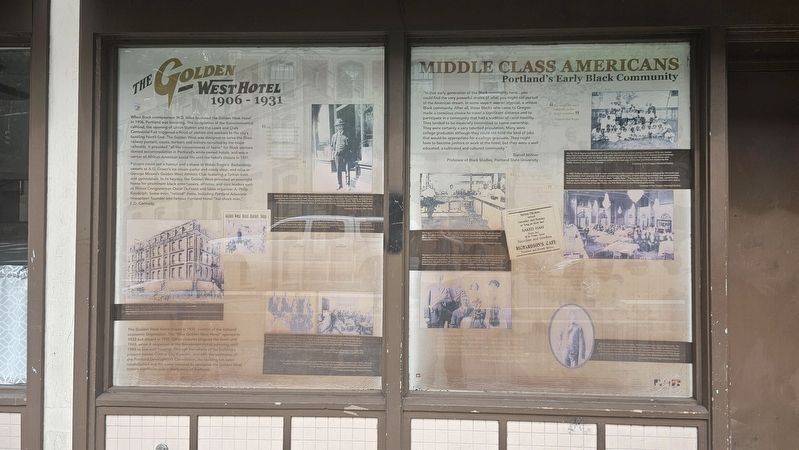
The marker is part of a diptych and also part of a series of markers found in the former hotel's windows.
Oregon Historical Society
4. The Golden West Hotel Candy Shop
The interior of A.G. Green's Golden West Hotel Candy Shop around 1910. Four unidentified people stand at the counter.
Credits. This page was last revised on October 14, 2026. It was originally submitted on August 23, 2026, by Ian Lefkowitz of New York, New York. This page has been viewed 19 times since then. Photos: 1, 2, 3, 4. submitted on August 23, 2026, by Ian Lefkowitz of New York, New York. • Devry Becker Jones was the editor who published this page.
