Northwest Portland in Multnomah County, Oregon — The American West (Northwest)
Middle Class Americans
Portland's Early Black Community
| — | The Golden West Hotel 1906–1931 | — |
Photographed by Ian Lefkowitz, June 25, 2026
1. Middle Class Americans: Portland's Early Black Community Marker
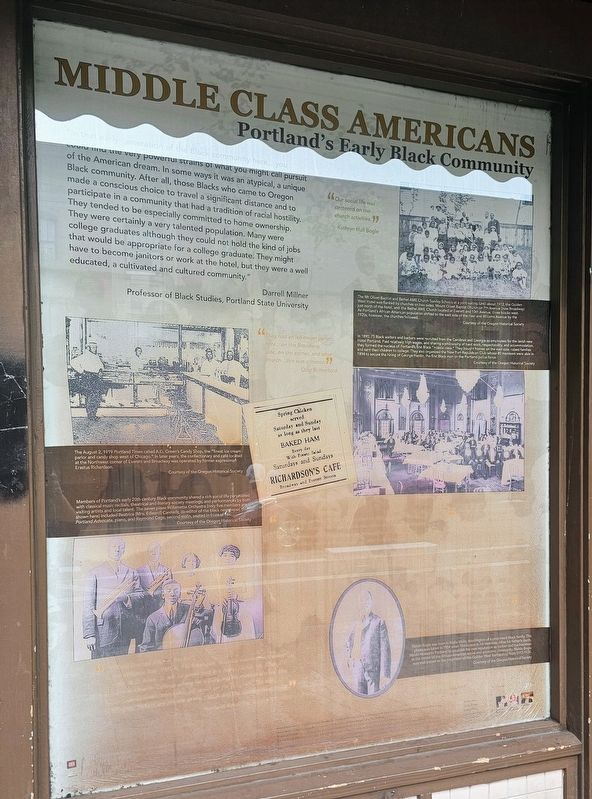
“In that early generation of the Black community here…you could find the very powerful strains of what you might call pursuit of the American dream. In some ways it was an atypical, a unique Black community. After all, those Blacks who came to Oregon made a conscious choice to travel a significant distance and to participate in a community that had a tradition of racial hostility. They tended to be especially committed to home ownership. They were certainly a very talented population. Many were college graduates although they could not hold the kind of jobs that would be appropriate for a college graduate. They might have to become janitors or work at the hotel, but they were a well educated, a cultivated and cultured community.”
Darrell Millner
Professor of Black Studies, Portland State University
“Our social life was centered on the church activities.”
Kathryn Hall Bogle
“They had an ice cream parlor here…on the Broadway side, on the corner, and after church…this was a mecca.”
Otto Rutherford
[Captions:]
The Mt. Olivet Baptist and Bethel AME Church Sunday Schools at a joint outing. Until about 1912, the Golden West Hotel was flanked by charitable churches: Mount Olivet Baptist Church on 7th Avenue (now Broadway) just north of the hotel, and the Bethel African Methodist Episcopal (AME) Church located at Everett and 10th Avenue, three blocks west. As Portland's African American population shifted to the east side of the river and Williams Avenue by the 1920s, however, the churches followed.
Courtesy of the Oregon Historical Society
In 1890, 75 Black waiters and barbers were recruited from the Carolinas and Georgia as employees for the lavish new Hotel Portland. Paid relatively high wages, and sharing a philosophy of hard work, respectability, and accommodation, they formed the nucleus of Portland’s first Black "middle class." They bought homes on the east side, raised families, and sent their children to college. They also organized the New Port Republican Club, whose 80 members were able in 1894 to secure the hiring of George Hardin, the first Black man on the Portland police force.
Courtesy of the Oregon Historical Society
The August 2, 1919 Portland Times called A.G. Green’s Candy Shop, the “finest ice cream parlor and candy shop west of Chicago.” In later years, the confectionery and café located at the Northwest corner of Everett and Broadway was operated by former expressman Erastus Richardson.
Courtesy of the Oregon Historical Society
Members of Portland’s early 20th century Black community shared a rich social life punctuated with classical music recitals, theatrical and literary society meetings, and performances by both visiting artists and local talent. The seven-piece Willamette Orchestra (only five members are shown here) included Beatrice [Mrs. Edward] Cannady, co-editor of the Black newspaper, the Portland Advocate, piano, and Raymond Cage, second violin, seated in front of her.
Courtesy of the Oregon Historical Society
Waldo Bogle was born in Walla Walla, Washington of a prominent Black family. This photo was taken in 1904 when Waldo was in his twenties. After his father’s death, Waldo moved to Portland to establish his own reputation as barber and businessman at the center of the African-American social and economic community. Waldo Bogle was well known as the proprietor of the Golden West Barbershop from 1913-1930.
Courtesy of the Oregon Historical Society
Topics.
this page online
Location. 45° 31.523′ N, 122° 40.66′ W. Marker has been reported unreadable. Marker is in Portland, Oregon, in Multnomah County. It is in Northwest Portland. It is on Northwest Broadway north of Northwest Everett Street, on the right when traveling south. Touch for map. Marker is at or near this postal address: 301 NW Broadway, Portland OR 97209, United States of America. Touch for directions.

Regionally, this marker is in the Columbia River Gorge and in the Willamette Valley. It is also on the American Pacific Coast, in the Pacific Northwest, and in the Lewis & Clark Corridor. Globally, it is in North America, on the Ring of Fire, on the Pacific Rim, in the Western Hemisphere, in the Western World, and in the Anglosphere.
Other nearby markers. At least 8 other markers are within walking distance of this location: The Golden West Hotel (here, next to this marker); a different marker also named Golden West Hotel (a few steps from this marker); Working on The Railroad (a few
Photographed by Ian Lefkowitz, June 25, 2026
2. Middle Class Americans: Portland's Early Black Community Marker
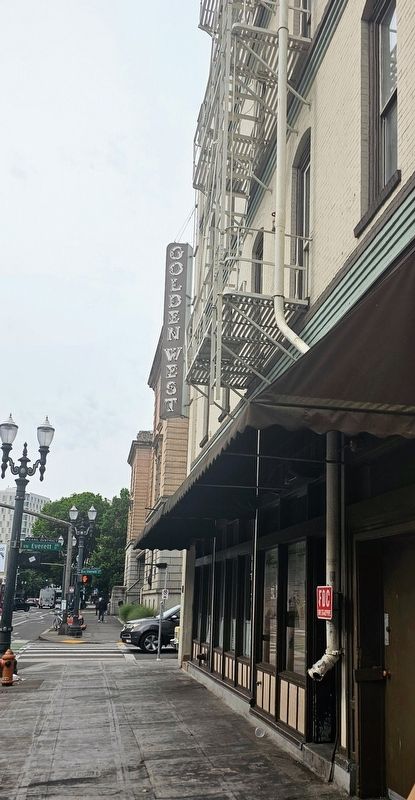
The marker can be seen on the Broadway side of the former Golden West Hotel.
More about this marker. Parts of the marker are unreadable due to water damage.
Photographed by Ian Lefkowitz, June 25, 2026
3. Middle Class Americans: Portland's Early Black Community Marker
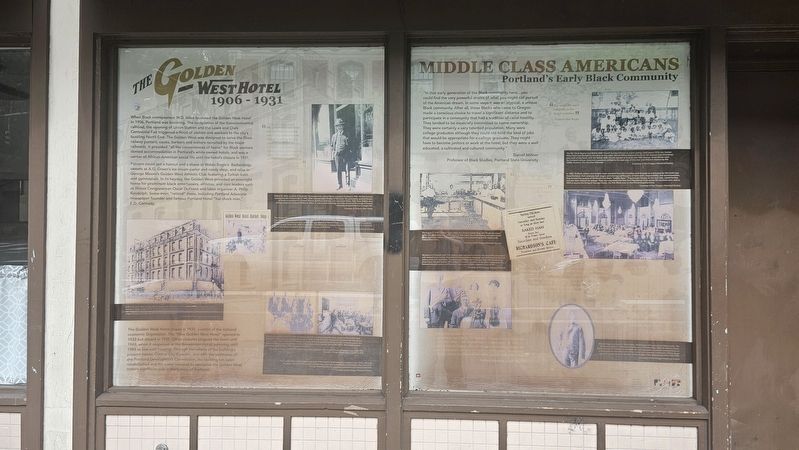
The marker is part of a series located in the windows of the former hotel.
Credits. This page was last revised on October 14, 2026. It was originally submitted on August 23, 2026, by Ian Lefkowitz of New York, New York. This page has been viewed 14 times since then. Photos: 1, 2, 3. submitted on August 23, 2026, by Ian Lefkowitz of New York, New York. • Devry Becker Jones was the editor who published this page.
