Pigtown in Baltimore, Maryland — The American Northeast (Mid-Atlantic)
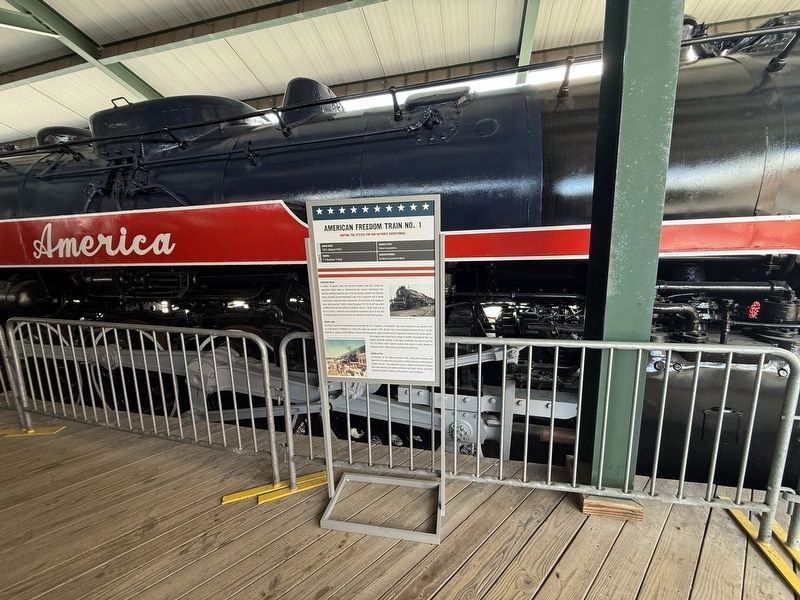
American Freedom Train No. 1
Uniting the States for Our Nation's Bicentennial
| — | ★ ★ ★ ★ ★ ★ ★ ★ ★ ★ | — |
Specs
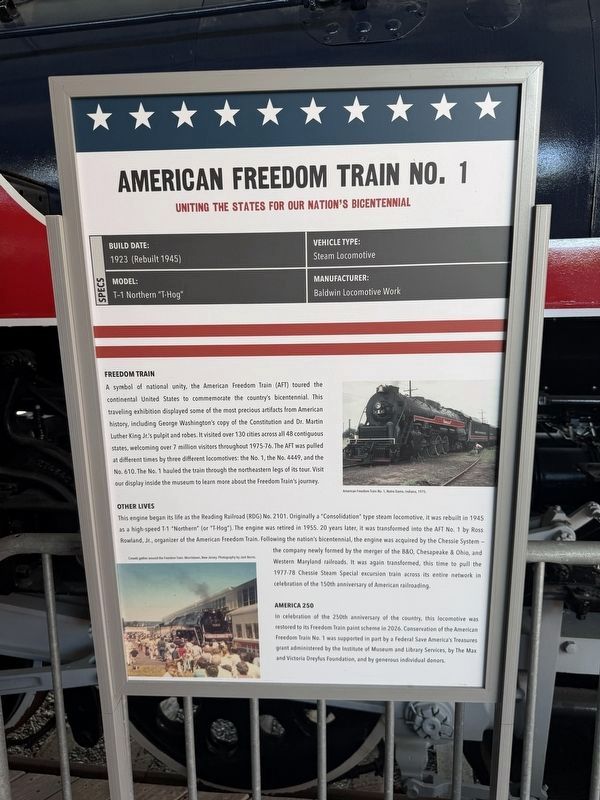
Build Date: 1923 (Rebuilt 1945)
Model: T-1 Northern "T-Hog"
Vehicle Type: Steam Locomotive
Manufacturer: Baldwin Locomotive Work
Freedom Train
A symbol of national unity, the American Freedom Train (AFT) toured the continental United States to commemorate the country's bicentennial. This traveling exhibition displayed some of the most precious artifacts from American history, including George Washington's copy of the Constitution and Dr. Martin Luther King's pulpit and robes. It visited over 130 cities across all 48 contiguous states, welcoming over 7 million visitors throughout 1975-76. The AFT was pulled at different times by three different locomotives: the No. 1, the No. 4449, and the No. 610. The No. 1 hauled the train through the northeastern legs of its tour. Visit our display inside the museum to learn more about the Freedom Train's journey.
Other Lives
This engine began its life as the Reading Railroad (RDG) No. 2101. Originally a "Consolidation" type steam locomotive, it was rebuilt in 1945 as a high-speed T-1 "Northern" (or "T-Hog"). The engine was retired in 1955. 20 years later, it was transformed
this page online
America 250
In celebration of the 250th anniversary of the country, this locomotive was restored to its Freedom Train paint scheme in 2026. Conservation of the American Freedom Train No. 1 was supported in part by a Federal Save America's Treasure grant administered by the Institute of Museum and Library Services, by The Max and Victoria Dreyfus Foundation, and by generous individual donors.
Erected by National Museum of Railroad History & Innovation.
Topics and series. This historical marker is listed in these topic lists: Patriots & Patriotism • Railroads & Streetcars. In addition, it is included in the America 250 series list. A significant historical year for this entry is 1923.
Location. 39° 17.105′ N,

Regionally, this marker is in Central Maryland. It is also in the American Mid-Atlantic, in the Chesapeake Bay Region, and on the Eastern Seaboard. Globally, it is in the North Atlantic Region, North America, the Western Hemisphere, the Western World, and the Anglosphere. Historically, it finds itself in what was once one of the original Thirteen Colonies and also the Antebellum South.
Other nearby markers. At least 8 other markers are within walking distance of this marker: B&O No. 908 (here, next to this marker); Luther G. Smith (a few steps from this marker); Connectivity: Street Art at the Intersection of Rail, Community, & Identity (within shouting distance of this marker); B&O Railroad Museum (within shouting distance of this marker); Main Line Electrification of the Baltimore and Ohio Railroad (B&O) 1895 (within shouting distance of this marker); Pullman Troop Sleeper No. 7437 (within shouting distance of this marker); CSX Corporation (within shouting distance of this marker); Site of Old Relay Station and Hotel (about 300 feet away). Touch for a list and map of all markers in Baltimore.
Other markers no longer nearby. First Commercial Railroad Right-of-Way in America (was here, next to this marker but has been permanently removed); Working for the Railroad: African Americans (was within shouting distance of this marker but has been permanently removed); Camp Carroll (was within shouting distance of this marker but has been permanently removed); Working for the Railroad: Women (was within shouting distance of this marker but has been permanently removed); Baltimore & Ohio Railroad (was about 300 feet away, measured in a direct line but has been replaced with another marker now near it).
Credits. This page was last revised on August 23, 2026. It was originally submitted on August 23, 2026, by Devry Becker Jones of Washington, District of Columbia. This page has been viewed 18 times since then. Photos: 1, 2. submitted on August 23, 2026, by Devry Becker Jones of Washington, District of Columbia.
