Southwest Portland in Multnomah County, Oregon — The American West (Northwest)
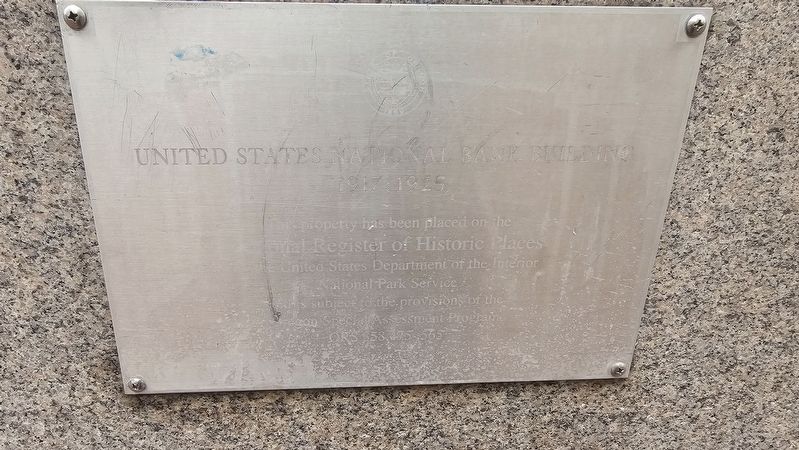
United States National Bank Building
1917; 1925
Photographed by Ian Lefkowitz, June 25, 2026
1. United States National Bank Building Marker
National Register of Historic Places
by the United States Department of the Interior
National Park Service
and is subject to the provisions of the
Oregon Special Assessment Program
ORS 358.475–565
Erected by United States Department of the Interior.
Topics. This historical marker is listed in these topic lists: Architecture • Industry & Commerce. A significant historical year for this entry is 1917.
Location. 45° 31.279′ N, 122° 40.654′ W. Marker is in Portland, Oregon, in Multnomah County. It is in Southwest Portland. It is at the intersection of Southwest 6th Avenue and Southwest Harvey Milk Street, on the left when traveling north on Southwest 6th Avenue. Touch for map. Marker is at or near this postal address: 309 SW 6th Avenue, Portland OR 97204, United States of America. Touch for directions.

Regionally, this marker is in the Columbia River Gorge and in the Willamette Valley. It is also on the American Pacific Coast, in the Pacific Northwest, and in the Lewis & Clark Corridor. Globally, it is in North America, on the Ring of Fire, on the Pacific Rim, in the Western
this page online
Other nearby markers. At least 8 other markers are within walking distance of this marker: Imperial Hotel, 1894–95 (about 300 feet away, measured in a direct line); The Salvation Army (about 500 feet away); Selling Building, 1910 (about 600 feet away); Portland is a Public Market City (about 600 feet away); About James Beard (about 700 feet away); Shang Dynasty Replica / 青銅品象尊 (approx. 0.2 miles away); Portland's First Public School (approx. 0.2 miles away); The Portland Hotel (approx. 0.2 miles away). Touch for a list and map of all markers in Portland.
Also see . . . United States National Bank Building (National Register of Historic Places Nomination Form).
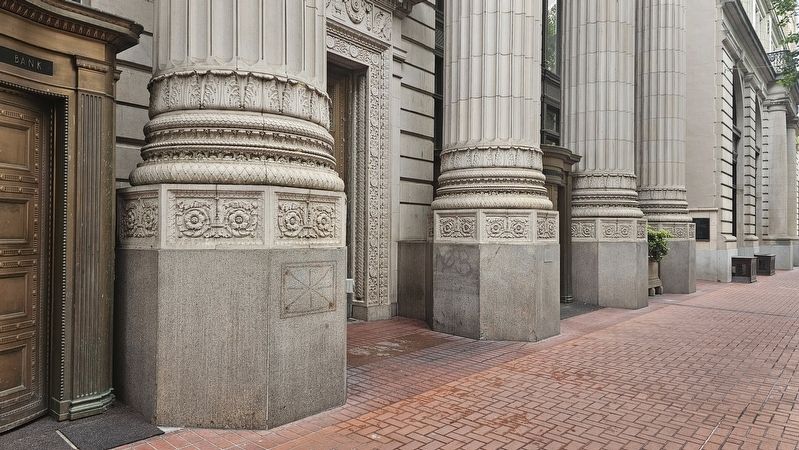
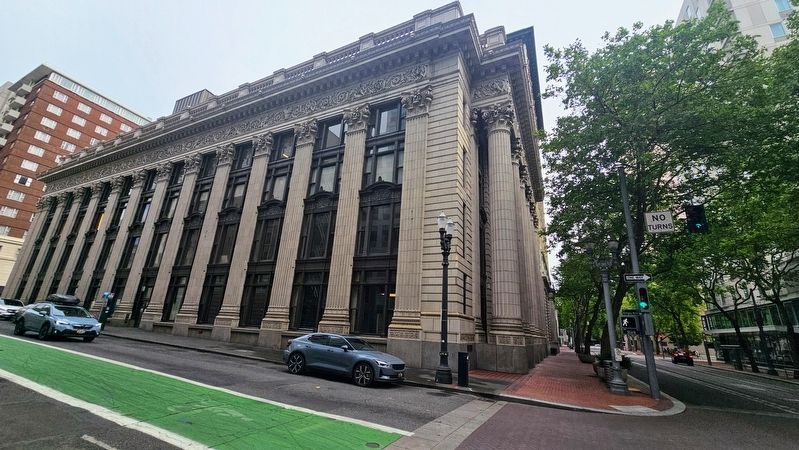
The United States National Bank building at Sixth and Stark in Portland, Oregon was erected in two phases: the original, easterly quarter-block volume in 1916-1917; and the westerly addition of essentially equal size, fronting on Broadway and Stark, in 1925. Designed by leading Portland architect of the period, Albert E. Doyle, the bank is widely regarded the state's quintessential(Submitted on August 23, 2026, by Ian Lefkowitz of New York, New York.)example of Roman Classical architecture in the tradition of the American Cultural Renaissance.Photographed by Ian Lefkowitz, June 25, 20262. United States National Bank Building MarkerThe faded plaque can be found on one of the central columns of the bank building.
Photographed by Ian Lefkowitz, June 25, 2026
3. United States National Bank Building
The eastern half of the building was completed in 1917, the western half in 1925.
Credits. This page was last revised on August 26, 2026. It was originally submitted on August 23, 2026, by Ian Lefkowitz of New York, New York. This page has been viewed 14 times since then. Photos: 1, 2, 3. submitted on August 23, 2026, by Ian Lefkowitz of New York, New York. • Andrew Ruppenstein was the editor who published this page.
