Ballston in Arlington in Arlington County, Virginia — The American South (Mid-Atlantic)
Korean War Memorial
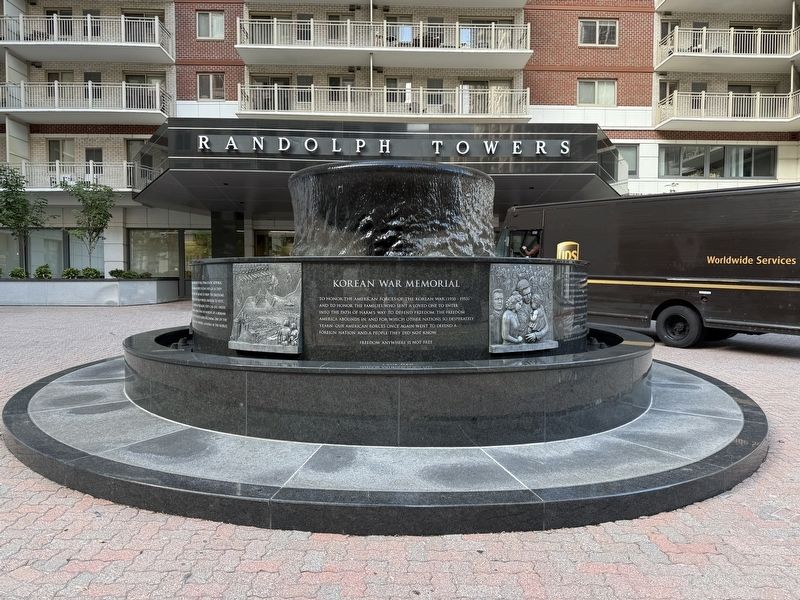

To honor the American forces of the Korean War (1950 - 1953) and to honor the families who sent a loved one to enter into the path of harm's way to defend freedom, the freedom America abounds in, and for which other nations so desperately yearn. Our American forces once again went to defend a foreign nation and a people they did not know.
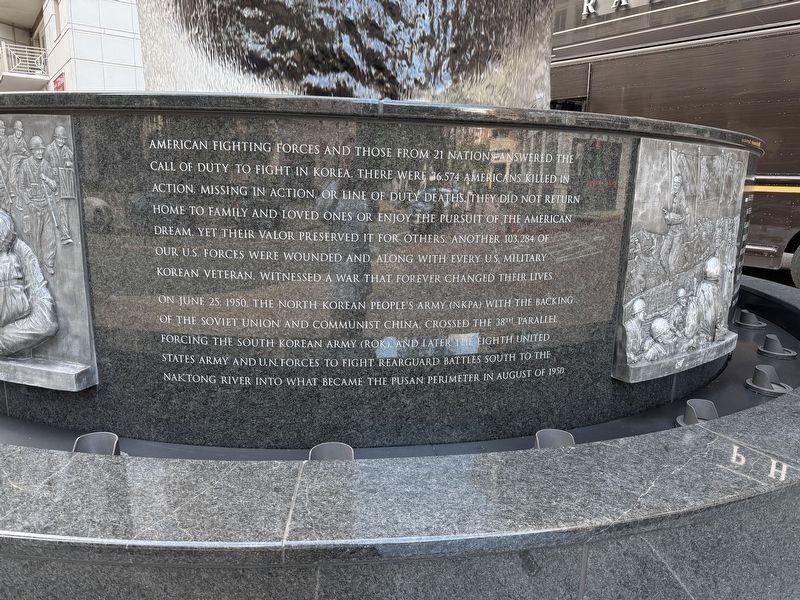
American fighting forces and those from 21 nations answered the call of duty to fight in Korea. There were 36,574 Americans killed in action, missing in action, or line of duty deaths. They did not return home to family and loved ones or enjoy the pursuit of the American dream. Yet their valor preserved it for others. Another 103,284 of our U.S. forces were wounded and, along with every U.S. military Korean veteran, witnessed a war that forever changed their lives.
On June 25, 1950, the North Korean People's Army (NKPA) with the backing of the Soviet Union and Communist China, crossed the 38th Parallel forcing the South Korean Army (ROK) and later the Eighth United States Army and U.N. Forces to fight rearguard battles
this page online
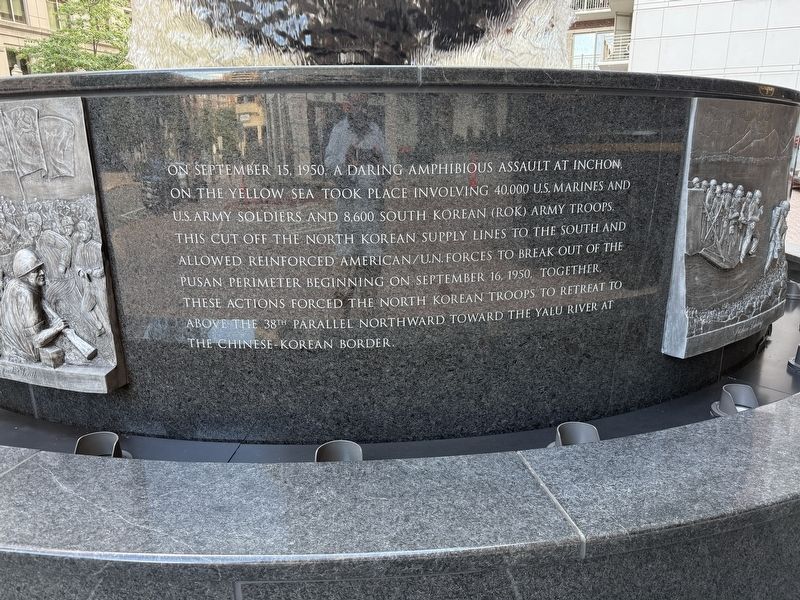
On September 15, 1950, a daring amphibious assault at Inchon, on the Yellow Sea took place involving 40,000 U.S. Marines and U.S. Army soldiers and 8,600 South Korean (ROK) Army Troops. This cut off the North Korean supply lines to the South and allowed reinforced American/U.N. Forces to break out of the Pusan Perimeter beginning on September 16, 1950. Together, these actions forced the North Korean troops to retreat to above the 38th Parallel northward toward the Yalu River at the Chinese-Korean border.
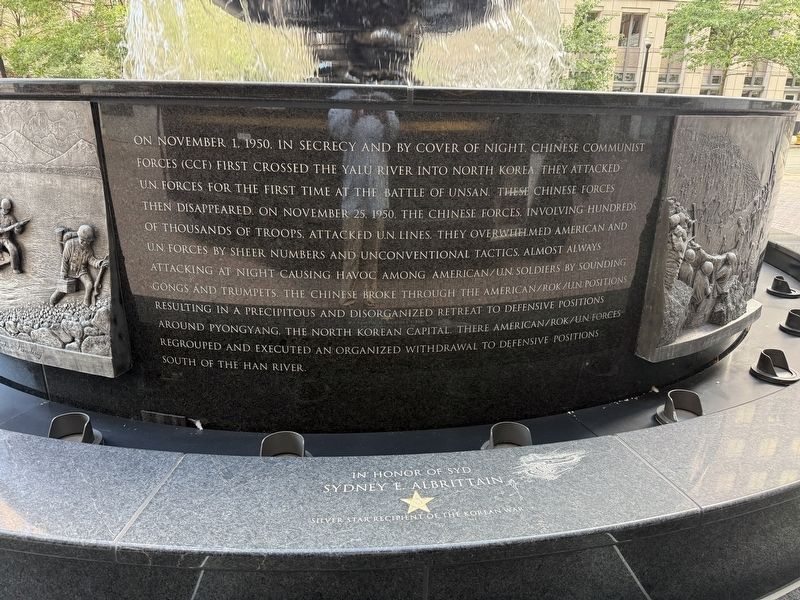
On November 1, 1950, in secrecy and by coverof night, Chinese Communist Forces (CCF) first crossed the Yalu River into North Korea. They attacked U.N. Forces for the first time at the Battle of Unsan. These Chinese forces then disappeared, on November 25, 1950. The Chinese forces, involving hundreds of thousands of troops, attacked U.N. lines. They overwhelmed American and U.N. forces by sheer number and unconventional tactics, almost always attacking at night causing havoc among American/U.N. soldiers by sounding gongs and trumpets. The Chinese
Sydney E. Albrittain
★
Silver Star recipient of the Korean War
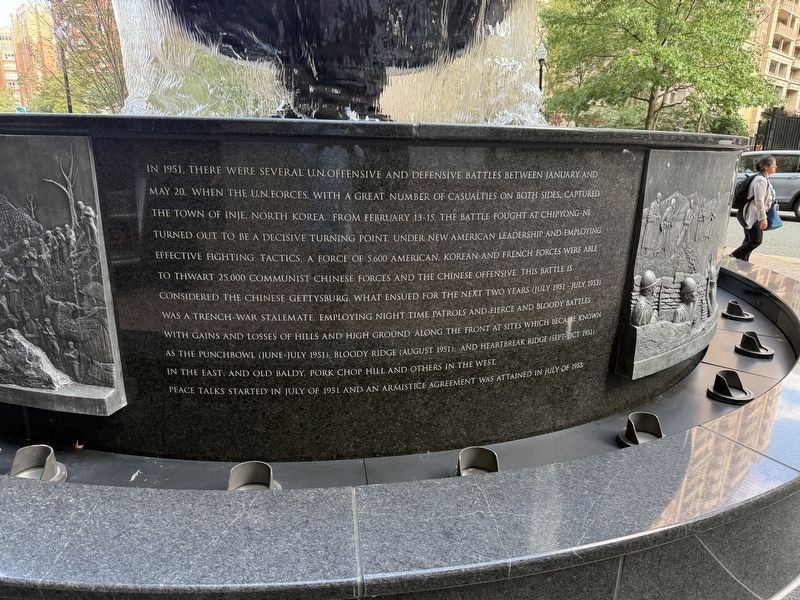
In 1951, there were several U.N. offensive and defensive battles between January and May 20, when the U.N. forces, with a great number of casualties on both sides, captured the town of Inje, North Korea. From February 13-15, the battle fought at Chipyong-Ni turned out to be a decisive turning point. Under new American leadership and employing effective fighting tactics. A force of 5,600 American, Korean and French forces were able to thwart 25,000 Communist Chinese forces and the Chinese offensive. This battle is considered the Chinese Gettysburg. What ensued for the next two years (July 1951 - July 1953) was a trench-war stalemate, employing night time patrols and fierce and bloody battles with gains and losses of hills and high ground along the front at
Peace talks started in July of 1951 and an armistice agreement was attained in July of 1953.
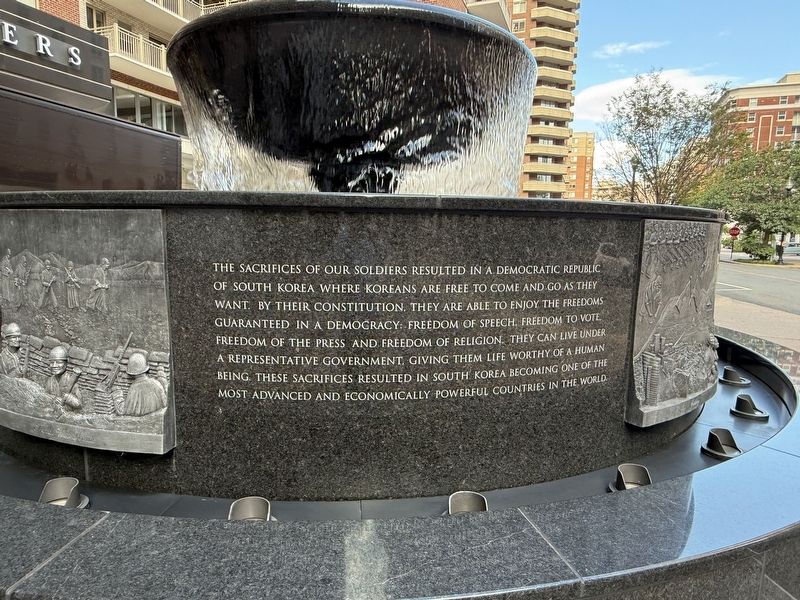
The sacrifices of our soldiers resulted in a Democratic Republic of South Korea where Koreans are free to come and go as they want. By their constitution, they are able to enjoy the freedoms guaranteed in a democracy: Freedom of Speech, Freedom to Vote, Freedom of the Press and Freedom of Religion. They can live under a representative government, giving them life worthy of a human being. These sacrifices resulted in South Korea becoming one of the most advanced and economically powerful countries in the world.
Topics. This memorial is listed in this topic list: War, Korean. A significant historical date for this entry is June 25, 1950.
Location. 38° 52.876′ N, 77° 6.503′ W. Memorial is in Arlington, Virginia, in Arlington County. It is in Ballston. It is on 9th Street North west of North Quincy Street, on the right when traveling west. Touch for map. Memorial

Regionally, this memorial is in the Washington Metropolitan Area and in Northern Virginia. It is also in the American South, specifically in the Upper South, in the Mid-Atlantic, and on the Eastern Seaboard. Globally, it is in the North Atlantic Region, North America, the Western Hemisphere, the Western World, and the Anglosphere. Historically, it finds itself in what was once the territory of the Mississippian Culture, one of the original Thirteen Colonies, one of the Confederate States of America, and the Antebellum South.
Other nearby markers. At least 8 other markers are within walking distance of this marker: Ballston (about 800 feet away, measured in a direct line); Robert Ball Sr. Family Burial Ground (about 800 feet away); Christ in Blessing, early 1930s (about 800 feet away); Welburn Square (approx. 0.2 miles away); Ball's Crossroads (approx. ¼ mile away); Maury School (approx. 0.3 miles away); Spielschiff, 2007 (approx. 0.3 miles away); Untitled, early 1930s, restored 2004 (approx. 0.3 miles
Credits. This page was last revised on August 25, 2026. It was originally submitted on August 25, 2026, by Devry Becker Jones of Washington, District of Columbia. This page has been viewed 16 times since then. Photos: 1, 2, 3, 4, 5, 6. submitted on August 25, 2026, by Devry Becker Jones of Washington, District of Columbia.
